







ETF vs Index Funds: A complete guide to passive investing


In simple terms, passive investing is a type of investment strategy where investors can maximise their income by minimising their purchases and sale. Passive investing broadly refers to the buy-and-hold portfolio strategy. It is done for long-term investment horizons, with minimal trading in the market. This type of investment is considered cheaper and less complex. Moreover, over time, it may produce after-tax returns.
Understanding passive investing:
This investment method tries to avoid certain factors like fees. The goal of passive investing is to build wealth gradually. Also popularly referred to as the buy-and-hold strategy, passive investors don’t seek profits from short-term price fluctuations or market timing. The underlying assumption of this type of strategy is that the market posts positive results over time.
Passive investors try to match market or sector performance. Investors using this strategy attempt to replicate the market performance by constructing well-diversified portfolios of single stocks. It is important to note that if the aforementioned action is done individually, the investor would be expected to carry out extensive research.
Are there benefits to passive investing?
Listed below are some of the key advantages of passive investing:
• It is very simple:
One of the most notable advantages of passive investing is its simplicity. Comprehending an index or group of indices is far easier than using a dynamic strategy, where you are required to carry out research constantly and adjust accordingly.
• It is tax-efficient:
Another advantage is that the buy-and-hold strategy doesn't usually result in a massive capital gains tax for the year.
What are the examples of passive investing?
Here are some of the notable examples of passive investments:
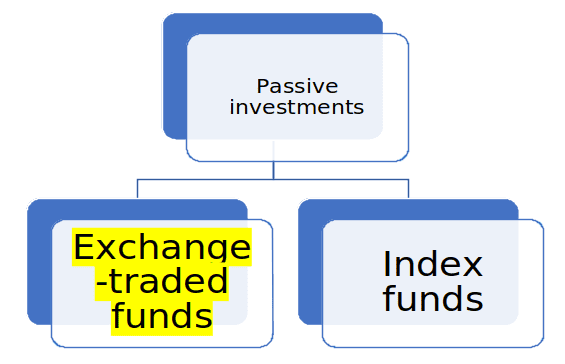
Exchange-traded funds:
One of the most common examples of passive investing is exchange-traded funds which are also referred to as ETFs. They consist of a collection of various securities such as shares, money market instruments, and bonds. These funds are regarded as a mashup of different investment avenues. They are known for offering the best of two popular financial assets, namely, mutual funds and stocks.
Index funds:
Much like the ETFs, index funds also track an underlying index and analyse its performance. An index fund is constructed to match or track the components of a financial market index.
Exchange-traded funds:
Exchange-traded funds (ETFs) are a kind of pooled investment security that tracks a particular index, sector, commodity, or other assets. However, unlike mutual funds, ETFs can be purchased or sold on a stock exchange the same way that a regular stock can.
What are the key features of ETFs?
- Exchange-traded funds (ETF) are a basket of securities that trade on an exchange just like a stock does.
- Their share prices fluctuate all day as ETFs are bought and sold.
- ETFs offer fewer broker commissions and low expense ratios than buying the stocks individually.
- Another important feature of ETFs is that they can contain all types of investments, including bonds, stocks and commodities. Some even offer country-specific holdings, while others remain international.
Types of ETFs:
There are various types of ETFs that are available to investors. Each of these types can be used for income generation. Listed below are some of the ETFs that are available on the market today:
• Passive and Active ETFs:
Exchange-traded funds are usually categorised either as passively or actively managed. The main aim of Passive ETFs is to replicate the performance of a broader index; either belonging to a specific targeted sector or trend or diversified indices. A good example of a specific targeted sector ETFs is gold mining stocks. They are shares in the form of gold that an individual owns in a gold company, either a mining corporation, gold mutual funds or exchange-traded funds. It basically means that you own a certain part of the company, and you are entitled to any profit that comes out of your investment in the gold stocks.
On the other hand, active ETFs typically do not target an index of securities. Rather, portfolio managers make decisions like which securities they should include in the portfolio. These funds have benefits over passive ETFs but tend to be more expensive for investors.
• Bond ETFs:
Bond ETFs can be used by investors as a way to earn a regular income. The income distribution depends on the performance of underlying bonds. These underlying bonds might include things like corporate bonds, government bonds and local and state bonds, which are also referred to as municipal bonds. Unlike their underlying instruments, bond ETFs do not come with a maturity date. They generally trade at a premium or discount from the actual bond price.
• Stock ETFs:
Stock ETFs consist of a basket of stocks to track a single industry or sector. For instance, a stock ETF might track automotive or foreign stocks. The aim is to provide diversified exposure to a single industry, both experienced high performers and new entrants that have a potential for growth. Stock ETFs also have lower fees and do not involve actual ownership of securities.
Apart from the three above, there are other types of ETFs, namely, Industry/Sector ETFs, Commodity ETFs, Currency ETFs, Inverse ETFs and Leveraged ETFs.
Are there any advantages of Exchange-traded funds?
Here are some of the numerous advantages of Exchange-traded funds:
• They have a diversified pool of securities:
Investing your funds in ETF enables you to keep your finances spread over the equities of numerous companies. Doing so results in a significant dilution of risks. Even if one asset were to underperform, the loss can be cushioned by the growth of the others.
• They are passively managed:
Putting money in ETFs is considered a smart choice as they are managed passively. Another major reason why they are considered a smart investment choice is that the investors here put their money in the best-performing businesses that are listed on a particular stock exchange.
• They are liquid:
If your funds have been allocated to ETFs and the fund manager notices any changes in their values, they can either opt to buy or sell them throughout the business day. So, ETFs also offer investors liquidity. Liquidity also enables investors to shift their assets to another security with ease if particular security does not generate enough income.
Index Funds:
An Index fund is a type of mutual fund with a portfolio constructed to match or track the components of a financial market index. An index mutual fund exposes an investor to things like low operating expenses and low portfolio turnover. These funds follow their benchmark index regardless of the state of the markets.
What are the key features of index funds?
- Index funds are a portfolio of stocks or bonds that are designed to mimic the composition and performance of a financial market index.
- They are known for following a passive investment strategy.
- Index funds are known to attract investors due to their lower expenses and fees.
- They seek to match the risk and the income of the market. It is done based on the theory that in the long term, the market will outperform any single investment.
What happens when you invest in an index fund?
Once you opt to invest in an index mutual funds, your money is pooled with other investors. After taking money, the fund manager allocates it to instruments that make up the index such as stocks and bonds.
Moreover, there are also index ETFs. When you buy an ETF, you aren't paying a mutual fund company to invest. Instead, you're buying the fund directly from investors who are selling their shares. There are mechanics to create new shares if demand surpasses supply. The end result, therefore, is very similar to investing in an index mutual fund.
Are there any advantages of index funds?
Investing in index funds comes with benefits such as:
• They have low fees:
As stated earlier, index funds mimic their underlying benchmark. Also, there is no active trading of stocks. All these factors lead to the low managing cost of an index fund. So, if you are looking for an option in which you don’t need to pay a huge fee, you don’t need to look further than index funds.
• There are no biased investments:
Index funds are known for following an automated, regulation-based investment method. The investor puts a certain sum of money on the index funds of various securities. If an investment portfolio is managed by a fund manager, then the latter is provided with a defined mandate that contains the amount to be invested in the fund and its various securities. So, this eliminates the inherent human bias or discretion while taking investment decisions.
• They provide broad market exposure:
By putting money in an index, you ensure that the portfolio is spread across all sectors and stocks. By doing so, an investor can seize the probable income on the larger segment of the market through a single index fund. Consider this scenario. You decide to invest in the Nifty50 index fund. By doing so, you enjoy the investment exposure to numerous stocks spread across a wide range of sectors. Through index funds, you can invest in businesses of different sectors ranging from pharma to financial services.
• There are tax benefits of investing in index funds:
Index funds are passively managed. Because of that, these funds are known for usually generating a low turnover. Low turnover means very few trades are placed by a fund manager in a year. Fewer trades result in fewer capital gains distributions that can be passed on to the unitholders.
• They serve as an alternative to equity investments:
Index mutual funds are ideal for those investors who are searching for an investment tool that may not involve many risks. Another alluring feature of these funds is that they do not require extensive research and tracking. Consider this hypothetical scenario. You are looking for schemes that invest in equities. However, you don’t want to expose your funds to the risks associated with actively managed equity funds. So, you can go ahead and opt for a NIFTY or SENSEX index fund.
• They are easier to manage:
Index funds are easier to manage as investors do not have to worry about how the stocks on the index are performing in the market. All an investor here needs to do is rebalance the portfolio periodically.
Apart from the details above, if you still have any doubts about index funds and ETFs, please contact a financial advisor as soon as possible.
Mutual Fund Investments are subject to market risks, read all scheme related documents carefully.
Calculator
View All








Mutual fund investments are subject to market risks, read all scheme related documents carefully.
Copyrights  2020. All rights reserved Axis Mutual Fund.
Privacy | Terms | Disclaimer | Sitemap