









Why Choose Axis Balanced Advantage Funds? An In-depth Analysis for Investors


In the ever-changing world of investment, finding the right balance between risk and reward can be a daunting task. One such fund that could strive to strike a balance & dynamic approach to your portfolio could be balanced advantage funds (BAFs), a dynamic mutual fund that attempts to navigate this tightrope walk for you. But are BAFs the perfect fit for your portfolio? This in-depth analysis will delve into the workings of BAFs and their potential benefits and drawbacks.
Dynamic Asset Allocation through Balanced Advantage Fund in ever-changing market conditions
Balanced Advantage Fund are hybrid mutual funds investing in both debt and equity instruments. What sets this category apart is the dynamic asset allocation where the funds manage asset allocation dynamically between equity and debt instruments according to changing market conditions.
The volatility of the markets often influences investor behaviour leading them to buy at market peaks and sell at market lows. The fund aims to mitigate exactly this risk by balancing between equity and debt exposure and achieving the basic tenet of investing viz. buy low and sell high. The strategy is to increase equity exposure when equity valuations are cheap and increase debt allocation when equity valuations are high; thus, capitalising on market opportunities and managing downside risks simultaneously.
Dynamic asset allocation through Balanced Advantage Fund may offer versatile solutions for achieving different financial goals. Whether investors seek wealth accumulation, capital preservation, or risk management, the fund may offer comprehensive solutions to their financial goals.
Dynamic asset allocation can be ideal for
• Investors looking for a solution that dynamically adjusts equity exposure
• Investors looking to cushion downside while participating decently in market rallies
• Relatively conservative investors who are not looking for pure equity returns
• Investors who have an investment horizon of at least 5 years
The benefits of investing in Dynamic Asset Allocation are as follows:
• Manage volatility: By strategically increasing debt allocation during volatile market periods, the aims to cushion portfolio downfall. Similarly, it tries to tap into the equity upside when the equity markets are favorable.
• Less Emotional Investing: The fund removes the temptation for investors to time the market. The fund's dynamic allocation strategy takes the guesswork out of asset allocation, potentially leading to more disciplined investing.
• Structured balancing approach – The balance in the fund is achieved through a structured process or strategy which will be different for each fund.
• Diversification - Additionally, the fund provides the necessary diversification of the portfolio as it provides balanced exposure to equity and debt
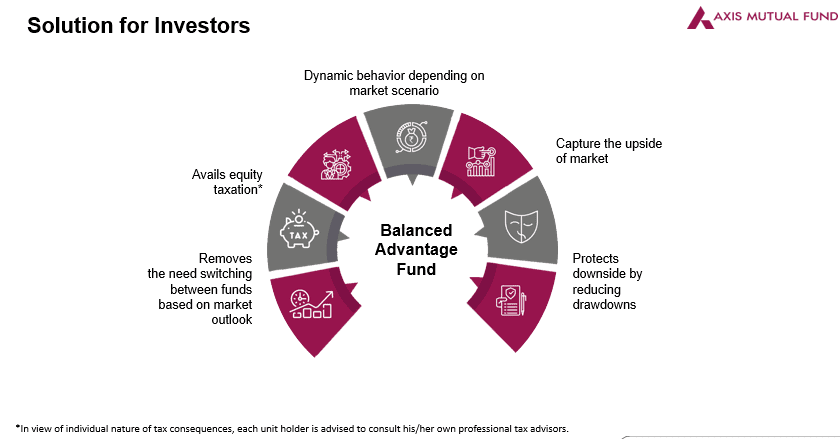
However, before investing in Dynamic asset allocation through Balanced Advantage Fund, investors should consider the following points:
• Assess their own risk appetite, investment horizon and objectives and align it with the fund risk.
• Understand that due to the equity component investors should look for minimum investment horizon of at least 3 to 5 years.
How Axis Balanced Advantage Fund can provide an investment opportunity for long term
Axis Balanced Advantage Fund has a unique investment strategy and a disciplined investment strategy.
The key difference between various balanced advantage funds lies in their investment strategies. Each fund house relies on its own internal model to guide asset allocation decisions, impacting the balance between equity, and debt.
Axis Balanced Advantage Fund 5 factor approach:
Axis BAF follows a 5-factor approach to determine equity exposure while rebalancing viz. valuation, earning momentum, global and domestic macros, market trends and global geo-political scenarios. All 5 variables are given importance while computing the net long exposure. This ensures the 360o coverage of factors to ensure the equity allocation is not just the basis of valuation, macros and trends but also includes broad parameters like FII flows, geo-political scenarios and unexpected market events. In the black swam events like Covid, and the Russia-Ukraine war, the internal asset allocation committee can immediately take an active call on asset allocation.

The distinguishing factors of Axis BAF lie in its Portfolio Strategy and 3 pillar investment approach to security selection.
The portfolio strategy
• Equity investments focus on flexibility and growth, employing bottom-up stock selection with an emphasis on growth at a reasonable price. The investment philosophy emphasizes growth at a reasonable price, combining quality attributes with the principles of Growth at a Reasonable Price (GARP).
• Fixed income adopts an actively managed duration approach to optimize returns amid changing interest rate environments with a mix of high-quality corporate bonds and g-secs.
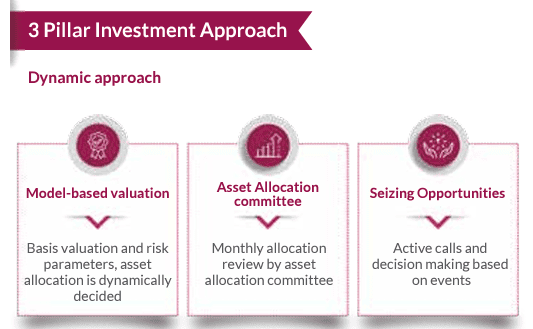
The 3-pillar strategy investment approach
• Firstly, A model-based valuation framework is used which involves continuous monitoring of key metrics such as P/E and P/B ratios and other risk indicators.
• Secondly, an Asset Allocation Committee convenes monthly for portfolio allocations, which gives an advantage of expert knowledge and perspective.
• Lastly, the strategy emphasizes on proactive approach to seizing opportunities, enabling active calls and decision-making based on market events.
Both strategies have ensured long-term growth while effectively managing investment risks.
Details of the scheme are as follows:
| Inception date | 01.08.2017 |
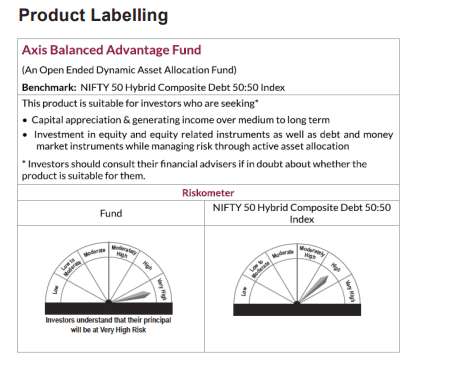
| Benchmark | NIFTY50 Hybrid Composite Debt 50:50 Index |
| Fund Manager | Mr. Jayesh Sundar, Mr. Ashish Naik, Devang Shah and Hardik Shah |
| Minimum application | Rs. 100 and in multiples of Re. 1/- thereafter |
| Exit Load | If redeemed / switched-out within 12 months from the date of allotment: For 10% of investments: NIL For remaining investments: 1% If redeemed / switched-out after 12 months from the date of allotment: NIL |
The decision to invest in BAFs depends on your individual financial goals, risk tolerance, and investment time horizon. BAFs may be a valuable tool for investors seeking a balanced approach with the potential for growth and risk mitigation. However, it's essential to weigh the potential benefits against the drawbacks and their ability to withstand associated risks.
Disclaimer: Past performance may or may not be sustained in the future.
Effective Oct 1, 2021, fundamental attribute of Axis Balanced Advantage Fund (erstwhile Axis Dynamic Equity Fund) has been revised.
Devang Shah is managing Axis Liquid Fund, Axis Dynamic Bond Fund, Axis Gilt Fund, Axis Strategic Bond Fund and Axis Short Duration Fund since 5th November,2012, Axis Credit Risk Fund, Axis Money Market Fund and Axis Arbitrage Fund since 14th August , 2014 and Axis Treasury Advantage Fund and Axis Conservative Hybrid Fund and Axis Corporate Bond Fund since July 13th, 2017 and Axis CRISIL IBX 70:30 CPSE Plus SDL April 2025 Index Fund since inception and Axis Long Duration Fund since July 27th December, 2022, Axis All Seasons Debt Fund of Funds since 1st February, 2023, Axis Multi Asset Allocation Fund since 5th April, 2024, Axis Balanced Advantage Fund since 5th April, 2024, Axis Retirement Fund since 5th April, 2024, Axis Aggressive Hybrid Fund since 5th April, 2024, Axis Equity Savings Fund since 5th April, 2024, Axis Childrens Gift Fund since 5th April, 2024.
Hardik Shah is managing Axis Balanced Advantage Fund, Axis Corporate Bond Fund and Axis Floater Fund since 29th February 2022 and Axis CRISIL IBX SDL May 2027 Index Fund since Inception and Axis Long Duration Fund since July 27th December, 2022, Axis CRISIL IBX 50:50 Gilt Plus SDL June 2028 Index Fund since 24th January, 2023, Axis Equity Savings Fund, Axis Children's Fund since 1st February, 2023, Axis Fixed Term Plan - Series 112 (1143 Days) , Axis Banking and PSU Debt Fund since 3rd July, 2023, Axis Dynamic Bond Fund since 5th April, 2024, Axis All Seasons Debt Fund of Funds since 5th April, 2024, Axis Multi Asset Allocation Fund since 5th April, 2024, Axis Retirement Fund since 5th April.
Ashish Naik is managing the equity portion of Axis Conservative Hybrid Fund and Axis Multi Asset Allocation Fund since 22nd June,2016 and Axis Children's Fund since July 6th, 2016 and Axis Nifty 50 ETF since July 3rd, 2017 and Axis Special Situations Fund, Axis Nifty 100 Index Fund, Axis NIFTY India Consumption ETF, Axis Quant Fund and Axis NIFTY Bank ETF Since 04th May 2022 and Axis Aggressive Hybrid Fund since inception, Axis Arbitrage Fund since 4th May, 2022, Axis Business Cycles Fund since inception, Axis Balanced Advantage Fund since 1st March 2023, Axis S&P BSE SENSEX ETF since Inception, Axis Bluechip Fund and Axis ELSS Tax Saver Fund since 3rd August 2023, Axis S&P BSE Sensex Index Fund Since 27th Feb, 2024.
Jayesh Sundar is Managing Axis Balance Advantage Fund, Axis Aggressive Hybrid Fund, Axis Multi Asset Allocation Fund, Axis Children’s Fund, Axis Equity Savings, Axis Conservative Hybrid Fund since 28th September, 2023, Axis Retirement Fund which include Aggressive Plan, Dynamic Plan, Conservative Plan since 15th January, 2024.
This document represents the views of Axis Asset Management Co. Ltd. and must not be taken as the basis for an investment decision. Neither Axis Mutual Fund, Axis Mutual Fund Trustee Limited nor Axis Asset Management Company Limited, its Directors or associates shall be liable for any damages including lost revenue or lost profits that may arise from the use of the information contained herein. No representation or warranty is made as to the accuracy, completeness or fairness of the information and opinions contained herein. The AMC reserves the right to make modifications and alterations to this statement as may be required from time to time.
Statutory Details: Axis Mutual Fund has been established as a Trust under the Indian Trusts Act, 1882, sponsored by Axis Bank Ltd. (liability restricted to Rs.1 Lakh). Trustee: Axis Mutual Fund Trustee Ltd. Investment Manager: Axis Asset Management Co. Ltd. (the AMC). Risk Factors: Axis Bank Limited is not liable or responsible for any loss or shortfall resulting from the operation of the scheme.
Mutual Fund Investments are subject to market risks, read all scheme-related documents carefully.
Calculator
View All








Mutual fund investments are subject to market risks, read all scheme related documents carefully.
Copyrights  2020. All rights reserved Axis Mutual Fund.
Privacy | Terms | Disclaimer | Sitemap