









Who Should Consider Investing In Conservative Hybrid Funds?


(As on date 18th Jan, 2021)
Some investors live under the false assumption that conservative investment schemes do not carry any type of risk. Once you invest your money in any type of financial scheme do remember that there is always some risk associated with it. No investment is considered to be a risk free investment. This is the reason why most financial advisors recommend investors to first determine the risk appetite before going ahead with any type of investment. Determining one's risk appetite allows investors to understand how much money they can invest in a financial scheme. Investing without knowing your limitations is never a good idea. So it is better to understand your risk appetite for investing in any type of investment scheme.
Mutual funds are a pool of professionally managed schemes where the fund manager buys and sells securities in accordance with the scheme's investment objective. In its investor education program market regulator SEBI (Securities and Exchange Board of India) has described mutual funds as 'a mechanism for pooling the resources by issuing units to the investors and investing funds in securities in accordance with objectives as disclosed in offer document.
Investments in securities are spread across a wide cross-section of industries and sectors and thus the risk is reduced. Diversification reduces the risk because all stocks may not move in the same direction in the same proportion at the same time. Mutual fund issues units to the investors in accordance with quantum of money invested by them. Investors of mutual funds are known as unitholders.
The profits or losses are shared by the investors in proportion to their investments. The mutual funds normally come out with a number of schemes with different investment objectives which are launched from time to time. A mutual fund is required to be registered with Securities and Exchange Board of India (SEBI) which regulates securities markets before it can collect funds from the public.'
Of the several mutual fund categories available, conservative hybrid funds have recently attracted the tension of both young and seasoned investors. The primary reasons for conservative hybrid funds to stand out among other mutual funds is their unique asset allocation strategy. While an equity mutual fund predominantly invests in equity where as a debt fund invests in fixed income securities that generate regular income, a conservative hybrid fund allocates majority of its assets to debt and other fixed income securities while the remaining of its assets are invested in equity and equity related instruments.
Why you should invest in conservative hybrid funds
Apart from the fact that a conservative hybrid fund carries a debt oriented portfolio with some investments in equity, here are some of the reasons you should consider investing in these funds:
Conservative hybrid funds allow SIP and lumpsum investment
Depending on investors financial needs they can either make a lump sum investment in conservative hybrid fund or opt for a systematic investment plan. If you make a lump sum investment in a conservative hybrid fund you will be allotted units in quantum with the investment amount. A systematic investment plan on the other hand allows investors to invest small amounts at regular intervals over the long term. Investments made through SIP also stand a chance of benefiting from power of compounding where the investment amount may multiply and turn into a decent corpus over the long term.
Conservative hybrid schemes are available in growth and IDCW option
If you are investing in conservative hybrid funds for regular income then the IDCW option may work in your favor. However, a mutual fund house may only distribute IDCW if the conservative hybrid fund generates capital appreciation. On the other hand if your purpose of investing in conservative hybrid funds is to generate capital appreciation over the long term then you can go with the growth option. In growth option the capital appreciation earned by the scheme is invested back in the fund instead of distributing it in the form of IDCW. So depending on your financial need you can choose from growth or IDCW option.
Conservative hybrid funds are available in regular and direct plans
An investor can purchase a direct conservative hybrid fund plan from the Asset Management Company owning that hybrid fund. Since you are buying the hybrid fund directly from the fund house the expense ratio for owning a direct plan is generally on the lower side. On other hand regular conservative hybrid fund plan can be bought from an aggregator like a broker or distributor or an agent. Since a third party is involved in selling a regular conservative hybrid fund plan the expense ratio of a regular is on the higher and as compared to the direct plan.
Although conservative hybrid funds hold the potential of offering capital appreciation over the long-term, investors should do a thorough background check of the scheme that they are about to invest in. if you are new to investing in mutual funds in general do consult a financial advisor who might help you in making informed investment decision. If you are keen on diversifying your portfolio with a conservative hybrid scheme you can consider investing in Axis Conservative Hybrid Fund.
Axis Conservative Hybrid Fund
An open ended hybrid scheme investing predominantly in debt instruments
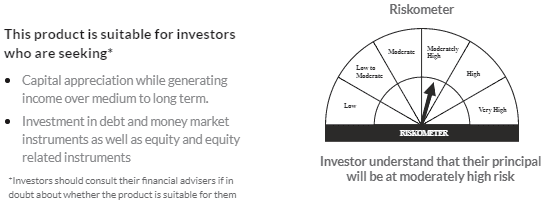
Mutual fund investments are subject to market risk read all scheme related documents carefully.
Calculator
View All








Mutual fund investments are subject to market risks, read all scheme related documents carefully.
Copyrights  2020. All rights reserved Axis Mutual Fund.
Privacy | Terms | Disclaimer | Sitemap