








When is the right time to sell your ELSS fund?


As an investor in an Equity-Linked Saving Scheme (ELSS), also called a tax-saving scheme, you may be confused about the best time to sell your investments. This confusion may occur even if you are a seasoned investor. One reason for this confusion may arise from the fact that ELSS investments must be held for at least three years before they can be redeemed. Consequently, you may struggle to determine the most suitable time to sell your investments to maximize your returns.
If this is true for you, fret not. Read on as we take a deeper dive into ELSS to understand what is the right time to divest your ELSS investments.
What is an ELSS fund?
An ELSS is a tax-efficient instrument to invest your capital for long-term growth and capital appreciation. These types of mutual funds tend to invest the bulk of their money in stocks, thereby offering greater potential for long-term growth compared to other types of mutual funds that invest in bonds or other less-volatile assets.
As an investor in an ELSS fund, you may be eligible for tax breaks under section 80C of the Income Tax Act, 1961. This allows you to claim a deduction of up to Rs 1.5 lakh annually on your contributions to these funds.
It's important to understand that there is a three-year lock-in period on investments in ELSS funds, which means you cannot withdraw your money for three years from the date of investment. This is shorter than the lock-in periods for other tax-saving investment options such as Public Provident Fund (PPF) and National Savings Certificate (NSC), which have lock-in periods of 15 and 5 years, respectively.
Let us look at a few characteristics of ELSS to figure out the best time to divest.
Tax breaks: Under section 80C of the Income Tax Act, ELSS investments of up to Rs. 1.5 lakh in a financial year are exempt from tax.
Equity investment: ELSS funds mostly invest in stocks and other instruments related to stocks. Therefore, over the long term, they may offer potentially higher returns.
Lock-in period: ELSS investments have a three-year lock-in period, meaning that the invested sum cannot be redeemed before three years from the date of investment.
Diversification: ELSS funds invest in a diversified portfolio of stocks, which gives you the benefits of diversification.
Professional management: ELSS funds are managed by professionals who know how to pick stocks and take care of the fund's portfolio.
Flexibility: You can choose to invest in an ELSS through the lump sum route or through a Systematic Investment Plan (SIP). An SIP lets you invest a set amount of money at regular intervals instead of investing all of your money in the market at once.
Transparency: ELSS funds are required to announce their portfolio holdings and other important information on a regular basis. This provides you a clear picture of what the fund is investing in.
The right time to divest an ELSS
There is no categorical answer to this question because the decision to sell an ELSS fund depends on various factors such as your investment goals, risk appetite, and the fund’s performance. In deciding whether to sell your ELSS fund, you may want to consider the following:
Re-evaluate your investment goals: If your investment goals have changed since you made the investment, it may be prudent to sell your ELSS investment and reinvest the money in a fund that is more aligned with your new goals.
Check how well the fund has performed: If the ELSS fund has not performed well relative to its benchmark index or peer group, you might want to divest it and reinvest the money into a fund that has performed better.
Consider the lock-in period: ELSS funds have a lock-in period of three years, and are required to hold your investment until completion of the lock-in period.
Think about your risk tolerance: If the fund's investments are getting too risky for you, after the lock-in period, you might want to your holdings and reinvest the proceeds into a less risky instrument.
Conclusion
It is important to remember that timing the market is difficult, and selling a fund just because it has not performed well in the short term might not always be prudent.
In most cases, it is good to invest over the long term and hold your ELSS investment for at least five to seven years to give it time to grow and possibly outperform the benchmark. Before you decide to divest your ELSS holdings, it would be appropriate to consult a financial advisor.
Axis Long Term Equity Fund
(An Open Ended Equity Linked Savings Scheme with A Statutory Lock In Of 3 Years And Tax Benefit)
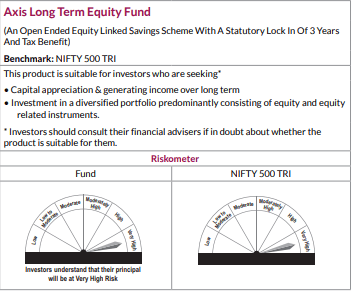
*ELSS Investments are subject to a 3-year lock-in period and are eligible for tax benefit under section 80C of the Income Tax Act, 1961.
#As per the present tax laws, eligible investors (individual/HUF) are entitled to deduction from their gross income of the amount invested in Equity Linked Saving Scheme (ELSS) up to Rs.1.5 lakhs (along with other prescribed investments) under section 80C of the Income Tax Act, 1961. Tax savings of Rs. 46,800 mentioned above is calculated for the highest income tax slab.
Finance Act, 2020 has announced a new tax regime giving taxpayers an option to pay taxes at a concessional rate (new slab rates) from FY 2020-21 onwards. Any individual/ HUF opting to be taxed under the new tax regime from FY 2020-21 onwards will have to give up certain exemptions and deductions. Since, individuals/ HUF opting for the new tax regime are not eligible for Chapter VI-A deductions, the investment in ELSS Funds cannot be claimed as deduction from the total income.
Investors are advised to consult his/her own Tax Consultant with respect to the specific amount of tax and other implications arising out of his/her participation in ELSS
Views and opinions contained herein are for information purposes only and should not be construed as investment advice/ recommendation to any party or solicitation to buy, sale or hold any security or to adopt any investment strategy. It does not warrant the completeness or accuracy of the information and disclaims all liabilities, losses and damages arising out of the use of this information. The recipient should exercise due caution and/ or seek professional advice before making any decision or entering into any financial obligation based on information, statement or opinion which is expressed herein.
Statutory Details: Axis Mutual Fund has been established as a Trust under the Indian Trusts Act, 1882, sponsored by Axis Bank Ltd. (liability restricted to Rs. 1 Lakh). Trustee: Axis Mutual Fund Trustee Ltd. Investment Manager: Axis Asset Management Co. Ltd. (the AMC). Risk Factors: Axis Bank Limited is not liable or responsible for any loss or shortfall resulting from the operation of the scheme. No representation or warranty is made as to the accuracy, completeness or fairness of the information and opinions contained herein. The AMC reserves the right to make modifications and alterations to this statement as may be required from time to time.
Past performance may or may not be sustained in the future.
Mutual Fund Investments are subject to market risks, read all scheme related documents carefully.
Calculator
View All








Mutual fund investments are subject to market risks, read all scheme related documents carefully.
Copyrights  2020. All rights reserved Axis Mutual Fund.
Privacy | Terms | Disclaimer | Sitemap