






What is the Difference Between Index Fund & Large Cap Funds?


The Indian investor has plenty of investment options to choose from. Although there are plenty of options, you cannot make an investment in each and every one of these schemes. So in order to determine where to invest your money, you may have to first understand financial planning. Having a financial plan will never go in vain. In fact, a financial plan may help investors in understanding their short term and long term goals. Those who are clear about what they want to achieve are less likely to get diverted from their goals midway.
Before making an investment in any scheme, investors are expected to determine their risk appetite. Every investment scheme carries a different risk profile and hence it is necessary that investors understand their risk appetite before putting their hard earned money in any kind of investment. There are some investors who are risk averse and hence do not wish to make any risky investments. But remember one thing, no investment is entirely risk-free. There is always some amount of risk associated with every investment.
If you are someone who is keen on seeking capital appreciation by investing in market linked schemes, you may consider investing in mutual funds. In the recent past, mutual funds have gained traction among investors here in India. Mutual funds are supposed to offer investors with an opportunity to invest in multiple asset classes and markets through one single investment.
SEBI’s mutual fund definition
Securities and Exchange Board of India, the regulator of mutual funds in India, describes mutual funds as, “a mechanism for pooling the resources by issuing units to the investors and investing funds in securities in accordance with objectives as disclosed in the offer document. Investments in securities are spread across a wide cross-section of industries and sectors and thus the risk is reduced. Diversification reduces the risk because all stocks may not move in the same direction in the same proportion at the same time.”
What are large cap funds?
SEBI has further categorized mutual funds based on their certain unique attributes like risk profile, investment strategy, asset allocation, investment objective, etc. The aim behind this categorization is to give investors a clearer picture about the various schemes on offer.
Large cap funds are those mutual funds that invest predominantly in stocks of companies having large market capitalization. Large cap funds invests in those companies who have earned a reputation over the years for being financially established.
What are index funds?
Index funds might be a viable investment option for investors who wish to remain invested for the long run. An index fund generally invests the exact same proportion as its underlying index, and hence may fluctuate depending on the performance of its underlying index. So if you invest in an index fund who tracks NIFTY 50 as its underlying index, you will have to benchmark NIFTY 50 to track the performance of that index fund.
Difference between large cap funds and index funds
Although both large cap funds and index funds are a mutual funds, there are certain this that distinguish the two:
| Parameter | Large cap funds | Index funds |
| SEBI definition | An open ended scheme investing predominantly in large cap company stocks | An index fund invests 95% of total assets in its underlying index. |
| Invests in | Stocks of companies with large market capitalization | Invests in a particular index for example, NIFTY 50 |
| Active / Passive management | The fund manager is actively involved in buying / selling securities in accordance with the scheme’s investment objective. Hence, these are actively managed funds. | Since there is not active involvement of the fund manager, index funds are considered to be passively managed funds. |
Both large cap funds and index funds have their own unique attributes. Whether you should invest in a large cap fund or an index fund may totally depend on your investment objective and what it is that you want to achieve with your investments in that long run.
While setting financial goals, investors are advised to not replicate the goals of their peers or friends. Every individual’s investment capacity may vary depending on certain things like their income, their existing liabilities, their existing investments, financial goals, investment horizon and finally risk appetite. Do invest in a high risk scheme just because someone you know is doing it. Also, while choosing a fund try and take a look at its past performance. Invest in a mutual fund that has been a consistent performance rather than settling with the top performing fund. And if you are completely new to financial planning and mutual fund investing and feel that you need further assistance, do seek the help of a financial advisor.
Axis NIFTY 100 Index Fund
An Open Ended Index Fund tracking the NIFTY 100 Index
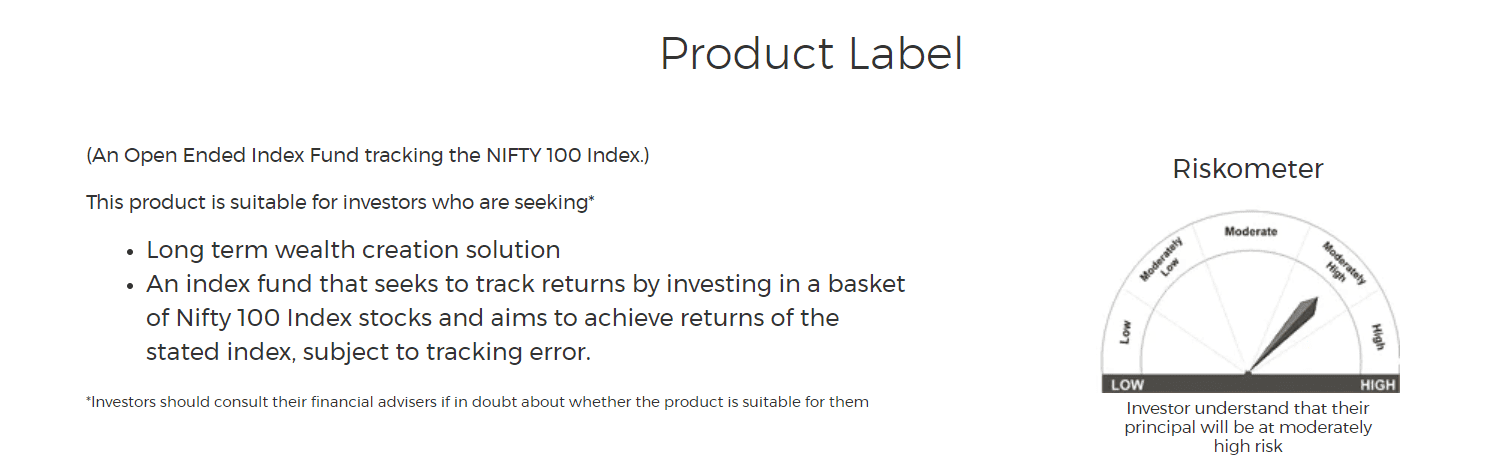
Mutual Fund Investments are subject to market risks, read all scheme related documents carefully.
Calculator
View All








Mutual fund investments are subject to market risks, read all scheme related documents carefully.
Copyrights  2020. All rights reserved Axis Mutual Fund.
Privacy | Terms | Disclaimer | Sitemap