








SIP Your Way to Tax-Saving Through ELSS Funds


(As on date 03rd June, 2020)
Every individual has a unique investment goal. Your financial goal may or may not align with that of your better half, your sibling, your parents or your colleagues. That’s why before investing in any scheme, it is better that you first understand the primary reason behind your investment. For efficient financial planning, one must know their ultimate financial goal. What is it that you wish to achieve in terms of building a financial corpus? Do you have a long term goal like building a retirement corpus, or do you have a short term goal like buying a luxury car? Or do you have a medium term goal like saving money for your wedding? Once you set a financial goal, working towards it becomes easier. What we mean to say is that having a realistic financial goal aids in financial planning as well as in narrowing down to certain financial instruments which may hold the potential to help you get closer to your financial goal.
For those who usually invest to save taxes, there are several financial instruments available in the market. Depending on your risk appetite, you may either invest in traditional or non-traditional financial instruments. Non-traditional tax saving instruments are usually preferred by risk averse investors who do not wish to expose their finances to market vagaries and settle with low interest rates. But, if you wish to give tax saving an aggressive approach and have a moderately high risk appetite, you may want to find out more about equity linked saving scheme (ELSS).
What is Equity Linked Saving Scheme?
Equity Linked Saving Scheme or ELSS is an open ended mutual fund scheme that comes with a tax benefit. As per section 80C of the Indian Income Tax Act, 1961, one can invest up to Rs. 1,50,000 in an ELSS scheme and claim for tax deductions. Axis' ELSS Fund comes with a three year lock-in period which is the shortest among tax saving instruments. This also means that you cannot redeem your ELSS investments for a minimum period of three years.
Here is an example to help you understand how ELSS can bring down your gross taxable incomes:
Anna Marie is a celebrity manager with a taxable income of Rs. 16 lakhs per annum. This lands her in the 30 per cent tax slab. Anna learns about the tax saving scheme and invests Rs. 1,50,000 in ELSS. This way, Anna manages to bring down her gross taxable income to Rs. 14.5 lakhs by investing in ELSS claiming tax deductions worth Rs. 1.5 lakhs*.
Like we stated earlier, Section 80C allows investments of up to Rs. 1.5 lakhs for tax exemption. But remember that you cannot invest more than Rs. 1.5 lakh for tax benefit. So if you invest Rs. 1.5 lakhs in ELSS you cannot invest in any other tax saving instrument that comes under Section 80C. However, there is no upper limit for ELSS investments, and you may invest in this tax saver fund depending on your risk tolerance.
If you want to give your ELSS investment a systematic approach, you may invest in equity linked saving scheme via systematic investment plan, also known as SIP.
What is Systematic Investment Plan?
Systematic Investment Plan or SIP is a systematic investment approach that allows investors to give their investments a systematic approach. ELSS usually has two investment option, lumpsum and SIP investment. When someone makes a lumpsum payment, they pay the entire ELSS investment amount at the beginning of the investment cycle. Lumpsum payment might be considered by those who are investing in ELSS at the last moment to save themselves from paying extra taxes. But lumpsum investment has its own drawbacks, and if you want to invest in a disciplinary manner and have a long term investment horizon, you may opt for a systematic investment plan. SIP is a modern investment method that allows an ELSS holder to systematically invest without having to visit the AMC or fund house manually. With SIP, all one needs to do is instruct their bank and every month on a fixed date, a predetermined amount is debited from the investor’s bank account and transferred to your ELSS fund.
How to choose the right ELSS fund?
You may start investing in ELSS fund via SIP, but here are few things to keep in mind while choosing a suitable ELSS scheme:
The investment horizon of the investor: Considering as a taxpayer one may have to continue investing in tax saving schemes till they retire, one may consider investing in ELSS for the long term. Also, if you have a long term investment horizon, ELSS might help you in accumulating a decent corpus. A lot of people turn to ELSS for meeting long term financial goals like retirement corpus or financially securing their child’s future. Even if you do not continue investing, you may remain invested as long as the scheme is giving acceptable gains or till your investment objective is met.
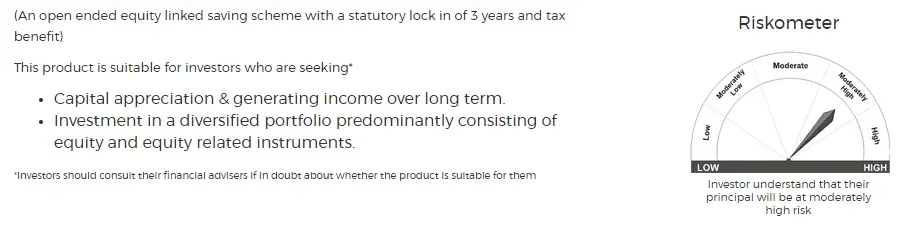
Invest according to your risk tolerance: All ELSS funds are subject to market volatility. That’s because ELSS invests predominantly in equity and equity related instruments, making it an investment option for tax payers with moderately high risk tolerance. Do you have the appetite to digest losses if the market tumbles suddenly? Hence, understanding one’s risk tolerance is essential before investing not just in ELSS but in any investment scheme. In case you are averse to taking any risk, you might want to consider tax saving options other than ELSS. But remember that no investment is risk free, and there is always the fear of losing your money when investing in financial instruments.
Look for an ELSS fund with a proven track record: There are numerous ELSS funds on offer by AMCs and fund houses. But as an investor, you need to check certain parameters about the fund. For example, how the ELSS fund has performed over a period of three months, six months, one year, three years, etc. Or how the fund is performing as compared to its peers. Whether the ELSS fund has managed to outperform its benchmark in the past. These things might give investors some idea about whether that particular fund is worth investing or not. But remember that just because an ELSS fund has given better results in the past, it may or may not continue to provide similar results in the present or future. But it is always better to invest in a fund offering consistent gains rather than investing in a fund that has only given better gains over a period of six months or one year.
Fund management
Behind the successful run of every ELSS fund lies an efficient fund management. An AMC that is equipped with modern tools for market analysis and interpretation of data usually has the upper hand of applying all their research into making an ELSS fund perform at the exchange. Also, it is necessary for an ELSS fund to be managed by an experienced fund manager. That’s because when you invest your hard earned money on a regular basis via SIP, you are entrusting it in the hands of the fund manager. It is the duty of the fund manager to buy/sell securities in accordance with the scheme’s investment objective and make some profit. Hence, it is essential that you invest in a fund that is under effective management and handled by a seasoned fund manager.
When shall I start SIP investment in an ELSS fund?
Why wait till the last minute when you can start investing in ELSS via SIP today? Remember that it is almost impossible for financial pundits to time the market. No one knows how that market will perform; whether it will score more points or crash. Everything is uncertain. But what one advise is that if you want to start investing in ELSS, it is better that you start early. The early you start the better it is. That’s because when you start early you give your investments more time to grow. And if you remain invested for the long run, you may even benefit from compounding. SIP investments have the power of turning small investments into a decent corpus. But if you wish to witness that, you might have to invest regularly in ELSS for a period of at least seven to ten years. The more you remain invested, the better chances you have of beating market inflation. Also, investments held for the long run seem to remain unaffected by daily market vagaries.
Benefits of investing in ELSS fund via SIP
ELSS has a short lock in period
ELSS has a three year lock in period which is the shortest among tax saving instruments. Which means you may continue investing in ELSS via SIP for three years and then depending on your requirements, withdraw or redeem your ELSS units. However, there is no compulsion of withdrawal, and if you want, you may continue investing in ELSS via SIP as long as the scheme is giving you desired results.
ELSS may help you with wealth creation
ELSS is an equity mutual fund. Historically equity mutual funds have given better results to those who remained invested in them for the long run. This means that if you remain invested in ELSS for a longer time period, this investment might even help you building wealth over the long term. And if you invest in ELSS via SIP, you are not only saving taxes per fiscal year but also saving a decent amount every month and increasing your chances of building a decent corpus over the long term.
ELSS may inculcate the habit of disciplinary investing
Systematic Investment Plan is an easy electronic way of investing in ELSS at regular intervals. If you continue investing in ELSS via SIP, you are automatically saving a certain amount every month. If you keep a long term investment horizon and invest in ELSS for the long term, you may inculcate the discipline of saving regularly. Disciplinary investing is essential, especially for someone who wants to build a decent corpus over the long run and investing in ELSS via SIP might help you get closer to your ultimate financial goal.
ELSS funds are available in growth and IDCW option
ELSS funds offer two investment choices for its unitholders – IDCW and growth option. If you are investing in ELSS with the hope of earning a regular income, you may consider opting for IDCW option. ELSS holders have the option of opting for regular payouts in the form of IDCW. Whenever the fund manages to make profit, the fund manager rolls out bonuses in the form of IDCW to the unitholders. The IDCW are given to investors from the ELSS fund’s NAV and in the long run this might bring down the value of the fund’s NAV. But if you are investing in ELSS for the long term, you might want to consider the growth option. In growth option, the profits earned by the ELSS fund are reinvested back in the scheme. This leads to an increase in the net asset value of the ELSS fund, which might, in turn, benefit its investors as well.
Like all investments, ELSS has its own perks and perils. Hence investors are requested to take their own sweet time and do enough research before investing in this tax saver fund. Also, it is better to consider an ELSS fund that has given consistent gains rather than settling with one season wonders. It is always feasible to accept low yet consistent gains rather than investing in a fund without a proven track record.
ELSS has become an investment choice for several tax payers. That’s because ELSS is the only mutual fund scheme that is eligible for tax benefit. So if you seek long term capital gains and also wish to save taxes, you may consider ELSS as an investment option. But like we said earlier, ELSS investments are exposed to the market, and hence it is better that you seek the help of a professional advisor who might be able to guide you in a better way.
*As per the present tax laws, eligible investors (individual/HUF) are entitled to deduction from their gross income of the amount invested in Equity Linked Saving Scheme (ELSS) up to Rs.1.5 lakhs (along with other prescribed investments) under section 80C of the Income Tax Act, 1961. Tax savings of Rs. 46,800 mentioned above is calculated for the highest income tax slab.
Finance Act, 2020 has announced a new tax regime giving taxpayers an option to pay taxes at a concessional rate (new slab rates) from FY 2020-21 onwards. Any individual/ HUF opting to be taxed under the new tax regime from FY 2020-21 onwards will have to give up certain exemptions and deductions. Since, individuals/ HUF opting for the new tax regime are not eligible for Chapter VI-A deductions, the investment in ELSS Funds cannot be claimed as deduction from the total income.
Investors are advised to consult his/her own Tax Consultant with respect to the specific amount of tax and other implications arising out of his/her participation in ELSS
Axis Long Term Equity Fund
An open ended equity linked saving scheme with a statutory lock in of 3 years and tax benefit
Mutual Fund Investments are subject to market risks, read all scheme related documents carefully.
Calculator
View All








Mutual fund investments are subject to market risks, read all scheme related documents carefully.
Copyrights  2020. All rights reserved Axis Mutual Fund.
Privacy | Terms | Disclaimer | Sitemap