









What is Axis Arbitrage Funds?


As written on: 15th Dec 2020
Axis Arbitrage Fund
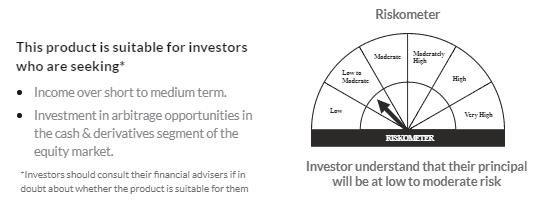
Axis Arbitrage Fund is an open ended scheme investing in arbitrage opportunities.
Investment objective of Axis Arbitrage Fund
The investment objective of Axis Arbitrage Fund is to generate income through low volatility absolute return strategies that take advantage of opportunities in the cash and the derivative segments of the equity markets including the arbitrage opportunities available within the derivative segment, by using other derivative based strategies and by investing the balance in debt and money market instruments. However, there is no assurance or guarantee that the investment objective of the Scheme will be achieved. The Scheme does not assure or guarantee any returns.
Benefits of an Axis Arbitrage Fund
- Arbitrage fund utilizes the price differential in the cash and derivatives segment of the equity market to generate returns with relatively low volatility
- Arbitrage mutual funds seek to capture the cash-futures spread in the equity market without getting affected by the market direction
- Arbitrage Fund is suitable to park short term money
Choose between SIP and lump sum before investing in Axis Arbitrage Fund
SIPs are ideal to target long term financial goals like retirement planning, buying your dream home, planning a destination wedding for your daughter or securing your child’s financial future. SIP and lump sum are two investment methods for investing in Axis Arbitrage Fund. Those who make a lump sum investment generally receive units in large quantities in quantum with their investment amount and also depending on the fund’s existing NAV (net asset value). However, lump sum investors end up exposing their entire investment amount right from the beginning of the investment cycle. Lump sum investments are generally favored by those investors who have surplus capital sitting ideal and want to put it to better use.
On the other hand, if you are someone who wishes to indulge in systematic investing without having to feel a pinch in your pocket, you can consider starting a Systematic Investment Plan in Axis Arbitrage Fund. A Systematic Investment Plan, often referred to as SIP, is a hassle free and convenient way of investing in mutual funds. One has to be a KYC complaint individual to start a SIP in Axis Arbitrage Fund. Investors must complete a one time mandate with their bank in order to start SIP investing. They get to choose the monthly investment amount, an amount they are comfortable investing without having to give up on their other financial commitments. The only catch while selecting the SIP amount is that is should comply with the minimum investment amount mentioned in the offer document. Once all the initial formalities are completed, every month on a fixed date this amount is auto-debited from the investor’s savings account and electronically transferred to the fund. Investors can also refer to a SIP calculator, a free online tool to help them determine get a rough estimate on the amount that needs to be invested at regular intervals in order to get closer to the targeted corpus.
Choose between growth plan and IDCW income plan before investing in Axis Arbitrage Fund.
Depending on their income needs investors can choose between growth plan and IDCW plan while investing in Axis Arbitrage Fund. Investors who seek regular income through their investments may opt for the IDCW plan while those who wish to achieve capital appreciation over the long term might find growth plan more feasible. A IDCW plan is more suitable for investors who aim at earning regular income. In the IDCW mutual fund scheme, whenever the fund manages to earn capital appreciation, the fund manager rolls out IDCW in the form of bonuses for its investors. However, these IDCW are rolled out at the sole discretion of the fund manager who may not release IDCW if the scheme fails to generate capital appreciation. Also, there is no guarantee that investors will receive IDCW at regular intervals. A growth plan on the other hand is generally considered by those who have long term financial goals and do not need their investment amount for any short term financial commitments. A growth plan generally works out in favor of those individuals who seek long term capital appreciation. In the growth plan, the capital appreciation earned by the scheme is reinvested back into it. Investors tend to benefit from the power of compounding as the interest earned gets reinvested in the scheme from time to time.
Mutual fund investments may seem like a lucrative investment choice as compared to conservative schemes that are known to offer low fixed interest rates. However, investors should bear in mind that mutual fund investments are subject to market risk and hence they should not depend on one asset class for capital appreciation.
Axis Arbitrage Fund
An open ended scheme investing in arbitrage opportunities
Mutual Fund Investments are subject to market risks, read all scheme related documents carefully.
Calculator
View All








Mutual fund investments are subject to market risks, read all scheme related documents carefully.
Copyrights  2020. All rights reserved Axis Mutual Fund.
Privacy | Terms | Disclaimer | Sitemap