








What Are the Similarities And Differences Between Flexi Cap and Multi-Cap Funds


When you think of investing, the term 'mutual funds' is presumably the first thing that comes to mind. Mutual funds have grown in popularity recently and are important as an investment tool. They appear to be the most popular option among investors right now owing to their potential to generate better capital appreciation than conservative investment avenues.
Thus, understanding the differences between Mutual Funds types is critical. Your investment may not generate good returns if you do not understand how different mutual fund schemes work. Today we are discussing the differences between Multi-Cap and Flexi-Cap Mutual and will try to understand how these equity funds work.
What are Flexi-Cap funds?
Flexi-cap Funds are a form of equity mutual fund with no upper or lower limits on their ability to invest across current valuation sectors, including large-cap, mid-cap, and small-cap. Fund managers have more flexibility when building portfolios thanks to this multi-cap method.
There are three categories of equities on the stock market based on market capitalization: mid-cap, large-cap, and small-cap companies. Whether a mutual fund is a large-cap, mid-cap, Flexi-cap, or small-cap fund depends on its exposure to various categories. The maximum market capitalization a fund may invest in varies for each category.
Market capitalization ceilings do not apply to flexi-cap funds. It can invest throughout the market spectrum, depending on the state of the market and its values. It was only later that the category was developed to set it apart from multi-cap funds.
What are Multi-Cap Funds?
There is always a difficulty regarding the type of mutual funds one may invest in before investing.
Mid-cap and small-cap funds provide incredibly high returns, while large-cap funds give your portfolio greater stability. If a specific sector performs very well, sectoral funds may increase the gains. The multi-cap category is one fund type that distinguishes out from the rest owing to its high degree of flexibility.
Multi-cap funds, then, are broadly diversified funds that buy equities of firms with a range of market capitalizations. To achieve the fund's investment goal, the investments are made in various ratios.
Similarities And Differences Between Flexi Cap and Multi-Cap Funds
The main difference between multi-cap and Flexi-cap funds is the extent to which they are exposed to mid-and small-cap funds. More importantly, this difference can grow quite large depending on market conditions. If the fund manager deems it necessary, Flexi-cap funds can reduce their exposure to mid or small caps to zero; however, in the case of multi-cap funds, this exposure can never be reduced to less than 25% for mid and small-cap stocks.
Flexi-cap funds are a good option for investors who want to diversify their exposure across market capitalization. They should, however, consider if the fund is managed flexibly in response to market opportunities and has generated consistent performance that meets their investment objectives.
When it comes to similarities:
• Flexi-Cap or Multi-Cap equity mutual fund sub-categories are appropriate for investors with a 5-year investment horizon and the stomach for very high risk in the pursuit of long term wealth creation.
• Whichever type of mutual fund scheme you choose, make sure it is compatible with your risk profile, investment objectives, financial goals, and time frame for achieving those financial goals.
• Finally, if the scheme selection meets your needs, you can invest in a lump sum or through a Systematic Investment Plan (SIP). When the equity markets are expected to be volatile, SIPs will mitigate the risk with their built-in rupee-cost averaging feature and compound your wealth over time, allowing you to meet your financial goals.
The decision to invest in Flexi-Cap or Multi-Cap schemes should be based on your own risk profile and overall portfolio construction rather than the current market situation. There is no hard and fast rule as to which is correct and which is incorrect. Everything is ultimately linked to the market. Before making a decision, the customer or investor must understand their own investment needs. To reap the benefits of any fund you choose based on the fund manager's long-term consistent performance, link it to your long-term goal.
Axis Multicap Fund
(An open ended equity scheme investing across large cap, mid cap, small cap stocks)
Investment Objective
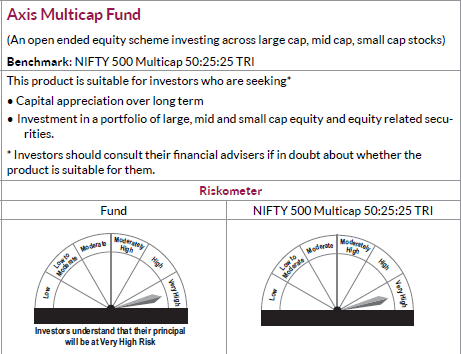
To generate long term capital appreciation by investing in a diversified portfolio of equity and equity related instruments across market capitalization. However, there is no assurance or guarantee that the investment objective of the Scheme will be achieved.
AXIS FLEXI CAP FUND
(An Open Ended Dynamic Equity scheme investing across Large cap, Mid cap, Small cap stocks)
Investment Objective
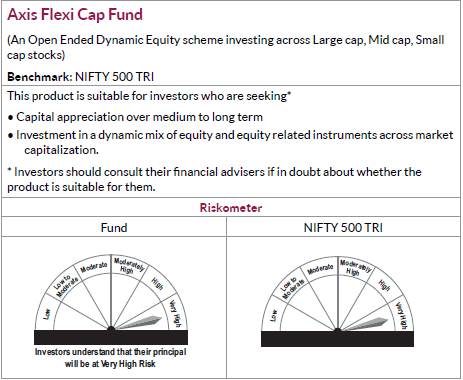
To generate long term capital appreciation by investing in a dynamic mix of equity and equity related instruments across market capitalizations. However, there is no assurance or guarantee that the investment objective of the Scheme will be achieved.
* Investors should consult their financial advisers if in doubt about whether the product is suitable for them.
Mutual Fund Investments are subject to market risks, read all scheme related documents carefully.
Calculator
View All








Mutual fund investments are subject to market risks, read all scheme related documents carefully.
Copyrights  2020. All rights reserved Axis Mutual Fund.
Privacy | Terms | Disclaimer | Sitemap