







What are Quant Funds ?


Quant funds are a type of mutual fund that use data-based models for selecting stocks in the portfolio. Here, stocks are selected on the basis of pre-defined rules. A data-driven approach is followed in this method of investing, where human intervention is limited to designing the approach and the model. Quant funds are at a nascent stage in India, but offer a wide scope for diversification of investing strategies in one’s portfolio.
How do Quant Funds work?
A fundamental data-based approach is used by setting parameters to arrive at a portfolio for informed decision-making. The criteria may include a combination of parameters across investing styles such as Quality, Growth and Value, which creates a good balance. For example, value parameters will score stocks based on factors such as, Price to Earning (P/E), Price to Book Value (P/B) and Dividend yield (D/P) parameters. Similarly, quality parameters include Return on Equity (ROE) and Debt-to-Equity (D/E) ratio. Growth parameters may include Earning Per Share (EPS) variability in the previous 5 years, etc.
After eliminating stocks from a larger universe as per the pre-defined criteria, stocks are scored along each of the parameters, and further weighted or sized using risk measures, sectoral limits, liquidity, and other important factors.
Apart from stock selection, these funds typically rebalance the portfolios periodically and also on an ad-hoc basis, that is, whenever the need arises.
Significance of investing in Quant Funds
Investing in quant funds can be beneficial as they use pre-defined, mathematical or statistical models and support bias-free, objective stock selection. A data-based approach can help limit human intervention in investing. Another interesting reason to invest in quant funds is that they add diversification in terms of investing strategy to one’s portfolio. Further, stringent risk controls within the rule-based framework can help manage risk better. The data-based, objective approach also aids consistency in performance across market ups and downs. Finally, this investing methodology instils discipline as it sticks to data-oriented facts and is not driven by impulses.
Suitability
Most Quant Funds investing in equity are ideal for those with a long-term investment horizon of at least 5 years. Investors can add these funds to diversify their mutual fund portfolio, as the investment strategy involves a systematic data-driven approach that ensures objective decision making.
Quant funds have the potential to be gain more traction in the future, as data becomes more central to making investing decisions and fund management moves towards greater efficiency.
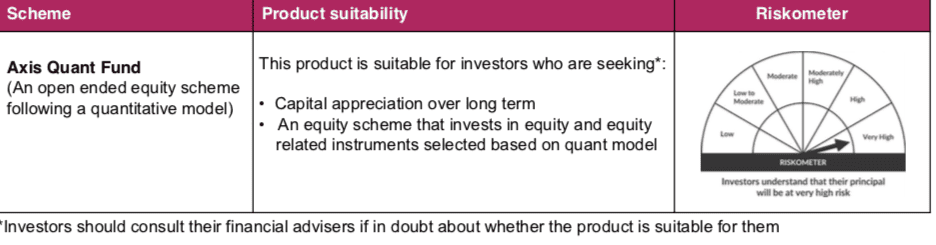
The product labelling assigned during the New Fund Offer is based on internal assessment of the Scheme Characteristics or model portfolio and the same may vary post NFO when actual investments are made.
Past performance may or may not be sustained in the future.
Statutory Details: Axis Mutual Fund has been established as a Trust under the Indian Trusts Act, 1882, sponsored by Axis Bank Ltd. (liability restricted to Rs. 1 Lakh). Trustee: Axis Mutual Fund Trustee Ltd. Investment Manager: Axis Asset Management Co. Ltd. (the AMC). Risk Factors: Axis Bank Limited is not liable or responsible for any loss or shortfall resulting from the operation of the scheme. This document represents the views of Axis Asset Management Co. Ltd. and must not be taken as the basis for an investment decision. Neither Axis Mutual Fund, Axis Mutual Fund Trustee Limited nor Axis Asset Management Company Limited, its Directors or associates shall be liable for any damages including lost revenue or lost profits that may arise from the use of the information contained herein. No representation or warranty is made as to the accuracy, completeness or fairness of the information and opinions contained herein. The AMC reserves the right to make modifications and alterations to this statement as may be required from time to time.
Mutual Fund Investments are subject to market risks, read all scheme related documents carefully.
Calculator
View All








Mutual fund investments are subject to market risks, read all scheme related documents carefully.
Copyrights  2020. All rights reserved Axis Mutual Fund.
Privacy | Terms | Disclaimer | Sitemap