






Unlock the power of the entire market spectrum with Axis Multicap Fund


Do you want to get exposure to the entire market spectrum with a single fund? Axis Multicap fund can be a suitable option!
But, before we delve into why investing in Axis Multicap fund could be your key to growth and wealth creation, let us see why investing across the market spectrum makes sense.
Understanding market cap segmentation:
The equity market can be segmented into 3 parts broadly:
• Large cap companies are top 100 companies in terms of full market capitalization. These are established businesses that tend to be stable, less volatile, and highly liquid.
• Mid Cap companies are companies ranking 101 to 250 in terms of full market capitalization. These companies are in their growth phase and tend to be slightly volatile and considerably liquid.
• Small Cap companies are those ranking 251 and lower by market capitalization. These companies could have possibility of huge growth opportunities, but tend to be highly volatile and not very liquid.
Over the years, growth has been seen across market segments at different phases. The cut-off of large cap and mid cap definition has almost doubled in the past 5 years, thus, showing how essential it is for investors to get exposure across all market segments.
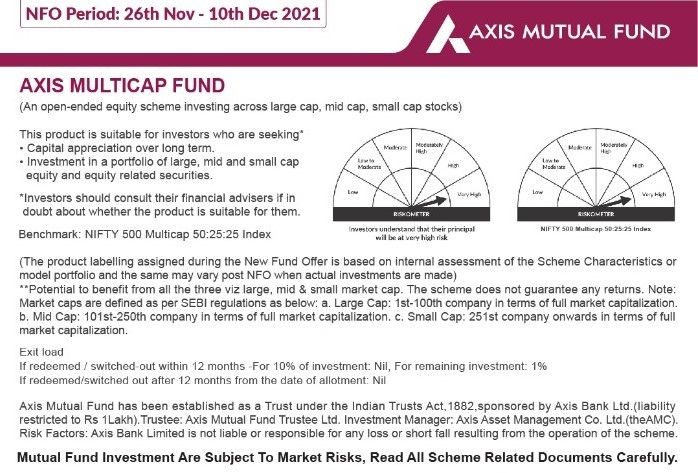
Market caps are defined as per SEBI regulations as below: a. Large Cap: 1st -100th company in terms of full market capitalization. b. Mid Cap: 101st -250th company in terms of full market capitalization. c. Small Cap: 251st company onwards in terms of full market capitalization.
Importance of selecting the right company:
While investing across the market spectrum, selecting the right company is very essential. For example, from the 100 companies that were categorized as large cap in terms of full market capitalization in 2010 , 61 were able to maintain the large cap status while 21 stocks trailed to become mid cap and 12 turned into small cap, while 6 of the large cap stocks merged, acquired, or were delisted.
Similarly, of the 150 companies that were categorized as mid cap in 2010, only 21 managed to grow into large cap stocks. 45 stocks managed to retain their midcap status, while 73 shifted backward to be included in the small cap market segment, and 11 of them were merged. Of the 251 companies categorized as small cap, only 3 transitioned to become large cap companies, 22 grew to become mid cap companies, and 33 of them were merged, acquired, or delisted.
Therefore, the key to wealth creation and growth is identifying potentially growth-worthy investment opportunities. That’s where Axis Multicap Fund gets an edge:
• An actively managed fund that carefully picks stocks in each market segment based on several qualitative and quantitative parameters.
• Highly efficient risk management system that evaluates stocks in each market cap segment for volatility, liquidity, business, size, and more.
• Efficient strategies designed for long-term growth and wealth creation
• Bottom-up approach to capture potentially growth worthy stocks that have just entered the growth phase.
• Opting only for leaders that are fundamentally strong in each of the market cap segments.
If you have a 5+ year investment horizon and want to diversify your investment across market segments with a single fund, Axis Multicap fund may be a valuable addition for your portfolio!
___________________________________
Past performance may or may not be sustained in future.
Source: Bloomberg, BSE, Axis AMC Research. Data as on 30th June 2021, Values in INR. Current Portfolio Allocation is based on the prevailing market conditions and is subject to changes depending on the fund manager’s view of the equity markets. Market caps are defined as per SEBI regulations as below:a.Large Cap: 1st -100th company in terms of full market capitalization. b. Mid Cap: 101st -250th company in terms of full market capitalization. c. Small Cap: 251st company onwards in terms of full market capitalization. Sector(s) / Stock(s) / Issuer(s) mentioned above are for the purpose of illustration and should not be construed as recommendation. The fundmanager(s) may or may not choose to hold the stock mentioned, from time to time. Investors are requested to consult their financial, tax and other advisors before taking anyinvestment decision(s).
Calculator
View All








Mutual fund investments are subject to market risks, read all scheme related documents carefully.
Copyrights  2020. All rights reserved Axis Mutual Fund.
Privacy | Terms | Disclaimer | Sitemap