









Union Budget 2025


The Union Budget presented by the finance minister is responsive, responsible and reform-oriented. As the eighth consecutive budget, it can be described as people-friendly, aiming to increase disposable income for the common man amidst a backdrop of slowing global growth. Overall, the budget is simple yet positive, with small efforts across various sectors collectively aiming to set India on a path of accelerated growth.
This budget was quite critical in the context of subdued sentiments due to consolidation in equities, FPI outflows in FY24-25 and US president and his policies adding to the uncertainty in an already uncertain environment of slowing global growth. The Budget has laid out a roadmap for economic resilience, focused on tax relief, infrastructure expansion, and sectoral reforms.
Key Highlights:
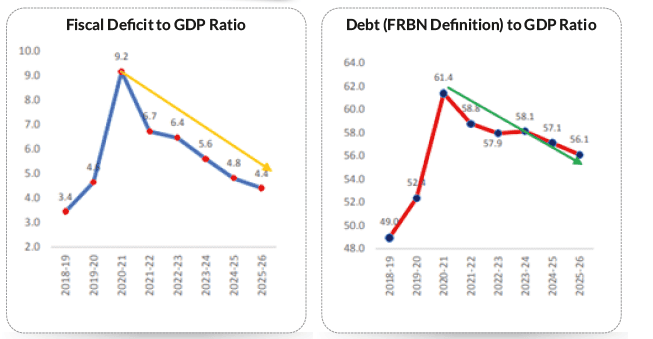
• Fiscal consolidation: We remain one of the few countries to reduce fiscal deficit from post covid expansion and this is now inching to pre covid levels.
• Cut in personal income tax: Individuals earning up to Rs 12 lacs per year will not be liable to pay income tax under the new regime. Slabs and rates were changed across the board. All of this is likely to amount to tax revenue foregone of Rs 1trn.
• Consumption boost: Lower tax rates effectively boost demand at all levels and beneficial for consumer discretionary.
• Capex thrust maintained: At 3.1% of GDP despite the consumption stimulus.
• Import tariffs slashed: Across a variety intermediary inputs and equipment.
• Tax simplification: A high level committee will be formed to lower the regulatory burden faced in the ease of doing business. For example steps taken in TDS and TCS payments.
Maintaining Fiscal Prudence
The government continues on the path of fiscal consolidation and fiscal deficit has been revised to 4.8% in FY25 (previous estimate- 4.9%) and 4.4% in FY26.
Fiscal deficit heading to pre covid levels
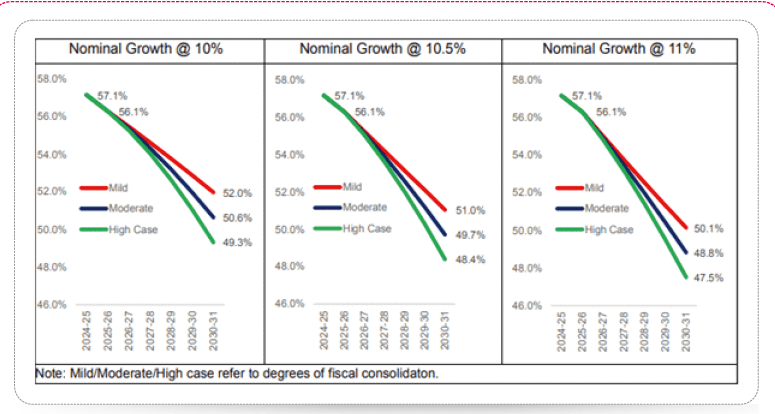
However, going forward, the Government has changed its context of fiscal deficit from glide path to Central Government debt on declining path in order to attain a debt to GDP level of about 50±1% by 31st March 2031 (the last year of the 16th Finance Commission cycle) vs 57.1% in FY25.
To finance the fiscal deficit, the net market borrowings from dated securities are estimated at Rs11.54 lac cr. The balance financing is expected to come from small savings and other sources. The gross market borrowings are estimated at Rs 14.82 lac cr. This bodes well for the markets reeling with liquidity deficits forcing the central bank to step in with liquidity measures.
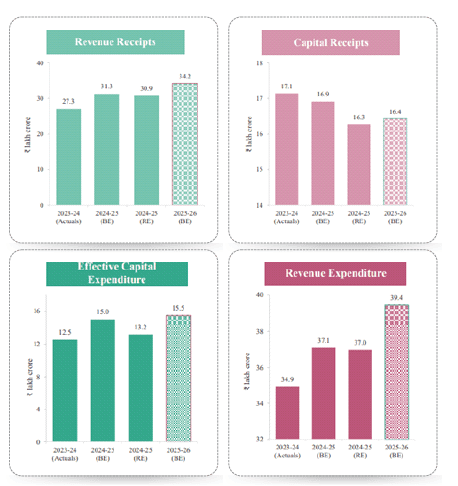
Growth and spending numbers look reasonable, revenues somewhat high
• Personal tax growth of 14.4% is a tad high at a time nominal GDP is growing 10.1%
• Dividends from the RBI and other financial institutions are at INR2.6trn (versus 2.3trn in FY25)
• On the current expenditure front, the government expects a cut in non-subsidy current expenditure.
• Capex is expected to grow in line with nominal GDP growth, coming in at INR11.2trn in FY26 (vs INR10.2trn in FY25)
Consumption to receive a Philip
Consumption has been a pain point for the government so far and with the impending slowdown globally, the government has pulled all stops at improving consumption by lowering the income tax rates. Higher disposable income effect should drive pickup in demand particularly discretionary, savings and even credit (loans). We believe that consumer discretionary in particular will benefit from the aspirational needs of the salaried class. Hence segments such as auto, retailing, travel and tourism, hospitality and real estate could be the beneficiaries. Pick-up in demand should also be a catalyst for improved capital spending by the private sector.
Simplification of taxes for the common man
In an effort to boost disposable income in the hands of the salaried class, the government has simplified the tax structures through lower income tax rates. This will help boost savings, increase consumption and thereby enhance growth.
New income tax slabs
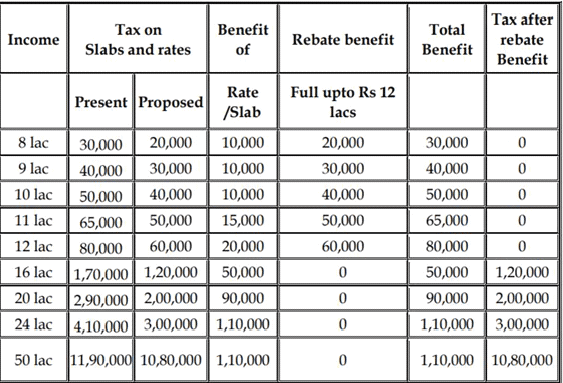
No income tax payable upto normal income (other than special rate income such as Capital Gains) of Rs 12 lakh under the new regime. This limit will be Rs 12.75 lakh for salaried tax payers, due to standard deduction of Rs 75,000. What is pertinent to note is that roughly 7.5 mn individuals (tax payers) will benefit from the revised slabs.
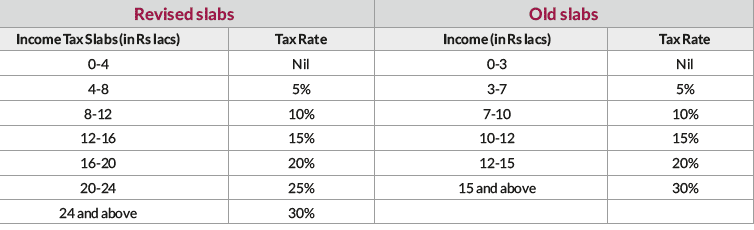
Examples of tax benefits at various levels of income under the new tax regime
Reducing regulatory burden and introducing reforms
The “regulatory cholesterol” that was quite high (regulatory burden) will now come down given that the government has mandated a “High-Level Committee for Regulatory Reforms” that will enhance the ease of doing business. Another committee “Financial Stability and Development Council” will be set up to evaluate impact of the current financial regulations and subsidiary instructions. It will also formulate a framework to enhance their responsiveness and development of the financial sector.
Equity market view
The Budget is a simple and realistic one with a focus on the common man. The realistic assumptions by the government will be key in accelerating growth, boosting consumption and avoiding any negative surprises in the future. The budget allocated Rs 11.2 lac cr for capex for FY26 is lower than the Rs 11.5 lac cr allocation of FY25 and this proves the governments intent on boosting private capex. The tax benefits to salaried class, focus on jobs, and policies directed towards housing and rural reforms (agri/allied sectors) will likely have a positive impact on the consumption theme. Given that there is more savings in the hands of the salaried class, we hope this is channelled effectively into investing in a disciplined manner.
Debt market view
In line with our expectations, the government is committed to stay on course of the fiscal consolidation path. The government has revised its fiscal deficit lower to 4.8% in FY25 and 4.4% in FY26. Gross market borrowing at Rs 14.82 lac cr is a tad higher than market expectations but we do not see any significant impact on the bond yields. From a medium term perspective, we see the government is moving from the fiscal deficit target to the centre debt to GDP target. Currently centres debt is around 56% and this should be around 50 +/-1% in the next 5 years. We believe that the budget was both credible and realistic and now the next action will be awaited from the central bank in its upcoming monetary policy meeting.
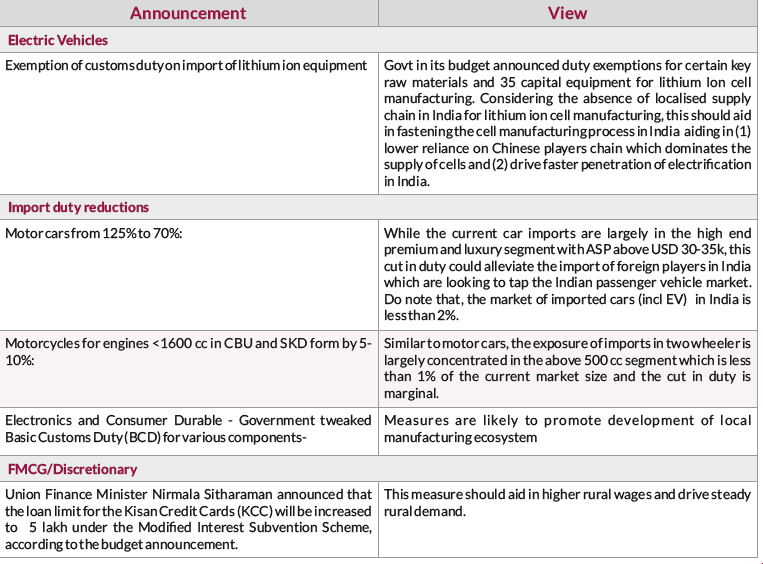
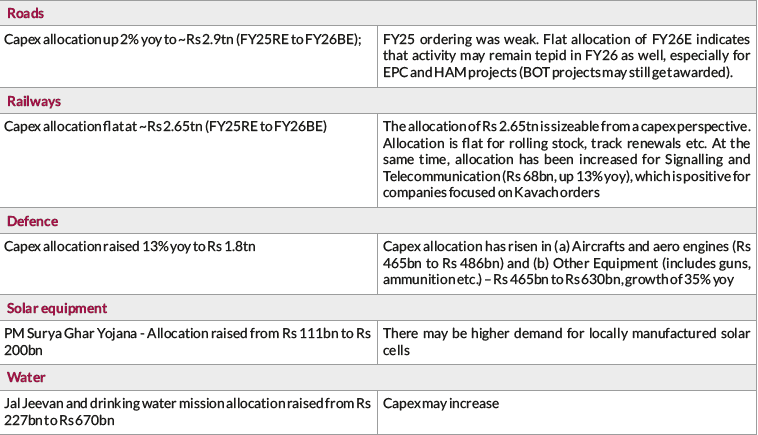
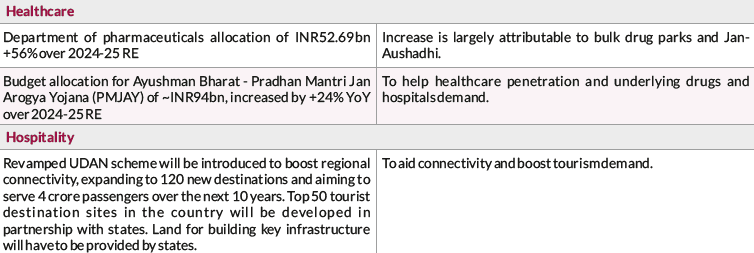
Key highlights on sectors
DISCLAIMER
Source & Date: Indiabudget.gov.in and Axis MF Research Date: 1st February 2025.
Disclaimer: This document represents the views of Axis Asset Management Co. Ltd. and must not be taken as the basis for an investment decision. Neither Axis Mutual Fund, Axis Mutual Fund Trustee Limited nor Axis Asset Management Company Limited, its Directors or associates shall be liable for any damages including lost revenue or lost profits that may arise from the use of the information contained herein. No representation or warranty is made as to the accuracy, completeness or fairness of the information and opinions contained herein. The AMC reserves the right to make modifications and alterations to this statement as may be required from time to time.
Sector(s) / Stock(s) / Issuer(s) mentioned above are for the purpose of disclosure of the portfolio of the Scheme(s) and should not be construed as recommendation.
Investors are requested to consult their financial, tax and other advisors before taking any investment decision(s).
Axis Bank Limited is not liable or responsible for any loss or shortfall resulting from the operation of the scheme.
Mutual Fund Investments are subject to market risks, read all scheme related documents carefully.
Calculator
View All








Mutual fund investments are subject to market risks, read all scheme related documents carefully.
Copyrights  2020. All rights reserved Axis Mutual Fund.
Privacy | Terms | Disclaimer | Sitemap