









Understanding ESG funds with Ashwin Patni


What is ESG?
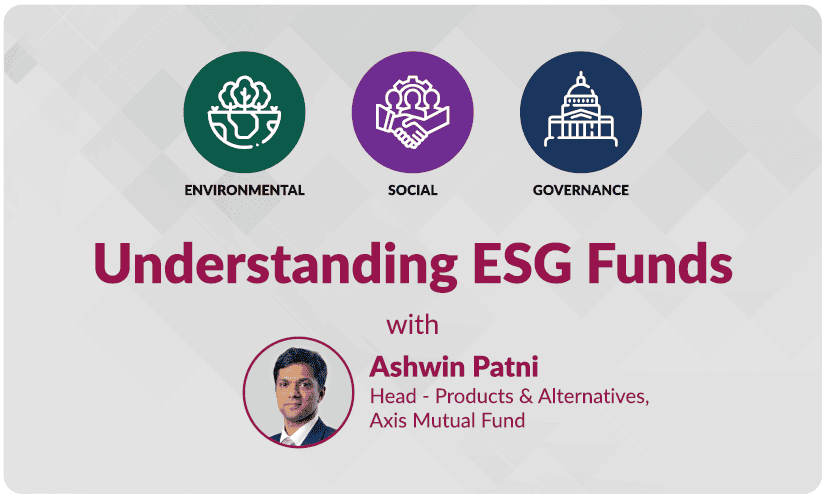
ESG is an acronym for Environmental, Social and Governance related parameters used to assess how companies are interacting with all their stakeholders (and the society in general) as a part of their business processes. ESG has evolved from socially responsible investing but has become a much broader way of capturing sustainable business practices. ESG analysis can help investors identify the long-term sustainability of a business as well as any intangible risk arising from these matters. Each of the three ESG pillars captures a broad number of issues. The environmental pillar broadly covers areas such as climate change, use of natural resources, waste management and renewable energy. Under the social pillar issues such as human capital, product safety and social opportunities are considered. In the third pillar of governance, business ethics, corporate governance and government and public policy are captured.
Is ESG as a theme here to stay? How is ESG relevant in the present day?
ESG is a theme that is becoming not just a luxury but indeed a necessity in the present-day scenario and is thus here to stay. With disruptive impact brought in by climate change, social upheavals, privacy and data handling and regulatory scrutiny, there is an increasing awareness about sustainability. Consumers across the world are asking questions about how businesses are being run and are willing to provide support or choose products of only those businesses that are run responsibly. With all stakeholders such as customers, investors and regulators demanding changes in the way businesses are being run, these non-financial factors are coming into the forefront for most companies. The winds of change are upon us, and ESG is going to be a theme that is here to stay for the long term.
Are Indian investors impacted by this global movement to invest responsibly?
ESG issues are affecting Indian investors as much as they are affecting investors globally. Examples include recent impact of extreme weather events such as floods, pushback against poor air quality in cities, social unrest and protests over issues such as land
Acquisitions, general awareness over health and fitness and herbal and ayurvedic products are necessitating changes the board. Regulatory measures and government policies are now reflective of such impending changes. At a time like this, responsible investing can no longer be an optional choice for the Indian investor.
How does ESG add value for an investor in the long term?
Essestially ESG provides fund mangers with an additional tool to test the risk to business sustainability over the long term and hence identify those businesses that can deliver sustainable growth. Thus ESG analysis has the potential to add significant value to the investor in the long term.
Sustainable companies consider the impact on all stakeholders and strive to manage for the long term by following responsible business tenets. Soundly managed companies face a lower cost of capital and are able to deliver improved operational performance. This reflects in their ability to generate sustainable growth over time which can reward their investors.
How are companies selected through the ESG filter?
ESG review in a combination of data and subjective analysis. ESG data disclosure standards are improving rapidly – pushed by the government, regulators and shareholders. The qualitative assessment is carried out on top of the ESG metrics disclosed by the company and tries to capture the analyst understanding of the company’s business model as well as forward-looking aspects. This is then juxtaposed against financial metrics to assess the long-term potential of the company.
What is the advantage of ESG companies over non-ESG companies?
Companies with strong ESG practices score higher in terms of reputation and carry lower risk probability because they incorporate sustainability as core value. This translates into steady and more sustainable performance for the business over the years. On the other hand, companies with a low ESG score due to irresponsible business practices expose investors to higher risks and greater potential for sudden shocks/losses over the long term.
Is there a precedent of ESG fund globally?
ESG funds form a well-defined category globally and these funds have been around for the past several years. There has been an increasing investor interest in ESG funds over the past years.
Additionally many mainstream funds have also started adopting ESG into their investment processes.
How does the ESG fund fit into the Axis philosophy?
Responsibility lies at the heart of every product managed by Axis MF. Thus, it is only natural that we are extremely positive about the potential for ESG investing and extremely pleased about being one of the first movers in this space in the Indian market. Our ESG process has been developed based on inputs of Schroders and thus incorporates global best practices. Our ESG will consist of a detailed qualitative and forward-looking analysis of the issues. All companies are evaluated using a standardized framework that allows us to compare scores across different companies. The ESG scores are evaluated on an ongoing basis to capture changes in the operating environment and review ESG issues faced by any company in the universe.
What do you think will be the impact of such a fund in the current scenario?
Social and environmental changes is happing faster than ever. The challenges posed by climate change, inequality and demographics are sizeable. The time is ripe for active changes in which all stakeholders must engage. Consumers are already aware and are demanding to know if companies are adhering to responsible business practices. It is thus clear now that sustainability that are able to adapt and thrive in this context will continue to benefit disproportionately, while those which ignore these issues will fall behind.
Mutual Fund Investments are subject to market risks, read all scheme related documents carefully.
Calculator
View All








Mutual fund investments are subject to market risks, read all scheme related documents carefully.
Copyrights  2020. All rights reserved Axis Mutual Fund.
Privacy | Terms | Disclaimer | Sitemap