









Understand How the 3 Year Lock-In Period of ELSS Works


(As on date 01st dec, 2020)
Of the several tax saving instruments out there, the equity linked savings scheme stands out because of its unique offerings. Taxpayers generally club tax planning and investment planning while making a financial plan. One has to pay taxes till the age of retirement. Thus, people can consider tax planning as a long term financial goal. Tax planning is something that every investor should take into consideration right from the beginning. The last thing you want is to lose out on your hard earned income because you lack tax planning. Although there are several conservative tax saving schemes which have been the primary choice of conservative investors in the past several years. Investors are now shifting to equity linked savings schemes because of the unique features that this scheme has to offer.
What is Equity Linked Savings Scheme?
Equity Linked Savings Scheme abbreviated as ELSS is an open ended mutual fund scheme that comes with a tax benefit. ELSS is a mutual fund scheme that carries a high risk profile. Hence, investors are requested to consult their financial advisor before investing in this tax saver fund. Apart from helping investors safe tax, equity linked savings schemes also give investors an opportunity to earn capital appreciation over the long term.
Use an example to help you understand how ELSS works:
Nisha Qureshi is a media manager with an annual gross income of Rs 14 lakhs. The income that Nisha draws lands in the 30% tax bracket. Upon learning about equity linked Saving Scheme from locally Nisha invests Rs. 1.5 lakhs* in this tax saver fund. According to Chapter VI-A, Section 80C of the Indian Income Tax Act, 1961 Indians can claim tax deduction up to Rs. 1.5 lakhs per fiscal year by investing in ELSS. By investing in ELSS Nisha has now brought down the gross taxable income to Rs. 12.5 lakhs.
Axis Long Term Equity Fund is an open ended tax saving mutual fund scheme that comes with 3 year lock-in and tax benefit. The investment objective of this tax saver fund is to generate income and long term capital appreciation from a diversified portfolio of predominantly equity and equality related securities. However, there can be no assurance that the investment objective of the scheme will be achieved.
Here are some of the benefits of investing in Axis long term equity fund:
- Axis Long Term Equity Fund is a diversified Equity Linked Savings Scheme (ELSS) that invests in a mix of large caps and select midcap
- Axis Long Term Equity Fund comes with the mandatory 3 year lock-in which is one of the lowest among other tax saving instruments
- A 3 year lock-in ensures that the money is invested in equities and does not get perturbed by market ups and downs. Add to it, the fund manager can make much informed decisions and look through the interim volatility.
- Being an ELSS scheme the scheme comes with the dual advantage of building wealth and saving tax
- The fund has a 3 year lock-in which gives investments a chance to grow over the long term.
- Axis Long Term Equity Fund invests predominantly in equity. Equity as an asset classes holds the potential to beat inflation and generate long-term wealth
How does the three year lock in ELSS work?
By now you know the ELSS comes with the predetermined lock in period of 36 months. This mean you cannot redeem your ELSS fund units for a minimum period of three years. This 3 year lock in period assures that the investments take advantage of the fluctuating markets and generate capital appreciation along with helping investors with saving some tax. It is the duty of the fund manager to buy and sell securities in quantum with the investment objective of the tax saving scheme. Equity schemes are known to be volatile in nature especially when it comes to short term investments. The 3 year lock in ensures that your equity investments meet the minimum investment requirement for an equity oriented mutual fund. Once the lock in period is over investors can withdraw capital appreciation they earn through their ELSS investments. This doesn't mean that one should always withdraw the capital appreciation once the lock in period is over. If the tax saving scheme that you invested in has been consistent in terms of generating capital appreciation, investors can remain invested in order to give their investments a chance to turn into a decent corpus over the long term.
ELSS is known to give a tax benefit and also an opportunity to generate capital appreciation there is no guarantee that the fund will work in the favor of the investor. Mutual Funds investments do not guarantee returns and hence one should always determine the risk appetite before making an investment decision.
*As per the present tax laws, eligible investors (individual/HUF) are entitled to deduction from their gross income of the amount invested in Equity Linked Saving Scheme (ELSS) up to Rs.1.5 lakhs (along with other prescribed investments) under section 80C of the Income Tax Act, 1961. Tax savings of Rs. 46,800 mentioned above is calculated for the highest income tax slab.
Finance Act, 2020 has announced a new tax regime giving taxpayers an option to pay taxes at a concessional rate (new slab rates) from FY 2020-21 onwards. Any individual/ HUF opting to be taxed under the new tax regime from FY 2020-21 onwards will have to give up certain exemptions and deductions. Since, individuals/ HUF opting for the new tax regime are not eligible for Chapter VI-A deductions, the investment in ELSS Funds cannot be claimed as deduction from the total income.
Investors are advised to consult his/her own Tax Consultant with respect to the specific amount of tax and other implications arising out of his/her participation in ELSS
Axis Long Term Equity Fund
An open ended equity linked saving scheme with a statutory lock in of 3 years and tax benefit
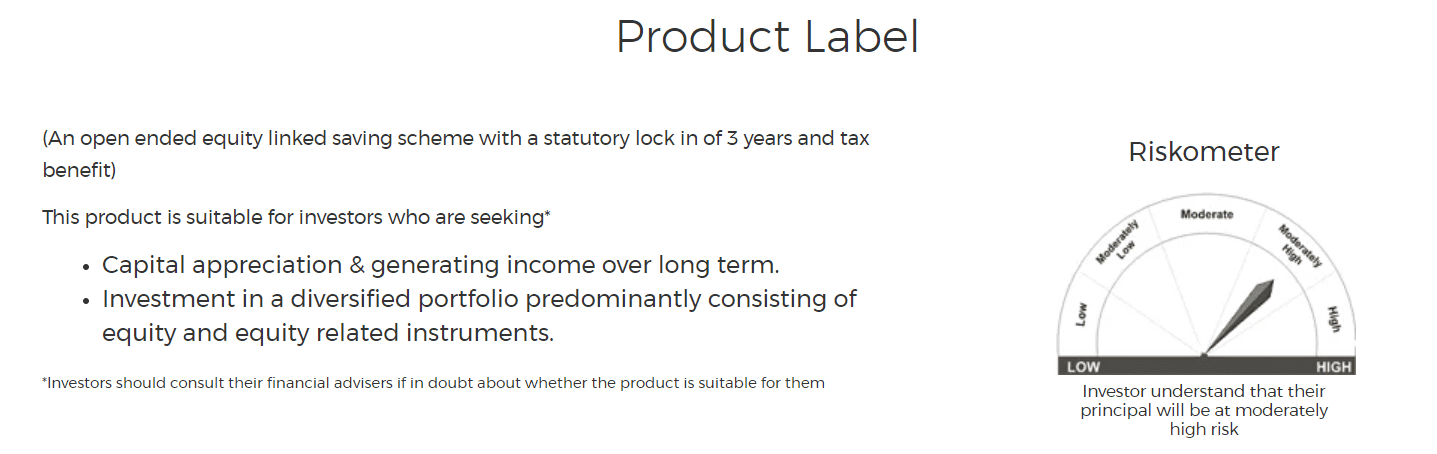
Mutual Fund Investments are subject to market risks, read all scheme related documents carefully.
Calculator
View All








Mutual fund investments are subject to market risks, read all scheme related documents carefully.
Copyrights  2020. All rights reserved Axis Mutual Fund.
Privacy | Terms | Disclaimer | Sitemap