






Seek Diversification Through Axis NIFTY 100 Index Fund


Like all mutual funds, index funds use the corpus accumulated from investors to invest in securities. However, while other mutual funds invest in stocks comprising various indices, index funds only invest in stocks that comprise a specific index. Investors who wish to diversify their investment portfolio may consider index funds. Not only can index funds help you with diversification, but they also offer a diversified portfolio themselves by investing in a portfolio of securities in the exact same way as they stand in the underlying index, without changing the portfolio composition.
An overview of Index Mutual Funds
Several investors wish to invest in the equity market, but they fear losing their hard-earned money to market volatility. Such investors choose to invest via equity mutual fund as they get several benefits like active portfolio management, a portfolio of stocks strategically curated by portfolio managers that may generate in the long run, etc. Since it is not possible for all individuals to research and build a portfolio of credible stocks belonging to different sectors and industries spread across market capitalizations, index funds can help you achieve the necessary diversification. Although it is true that they only invest in stocks that comprise a particular benchmark, they still may invest in stocks of companies belonging to different sectors and industries spread across the large cap, mid cap, and small cap markets.
Index funds invest a minimum of 95% of their investible corpus in equity and equity related instruments of companies that comprise a particular index/benchmark. They may invest the remaining of the portfolio in fixed income instruments. Index funds follow a passive investment strategy and try to generate returns similar to that of their underlying benchmark. While other mutual funds try to outperform the benchmark, index funds are designed to generate returns close to that of the index that they are tracking. Returns from index funds are subject to tracking errors.
If you are finding it tough to understand which index fund to choose among the two you shortlisted, remember that if both these index funds invest in the same index, they are more likely to generate similar returns. In such a scenario, the investor may choose to invest in an index fund that has a low expense ratio than the other using our Mutual Fund App. Index funds only change their portfolio composition if their underlying index witnesses any stock rejig.
AXIS NIFTY 100 INDEX FUND – An Open Ended Index Fund tracking the NIFTY 100 Index
Investment objective
To provide returns before expenses that closely correspond to the total returns of the NIFTY 100 subject to tracking errors. However, there can be no assurance that the investment objective of the Scheme will be achieved.
Achieving Investor Objectives with an Index Fund
Lower Expenses - Index Funds have relatively lower expenses than actively managed funds
Consistent Style - NIFTY 100 represents the top 100 companies based on full market capitalization from NIFTY 500.
Diversification - Nifty 100 Index consists of 100 companies spread across 16 Industries.
Market Linked Returns - NIFTY 100 tracks the behavior of a combined portfolio of two indices viz. NIFTY 50 and NIFTY Next 50
Benefits
• Take exposure to the top 100 companies by free float market capitalization through a single investment
• Low cost passive investment vehicle tracking the NIFTY 100 Index
• Equity Taxation
Axis Nifty 100 Index Fund
(An Open Ended Index Fund tracking the NIFTY 100 Index)
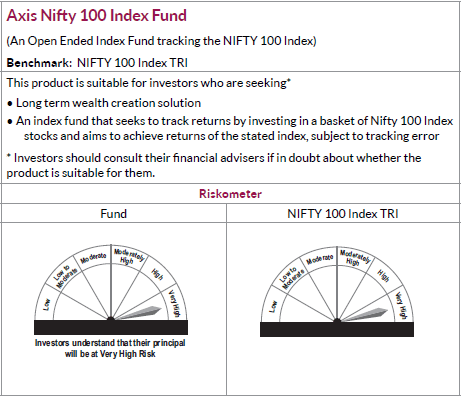
*Investors should consult their financial advisers if in doubt about whether the product is suitable for them.
Mutual Fund Investments are subject to market risks, read all scheme related documents carefully.
Calculator
View All








Mutual fund investments are subject to market risks, read all scheme related documents carefully.
Copyrights  2020. All rights reserved Axis Mutual Fund.
Privacy | Terms | Disclaimer | Sitemap