









Production Linked Incentives - Green shots in Indian Manufacturing


Background to the PLI scheme
As a measure to bring about structural reforms in the manufacturing sector and promote domestic manufacturing, the government announced an outlay of Rs. 1.97 Lakh Cr. for the Production Linked Incentive (PLI) Schemes across 14 key sectors, to create national manufacturing champions and to create 60 lakh new jobs. The scheme targeted an increase in manufacturing output by Rs. 30 lakh Cr. over the next 5 years.
Key Objectives of the PLI scheme
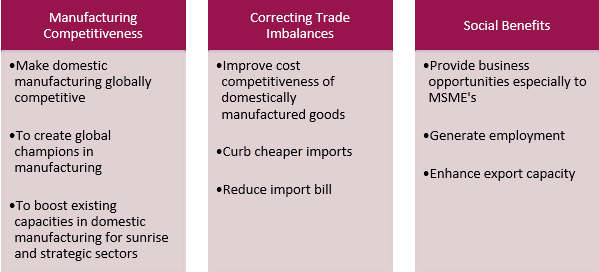
Source: National investment promotion & facilitation agency
The basic premise on which the PLI schemes stands are as follows:
1) Outcome-based and result-oriented: This means that incentives will be disbursed only after production has taken place in the country.
2) Linking incentives to output: The calculation of incentives will be based on incremental production to be achieved at a high rate of growth. To achieve this incremental production, beneficiaries will be required to make additional investments in establishing green-field facilities or carrying out expansion of existing facilities.
3) Creating ‘champions’ to maximize impact: The scheme focuses on size and scale by selecting those players who can deliver on volumes. The targeted nature of the scheme will make it highly effective and the beneficiaries are likely to become globally competitive.
4) Selection of sectors: Scope tailored to cover cutting-edge technology, integrate with global value chains and create large-scale employment.
The strategy behind the scheme is to offer companies incentives on incremental sales from products manufactured in India, over the base year. The scheme also invites foreign companies to set up units in India alongside encouraging local companies to set up or expand existing manufacturing units, generate more employment, and cut down the country's reliance on imports.
PLI – Dovetails other manufacturing incentives
In addition, to the PLI scheme which is the government’s flagship program on domestic manufacturing, the government currently offers several other incentives to manufacturers in select sectors. Notable amongst them are in key sunrise sectors as below
| Schemes | Comments |
| Production Linked incentive (PLI) scheme | • The PLI scheme awards a 4-6% incentive on ex-factory value of mobile phones/ components for the first 5 years, with an aim to boost domestic manufacturing and make India an export hub. The companies eligible under this scheme will have to incur stipulated capex. • For mobiles with a value of <Rs15k, incentives are available only to Indian cos. • Recently, the government also rolled out PLI scheme for chip manufacturing/ FAB units. |
| Phased Manufacturing Program | • To promote domestic manufacturing of Mobile Phones and various sub-assemblies involved in manufacturing of Mobile Phones, government laid out a roadmap to provide fiscal and financial incentives over the years. • Government is now extending Phased Manufacturing Programme to other product categories like Room ACs. |
| Remission of Duties or Taxes on Export Product (RoDTEP) | • This scheme replaces Merchandise exports from India Scheme (MEIS) and is extended to all exports w.e.f 1st Jan 2021. • This scheme aims at reimbursing taxes and duties paid by cos engaged in exports, which are not getting exempted or refunded under any other existing mechanism. |
| Scheme for Promotion of Manufacturing Electronics Components and Semiconductors (SPECS) | • The scheme will provide financial incentive of 25% on capital expenditure for the identified list of electronic goods that comprise downstream value chain of electronic products which involve high value added manufacturing (eg electronic components, semiconductor/ display fabrication units, ATMP units, etc.) • Applicant can apply for incentive under this scheme till FY23. The incentives will be available for investment made within 5 years from the date of acknowledgement of application. |
| Preference to Made in India products | • Govt has introduced a public procurement policy which prefers purchase of 'Made in India' products. • Class-I local suppliers (requires minimum domestic value addition of 50%) will be preferred in most of the government purchases. • Class I and Class II (20-50% local value addition) suppliers will be allowed to bid for all tenders worth <Rs2bn (except for a few global tenders). |
| Tariff and non-tariff barriers | Over the past few years, the government has imposed several tariff and non-tariff barriers on finished product and several components to not only boost final assembly but also increase value addition in India. |
Source: Government of India, News articles, MeitY, Investec Securities Research
Visible Impact
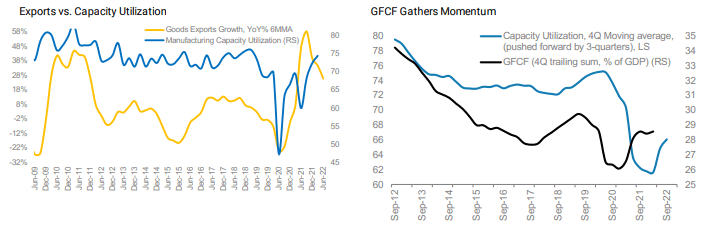
Incoming data for overall projects under implementation (as compiled by CMIE) for QE Jun-22 illustrated a broad based pickup in both private and public investment projects. While growth in public projects under implementation grew to a four-quarter high, private projects rose above previous quarter levels, albeit at a slower pace. Within new investments, whilst private investments accelerated on a four-quarter trailing basis, public investments decelerated.
Source: CEIC, Morgan Stanley, Haver Analytics
Sector data within new investments shows that growth moderated for all sectors barring electricity, which jumped up driven by base effect. Implementation of Production Linked Incentive (PLI) schemes for 14 sectors (including semiconductors) augurs well, in our view, for indigenous manufacturing capabilities to gather pace in the coming months. In terms of foreign investments, FDI flows remain robust, tracking at 2.7% of GDP on a 12-month trailing basis as of Apr-22.
Furthermore, while growth in center’s capex in FYTD23 is hovering at 70.1% YoY, it is expected to average at 24.5% YoY in F2023 as per budgeted estimates, as capex touches an 18-year high of 2.9% of GDP. In addition, the trend in state capex shows a slight moderation, albeit robust investment activity by states recording double-digit growth.
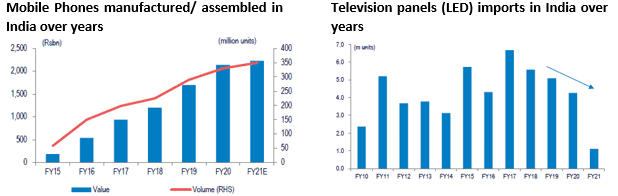
Another visible change is the change in sourcing strategies by large international manufacturers. With surging demand for products, the PLI scheme has become a trigger for global manufacturers to build/assemble products in India to meet domestic demand. Further, to optimize scale of operations a small proportion of external demand is also being catered to from Indian shores.
The situation in China and the need to adopt a China+1 manufacturing base has accelerated the pace of domestic capex by foreign multinationals. Examples as below
| Companies | Sourcing Strategy |
| Samsung | • Samsung used to largely assemble TVs in-house until three years back before it started importing from Vietnam (India has a FTA with Vietnam and these imports do not attract customs duty). • With government reducing duty on open cell panels to Nil in Sep-19, Samsung decided to procure domestically. • Samsung has outsourced manufacturing/ assembly of LED TVs to Dixon and Skyworth. |
| Xiaomi | • Xiaomi procures majority of its LED TV requirements domestically. • Dixon manufactures/ assembles majority of Xiaomi's requirements while remaining are supplied by Skyworth. |
| LG | • LG largely assembles its LED TV requirements in-house at its Pune plant. • Component are either procured from outsourced vendors/ imported. |
| Sony | • Largely outsourced to Foxconn in India. |
| Others | • Most fringe players largely rely on outsourcing or imports. Dixon and other OEM players carry on assembly for such players, mainly on ODM basis. Panasonic has also recently moved to ODM solution from Dixon. |
Source: Investec, Company reports. Data as on 28th July 2022. Stocks sectors mentioned are meant for illustrative purposes and should not be treated as recommendations or investment advice.
Below examples provides a breakdown by sector of the capex projects indicating that investment activity is gradually gaining strength and breadth.
Source: Ministry of Commerce, Investec Securities Research. Data as of 28th July 2022
Annexure - Industry Wise Update
| Industry | Outlay (US$ bn) | Projected Investment (US$ bn) | Cabinet Approval Status | Application Process | Company Details |
| Large-scale Electronics Manufacturers | 5.5 | 1.5 | Done | Ended | 16 applications were approved under the first round of the scheme (five companies under Global Champions Category, five companies under Domestic Champions Category, and six companies under the Electronic Components category). The approved companies under the PLI Scheme for Large Scale Electronics Manufacturing include Samsung, Lava International Limited, Dixon Technologies (India) Limited, Panache Digilife, Foxconn Hon Hai, Rising Star, Wistron and Pegatron. Out of these, three companies –namely Foxconn Hon Hai, Wistron and Pegatron – are contract manufacturers for Apple iPhones. |
| Pharmaceutical Drugs (KSM/API) | 0.9 | 0.7 | Done | Ended | Approvals have been accorded to 55 companies. |
| Medical Devices | 0.5 | 0.1 | Done | Ended | In all, 21 eligible participants approved which include both domestic and foreign participants. |
| Telecom and Networking Products | 1.6 | 0.4 | Done | Ended | A total of 31 companies, comprising 16 MSMEs and 15 Non-MSMEs (eight Domestic and seven Global companies) have been found eligible and are being given approval. Guidelines amended as of Jun-22. |
| Pharmaceutical Drugs 2.0 | 2 | 2 | Done | Ended | Stalled on accusations of alleged cartelization and monopoly. |
| IT Hardware Products | 0.97 | 0.4 | Done | Ended | Approved 14 eligible applicants. Four companies have been selected under the category IT Hardware Companies, which include Dell, ICT (Wistron), Flextronics and Rising Stars Hi-Tech (Foxconn). |
| Food Processing | 1.5 | - | Done | Ended | FPI has accorded approval to 60 applicants under Category 1. |
| White Goods (Air Conditioners and LED Lights) | 0.8 | 1.1 | Done | Ended | In all, 42 companies selected for PLI Scheme for White Goods, of which 26 companies to invest Rs39bn for Air Conditioner Components; 16 companies to invest Rs7.2bn for LED Component Manufacturing in round 1; 15 companies with committed investment of Rs9.1bn for AC's and Rs.6bn for LED's have been selected in round 2. |
| High Efficiency Solar PV Modules | 0.6 | 2.3 | Done | Ended | Letters of award have been issued to the extent of funds allotted. New round of the PLI scheme for solar manufacturing will have three schemes for different product categories |
| Advanced Chemistry Cells Battery Storage | 2.4 | 6 | Done | Ended | 10 companies submitted their bids; four selected to receive incentives worth Rs180bn |
| Specialty Steel | 0.8 | 5.3 | Done | Ongoing | Application window for companies extended for the fourth time until July 31, 2022 |
| Textiles | 1.4 | 2.5 | Done | Ended | Applications received from 67 companies; 61 approved. PLI 2.0 is being considered with a lower investment threshold |
| Autos & Drone Industry | 3.5 | 6.3 | Done | Ended | Applications for drone industry participants closed on March 31, 2022; 14 beneficiaries selected. 115 companies have filed applications in the auto industry. A total of 23 beneficiaries for drones and its components have been approved in the second provisional list. |
| Semiconductors | 10 | 20.5* | Done | Ended | Evaluation of applications to be completed by Dec-22. |
| Electrolyzes | - | - | Not Done | N/A | |
| Wearable/ Hearable Gear | - | - | Not Done | N/A | |
| Total | 32.5 | 28.6 |
* The total projected investment value excludes the estimated investments for semiconductors. US$20.5bn is announced for phase 1 of the scheme. Final details are awaited.
Source: Morgan Stanley, Ministry of Commerce, MEITY. Data as of 28th July 2022. Stocks/sectors mentioned are not to be treated as investment recommendations or investment advice.
Disclaimer
Source of Data: Axis MF Research, Investec Securities Research, Morgan Stanley, Ministry of Commerce, MeiTY.
This document represents the views of Axis Asset Management Co. Ltd. and must not be taken as the basis for an investment decision. Neither Axis Mutual Fund, Axis Mutual Fund Trustee Limited nor Axis Asset Management Company Limited, its Directors or associates shall be liable for any damages including lost revenue or lost profits that may arise from the use of the information contained herein. No representation or warranty is made as to the accuracy, completeness or fairness of the information and opinions contained herein. The material is prepared for general communication and should not be treated as research report. The data used in this material is obtained by Axis AMC from the sources which it considers reliable.
While utmost care has been exercised while preparing this document, Axis AMC does not warrant the completeness or accuracy of the information and disclaims all liabilities, losses and damages arising out of the use of this information. Investors are requested to consult their financial, tax and other advisors before taking any investment decision(s). The AMC reserves the right to make modifications and alterations to this statement as may be required from time to time.
Axis Mutual Fund has been established as a Trust under the Indian Trusts Act, 1882, sponsored by Axis Bank Ltd. (liability restricted to Rs. 1 Lakh). Trustee: Axis Mutual Fund Trustee Ltd. Investment Manager: Axis Asset Management Co. Ltd. (the AMC) Risk Factors: Axis Bank Limited is not liable or responsible for any loss or shortfall resulting from the operation of the scheme.
Mutual Fund Investments are subject to market risks, read all scheme related documents carefully.
Calculator
View All








Mutual fund investments are subject to market risks, read all scheme related documents carefully.
Copyrights  2020. All rights reserved Axis Mutual Fund.
Privacy | Terms | Disclaimer | Sitemap