







Investment Approach for ETF


Mutual funds can be an ideal way for young investors to get a taste of market vagaries and also an opportunity to seek capital appreciation. Mutual funds are broadly categorized depending on their unique characteristics like business objective, risk profile, benchmark, etc. This way, mutual funds cater to individuals with different investment objectives and offer unique investment schemes for almost everyone.
Exchange traded funds are those mutual funds that can be traded at the stock market, just like stocks and shares of publically listed companies. ETFs or exchange traded funds generally track the underlying index as its benchmark, like gold, PSU bank, SENSEX, NIFTY, etc. The job of the fund manager is to buy and sell stocks are per the performance of the underlying index with minimal tracking error. ETF returns solely to replicate the index it is mimicking, and because they involve minimum participation of the fund manager, exchange traded funds are considered to passively managed funds.
One good thing about ETFs is that they can be bought by ‘know nothing’ investors as well. That’s because investors considering investing in ETFs do not need extensive research or possess in depth industry or stock market knowledge. It’s easier to keep track of your ETF returns, too, because the fund does the simple job of tracking its underlying benchmark.
However, every investment should be given a strategic approach, especially if you want to be a smart investor. Here are approaches for ETF investments:
- Long term investment approach: This strategy can be implemented by investors who want to achieve long term financial goals. Remaining invested for the long run in exchange traded funds can not only give you a chance to beat market inflation, but also give you an opportunity to seek long term capital appreciation.
- Structural investment approach: It is necessary to give your ETF investments a fundamental approach. For this, you need to plan your investments well ahead of time. This includes deciding on how much you must regularly invest, which ETF funds to shortlist, the duration you wish to remain invested in ETFs, etc.
- Disciplinary investment approach: Give your ETF investments a systematic approach by investing in ETFs via SIP. You can opt for a Systematic Investment Plan for your exchange traded fund using your demat account. SIP investments are electronic transactions that investors can make the most out of. All they need to do is instruct their bank, and every month on a predetermined date, a fixed amount is debited from their bank account and transferred to their ETF fund. SIP has the potential to give your investments a disciplinary approach, and you can apply this strategy to invest systematically.
- Index specific approach: The benchmark of most ETF funds is either NIFTY 50 or SENSEX. Hence, depending on your financial goal, you can decide whether you want to invest in exchange traded funds that follow either NIFTY 50, SENSEX of any other specific indexes. Remember that only if the index performs well in the market, your ETF fund stands a chance of making some gains too. Hence, take your time and consult a financial advisor if needed before implementing this strategy.
If you have decided to invest in exchange traded funds, you may consider investing in Axis NIFTY ETF. The investment objective of this scheme is to provide returns that closely correspond to the total returns of the Nifty 50 Index, subject to tracking errors. However, there is no assurance or guarantee that the investment objective of the scheme will be achieved.
Here are some of the benefits of investing in AXIS NIFTY ETF:
- Axis NIFTY ETF offers diversification by holding a basket of securities corresponding to the NIFTY 50 index.
- Axis NIFTY ETF is a passively managed fund, which means investors don't have to keep track of every single ETF investment. The fund manager ensures that the portfolio resembles the benchmark index with minimal tracking error.
- Axis NIFTY ETF has low acquisition cost and can be purchased in multiples of 1 unit on listed stock exchanges.
- Axis NITFY ETF has tax efficiency as it is treated as equity oriented funds for the purpose of taxation.
- Axis NIFTY ETF offers you flexible same intraday pricing you get when trading stocks through a broker.
We hope that you consider these ETF investment strategies and implement the one that suits you. Remember to have a long term investment objective and invest only within your boundaries.
Axis NIFTY ETF
An open ended Scheme replicating/ tracking Nifty 50 Index
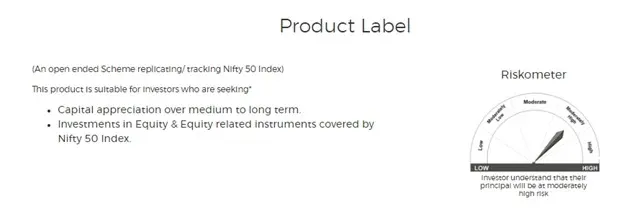
Mutual Fund Investments are subject to market risks, read all scheme related documents carefully.
Calculator
View All








Mutual fund investments are subject to market risks, read all scheme related documents carefully.
Copyrights  2020. All rights reserved Axis Mutual Fund.
Privacy | Terms | Disclaimer | Sitemap