









Can Liquid fund be used for Portfolio Investment?


Save now splash later...
If you are eager on investing your hard earned money in some financial scheme with the hope of earning some decent returns, you can consider investing in mutual funds. But investing in mutual funds requires you to take some amount of risk, and thus, it is better that you identify your risk appetite before going ahead with any investment decision. What investors also need to realize is that they need to set a realistic goal and then structure their investments depending on their horizon, existing liabilities and risk appetite.
Usually, there are two types of investors – those who are risk averse and prefer keeping their investments aloof from the dangers of direct equities. Then, there are those who do not mind giving their profile an aggressive approach with the hope of increasing the risk rewards ratio. However, if you have short term goals and looking to provide your investment portfolio with some liquidity, you can consider investing in liquid funds.
What are liquid mutual funds?
Liquid funds are a debt mutual funds category which heavily invests in debt and debt related instruments. Unlike equity mutual funds which heavily invest in equity related instruments, liquid funds invest in securities which come with a maturity period of up to 91 days. If you have idle cash parked and wish to put it to better use, you may consider investing it in liquid funds. Liquid funds invest in market securities like call money, government bonds, treasury bills and similar debt instruments, making them ideal for meeting short term goals.
Can liquid funds be ideal for adding to one’s portfolio?
The reason why most individuals are successful with their investments is that they have mastered the art of diversification. If you learn to diversify your portfolio and spread your investments across various assets, might also be successful in reducing the risk from your investment portfolio. If you already have a set of equity mutual funds in your portfolio and wish to give your folio some liquidity along with diversification, you may consider investing in liquid funds.
However, there are few things to keep in mind before investing in liquid funds:
- Risk appetite: Yes, it is true that liquid funds do not invest primarily in equity or equity related instruments, but that doesn’t make a completely risk free investment. Remember that all mutual funds are subject to market volatility and hence, returns from these investments are never guaranteed. Risk appetite is nothing but an investor’s ability to sustain losses. You should be able to bear the brunt in case the market collapses, and hence it is advisable to only invest within your limits. The last thing you want is to lose all your money in mutual fund investments. Thus, it is advisable that you identify your risk appetite and invest only within your boundaries.
- Investment objective: As we stated earlier, every individual will have separate goals, and it is better that you invest in a scheme that is suitable for you. There are several investment products, each having unique investment objectives, strategies, benchmarks and goals to achieve. So depending on your investment objective and your financial goals, you must choose a scheme that holds the potential to help you get closer to that goal.
- Investment horizon: Now, in order to achieve your financial goal, you need to know how many years you might possibly need in order to build the desired corpus. An investment horizon is nothing but the number of years an individual might need to have in hand in order to achieve his / her financial goals. To achieve goals like retirement corpus or to get a new home, you may need to have a long term investment horizon of at least 20 years.
- Expense ratio: The expense ratio levied by the fund house on a particular product might seem petty at the time of investment, but if you think from a long term perspective, this small percentage of expense ratio can become a big hurdle and have an adverse effect on your gains.
- Track performance of the liquid fund: If you are a new investor with very less knowledge or exposure to mutual funds industry, it is viable that you first check the track performance of the liquid fund before investing in it. If the liquid fund has given decent returns in the past, this doesn’t necessarily mean that the fund will continue delivering the same gains in future as well.
So if you have some short term goals to meet and wish to invest in mutual funds that will offer you portfolio some liquidity, you can consider investing in Axis Liquid Fund. The investment objective of Axis Liquid Fund is to provide a high level of liquidity by investing in a portfolio of money market and debt securities. However, there can be no assurance that the investment objective of the scheme will be achieved. If needed, consult an advisor to help you make an informed decision. We hope that through smart investing one day, you are able to fulfil your ultimate financial goal.
Axis Liquid Fund
An open ended liquid scheme
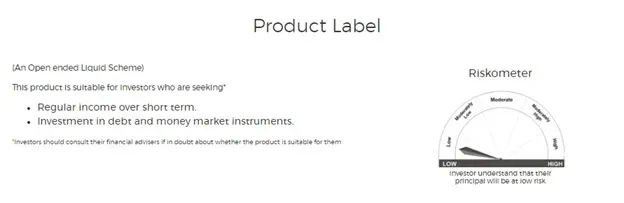
Mutual Fund Investments are subject to market risks, read all scheme related documents carefully.
Calculator
View All








Mutual fund investments are subject to market risks, read all scheme related documents carefully.
Copyrights  2020. All rights reserved Axis Mutual Fund.
Privacy | Terms | Disclaimer | Sitemap