






Know Why ETFs Are Perfect for Young Investors


Siddharth who started his professional career journey six months ago has managed to accumulate a sum of Rs. 50,000 which he wishes to invest for long term capital appreciation. He has been exploring investment options in India and since he has a very high risk appetite, he is confused between investing in equity mutual funds and exchange traded funds (ETFs). Should Siddharth go ahead and invest in equity mutual funds that have designated fund managers actively managing the portfolio or opt for ETFs that have a low expense ratio and generate returns by mimicking the performance of their benchmark?
The answer may depend on the kind of exposure Siddharth is seeking and the kinds of risks he is willing to take. While equity mutual funds are one of the most sought after mutual fund schemes, here’s why young investors like Siddharth may consider ETFs for diversifying their investment portfolio.
What are ETFs
As per market regulator SEBI (Securities and Exchange Fund of India), an exchange traded fund “is an open ended scheme which replicates/tracks the particular index. Of the total assets, this fund must invest a minimum of 95 percent in securities of a particular index (which is being replicated or tracked)”.
An exchange traded fund tracks the securities of its underlying index with minimal tracking error. They are listed at the stock exchange like company stocks. Investors can buy units of exchange traded funds at the current market price throughout the day during live trading hours. An exchange traded fund tracks a particular index or its benchmark for generating capital appreciation.
Why should young investors consider ETFs?
There are a variety of ETFs on offer
There are different exchange traded funds tracking different asset classes and indices which gives young investors numerous options to choose from. The most common are index ETFs which as mentioned earlier, mimic the performance of their underlying index. Then there are gold ETFs whose performance depends on the fluctuating international gold prices. Banking ETFs are exchange traded funds that invest in the listed banks for its underlying portfolio. We also have international ETFs that invest in foreign securities of companies listed outside India. With so many types of schemes to choose from, young investors may consider investing in an ETF depending on the kind of exposure they are seeking and depending on the type of asset class or sector they want to invest in.
ETFs avoid concentration risk
Although they are listed at the exchanges and investors can enter or exit ETFs just like one does with company stocks, ETFs offer diversification. They invest in a diversified portfolio of securities which is different than buying shares of one company. ETFs, avoid the risk of concentration through a diversified portfolio which can mitigate an investor’s overall investment risk.
A low expense ratio
Mutual funds are actively managed and to own such funds, one has to bear the expense ratio which they carry. ETFs, however, are passively managed and have a low expense ratio which makes them a cost effective investment scheme. To understand all the expenses related to ETFs, investors can get in touch with the AMC through which they are investing.
Invest with small capital
Although ETFs are passive funds that are under professional management, unlike stocks where investors are solely responsible for his or her investment decisions and can even face losses if they do not know how to trade smartly. Also, investing in ETFs is cost effective and one can start by buying a single ETF unit for a few hundred rupees. In the case of stocks, investors may need to have a large capital as sometimes a single stock may cost thousands of rupees.
Young investors who are considering adding ETFs to their investment portfolio can consider Axis NIFTY ETF. Axis NIFTY ETF is an open ended Scheme replicating/ tracking the Nifty 50 Index. The investment objective of this exchange traded fund is to provide returns before expenses that closely correspond to the total returns of the Nifty 50 Index subject to tracking errors. However, there is no assurance or guarantee that the investment objective of the Scheme will be achieved.
Retail investors should consult their financial advisor to understand if the above mentioned scheme is ideal for their financial goals.
Axis NIFTY ETF
An open ended Scheme replicating/ tracking the Nifty 50 Index
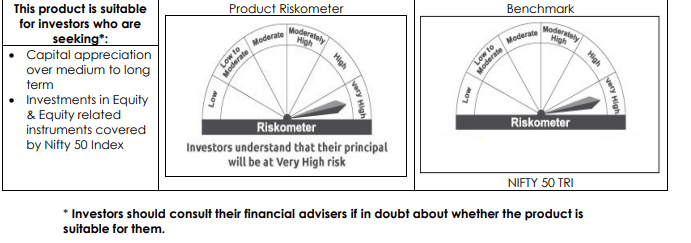
Mutual Fund Investments are subject to market risks, read all scheme related documents carefully.
Calculator
View All








Mutual fund investments are subject to market risks, read all scheme related documents carefully.
Copyrights  2020. All rights reserved Axis Mutual Fund.
Privacy | Terms | Disclaimer | Sitemap