









Know All Features And Benefits Of Axis Long Term Equity Fund: A Tax Saver Fund


No one wants to lose their money to tax deductions. We work so hard throughout our shifts to earn monthly income. So why let the government take away your hard-earned money? Young earners often ignore tax related investments and later complain when a huge chunk of money is deducted from their income. If you want to save yourself from tax woes, then better start investing at the beginning of the fiscal year. Whether one should invest in a conservative tax saving scheme or take the aggressive investment approach will depend on the taxpayer’s risk appetite.
Every tax paying individual must invest in a tax saving scheme. The purpose of tax saving instruments is to give tax payers an opportunity to bring down their gross taxable income. Investors here in India have several tax saving schemes to choose from. The only problem with conservative tax saving schemes is that they come with a lengthier lock-in period. To add to that, the fixed interest offered on these investments is generally on the lower end. This might be unfair for investors since they are investing a large amount and hardly earning any interest in return.
Thanks to the introduction of a tax saving scheme like ELSS, investors can save tax and expect to earn capital appreciation over the long term.
If you are someone who is young, with an aggressive investment approach, looking for a market linked scheme that offers long term capital appreciation and comes with a tax benefit, then you may consider investing in Equity Linked Saving Scheme. ELSS or Equity Linked Saving Scheme is an open-ended mutual fund scheme that comes with a tax benefit and a three-year lock in period. Since it is an equity-oriented scheme, this tax saver fund carries a very high-risk investment profile.
ELSS – What’s unique about this tax saving scheme?
Equity Linked Savings Scheme, often referred to as ELSS, is an open-ended mutual fund scheme that comes with a three-year lock-in and tax benefit. The three-year lock-in is probably the shortest time period among other tax saving instruments.
Here is an example to help you understand how ELSS works –
Ravi Rajendra is a medical professional who draws an annual Rs. 18 lakhs salary. This lands him in the 30 percent tax slab. After learning about ELSS, Ravi decides to invest Rs. 1.5 lakh in this tax saver fund. According to Section 80C of the Indian Income Tax Act, 1961 one can invest up to Rs. 1.5 lakh per fiscal year in a tax saver fund like ELSS and claim a tax deduction for the same.
By investing Rs. 1.5 lakh in ELSS, Ravi has brought down his gross taxable income to Rs. 16.5 lakh. Also, at the end of the three-year lock-in period, Ravi might be able to earn some interest on the investment amount.
Importance of ELSS investments
No individual would want to give a chunk of their hard-earned income to the government in the name of taxes. This is why investors need to invest every financial year in a tax saving scheme like ELSS. ELSS comes with a predetermined lock-in period of only three years. Investors can either liquidate their ELSS investments or continue to remain invested to earn better capital appreciation. ELSS investments not only help taxpayers bring down their overall tax liability, but they also stand an opportunity to target their life’s long term financial goals. Since ELSS is an equity oriented scheme, it would be unfair to expect decent capital appreciation from this investment over the short term. Also, if you have long term financial goals like buying a weekend home when you retire or wish to go on a world tour with your spouse, or want to give your daughter a surprise destination wedding, ELSS might help you achieve these goals. Thanks to the introduction of SIP, it is now possible for investors to invest small amounts at regular intervals instead of making lump-sum investments.
What is SIP?
A Systematic Investment Plan is one of the ways to make an investment in ELSS funds. Investors can either make a one-time lump-sum investment or opt for SIP. When you make a lump-sum investment you end up investing the entire investment amount right at the beginning of the investment cycle. On the other hand, a Systematic Investment Plan is easy and hassle free way to invest in ELSs. If you are a KYC compliant individual, you can invest in ELSS via SIP from the comfort of your home or office using a laptop or a smartphone. Investing has become so easy that you can start investing in ELSS funds via SIP using a laptop or a smartphone with a decent internet connection.
Why should you consider investing in ELSS via SIP?
To start investing in ELSS funds, investors first need to register and then need to instruct their bank and allow auto debit towards their SIP investments. Once you complete a one time mandate with your bank and decide the monthly SIP, every month on a fixed date a predetermined amount will be debited from your savings account and electronically transferred to the ELSS fund. One good thing about SIP is that investors do not need a large investment amount to start investing in ELSS funds. Some fund houses offer a monthly SIP plan as low as Rs. 500. ELSS comes with a statutory lock in period of 36 months. If you wish to inculcate the discipline of regular investing, then SIP might be the way to go.
ELSS may seem like a lucrative option for several taxpayers looking to bring down their tax liability this fiscal year. However, here are some of the things they should keep in mind before investing in ELSS:
Understand your risk appetite – ELSS is a tax saving scheme that predominantly invests in equity and equity related instruments. This makes it an investment product with a high risk profile. Although ELSS carries a high risk-reward ratio, it does not guarantee capital appreciation. One’s profile might even suffer some losses over the short term. Hence, every individual must understand their appetite for risk before investing.
Choose between SIP and lumpsum investment – There are multiple ways to invest in the ELSS scheme. One can either make a onetime lump-sum investment or they can start a SIP in the ELSS fund. A Systematic Investment Plan gives investors an opportunity to make small investments at regular intervals. One doesn’t even need to have a large capital to initiate SIP in ELSS funds. SIP investments have several advantages. Investors are allotted units every month depending on the fund’s current NAV (net asset value). SIP investments are also known to benefit from the power of compounding. In mutual funds compounding refers to interest accumulated on the interest earned from the principal investment amount. One can even refer to an online SIP calculator to determine how much money they need to invest at regular intervals in order to save taxes over the long term.
Investment objective – ELSS aims at generating capital appreciation over the long term and comes with a predetermined lock in period of three years. It is essential for the investor’s investment objective to align with that of the ELSS scheme. The scheme must hold the potential to address the investor’s investment needs.
Past performance of the ELSS fund – Market regulator SEBI, through its categorization, has managed to bring all similar investment schemes under one umbrella. Investors can now compare the performance of several investment schemes to determine a better performing fund. One must consider a consistently performing ELSS fund rather than opting for a top performing scheme.
These are some of the common things every ELSS fund investor should keep in mind before investing. Those who are new to tax saving or mutual funds in general, should consider consulting a financial advisor.
Axis Long Term Equity Fund - An open ended equity linked saving scheme with a statutory lock in of 3 years and tax benefit.
Investment Objective
To generate income and long-term capital appreciation from a diversified portfolio of predominantly equity and equity-related securities. However, there can be no assurance that the scheme’s investment objective will be achieved.
Features and benefits of Axis Long Term Equity Fund
• Axis Long Term Equity Fund is a diversified equity linked saving scheme (ELSS) that invests in a mix of large, mid and small caps
• The fund has a 3-year lock-in which is one of the lowest amongst other tax saving instruments
• A 3-year lock-in ensures that the money stays invested in equities and does not get perturbed by market ups and downs. Add to it, the fund manager can take much informed decisions and look through the interim volatility
• Being an ELSS scheme, the scheme comes with dual advantages of building wealth and saving tax
• The long term mutual fund has a 3-year lock-in which is one of the lowest amongst other tax saving instruments
• Equity as an asset class holds potential to beat inflation and generate long term wealth
• Investors can target long-term goals such as children’s education & their future, retirement, or any other long term growth that needs a wealth creation plan
Axis Long Term Equity Fund
An open ended equity linked saving scheme with a statutory lock of 3 years and tax benefit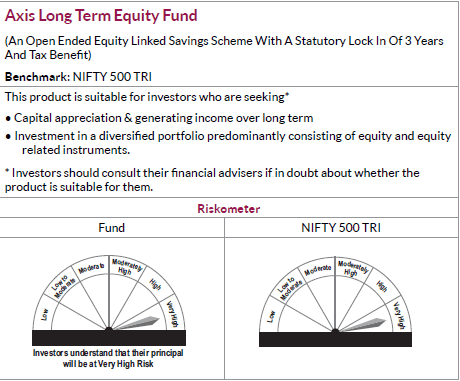
*ELSS Investments are subject to a 3-year lock-in period and are eligible for tax benefit under section 80C of the Income Tax Act, 1961.
#As per the present tax laws, eligible investors (individual/HUF) are entitled to deduction from their gross income of the amount invested in Equity Linked Saving Scheme (ELSS) up to Rs.1.5 lakhs (along with other prescribed investments) under section 80C of the Income Tax Act, 1961. Tax savings of Rs. 46,800 mentioned above is calculated for the highest income tax slab.
Finance Act, 2020 has announced a new tax regime giving taxpayers an option to pay taxes at a concessional rate (new slab rates) from FY 2020-21 onwards. Any individual/ HUF opting to be taxed under the new tax regime from FY 2020-21 onwards will have to give up certain exemptions and deductions. Since, individuals/ HUF opting for the new tax regime are not eligible for Chapter VI-A deductions, the investment in ELSS Funds cannot be claimed as deduction from the total income.
Investors are advised to consult his/her own Tax Consultant with respect to the specific amount of tax and other implications arising out of his/her participation in ELSS'
Mutual Fund Investments are subject to market risks, read all scheme related information carefully
Calculator
View All








Mutual fund investments are subject to market risks, read all scheme related documents carefully.
Copyrights  2020. All rights reserved Axis Mutual Fund.
Privacy | Terms | Disclaimer | Sitemap