









Is it better to invest in ELSS via SIP or Lump-sum?


If you have decided to save for your future self, you are on the right path in the financial planning process. But what scheme or fund to invest in is equally important as your investment decision should be aligned with your risk appetite and investment time horizon. A scheme with attractive returns and earning potential often lures investors as everyone wants to grow their investment corpus and achieve their goals. However, there is an investment scheme that not only has the potential to generate long term capital appreciation but also helps bring down their overall tax liability.
So, if you want to save tax and also earn long term capital appreciation you can consider Equity Linked Savings Scheme (ELSS), a tax saving mutual fund scheme.
Equity Linked Savings Scheme
ELSS is an open-ended mutual fund scheme that comes with a mandatory three-year lock-in period. This tax saver fund can help an individual bring down his or her overall gross taxable income by Rs. 1.5 Lacs every fiscal year. Any investment of up to Rs. 1.5 Lacs in an ELSS fund are eligible for tax deduction under Section 80C of the Indian Income Tax Act, 1961. Those who fall in the highest tax slab can save up to Rs. 48,600 in taxes.
Should you invest in ELSS via SIP or Lump-sum?
If you wish to make a lump-sum investment in an ELSS fund, the NAV of the scheme may have a poignant role to play. When you make a lump-sum investment in an ELSS scheme you buy more units at its existing NAV (Net Asset Value). This lump-sum investment will only appreciate in value when the NAV of the ELSS fund increases. Since investors may not have the entire investment sum to begin their investment journey, they can even start by investing small, fixed sums regularly through a Systematic Investment Plan.
Also referred to as SIP, a Systematic Investment Plan is a simple and effective way for an investor to average out the purchase cost. Throughout their investment time horizon, investors save and invest a fixed sum in the ELSS fund via SIP. Here is an example illustrating how SIP can help you build a decent corpus over a long duration.
Let us assume that you have 15 years in hand to invest before you need the corpus and you can afford to invest Rs. 12,000 every month regularly. Assuming that the mutual fund scheme will generate an 8% average rate of return, at the end of your investment horizon you would have invested a total of Rs. 21.60 Lacs and the total corpus accumulated would be Rs. 49.74 Lacs.
An individual can use an online SIP calculator to calculate total assumed returns earned through regular SIP investments.
SIP is ideal for salaried individuals as this allows them to invest a fixed sum from their salary every month. Lump-sum investing might be more relevant for those business owners who often earn through seasonal revenues and do not have a fixed income.
Axis Long Term Equity Fund – An open-ended equity linked saving scheme with a statutory lock in of 3 years and tax benefit
Investment objective
The investment objective of the Scheme is to generate income and long-term capital appreciation from a diversified portfolio of predominantly equity and equity-related Securities. However, there can be no assurance that the investment objective of the Scheme will be achieved.
Benchmark
S&P BSE 200 TRI
Plans and Options under the Plan(s) of the Scheme Plans
Axis Long Term Equity Fund – Regular Plan
Axis Long Term Equity Fund - Direct Plan
Options under each plan
Growth Income Distribution cum Capital Withdrawal (IDCW) (Payout)
Direct Plan
Direct Plan is only for investors who purchase/ subscribe Units in a Scheme directly with the Fund and is not available for investors who route their investments through a Distributor.
Eligible investors / modes for applying
All categories of investors (whether existing or new Unitholders) as permitted under the Scheme Information Document of the Scheme are eligible to subscribe under Direct Plan. Investments under Direct Plan can be made through various modes offered by the Fund for investing directly with the Fund {except Platform(s) where investors’ applications for subscription of units are routed through Distributors}. All the plans will have common portfolio.
Loads
Entry Load: Not Applicable
Exit Load: Nil
Axis Long Term Equity Fund
(An Open Ended Equity Linked Savings Scheme with A Statutory Lock In Of 3 Years And Tax Benefit)
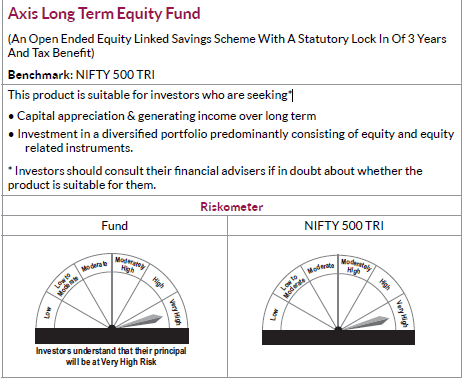
Investors should consult their financial advisers if in doubt about whether the product is suitable for them.
Mutual Fund Investments are subject to market risks, read all scheme related documents carefully.
Calculator
View All








Mutual fund investments are subject to market risks, read all scheme related documents carefully.
Copyrights  2020. All rights reserved Axis Mutual Fund.
Privacy | Terms | Disclaimer | Sitemap