








International Mutual Funds: What are they and How to Choose the Right One


Those who invest in a domestic mutual fund scheme generally do so by investing in ELSS, liquid fund, aggressive hybrid fund, gold fund and so on. However, if you want to invest in international market cycles and benefit from the growing international economies, you can consider investing in international mutual funds. International mutual funds, either directly or indirectly, invest in companies that are not publicly listed in India.
What are international mutual funds?
As mentioned earlier, international mutual funds invest majority of its investible corpus in international markets. As per market regulator SEBI (Securities and Exchange Board of India) guidelines, an international mutual fund must invest at least 80 percent of its investible corpus in equity and equity related instruments of a foreign country.
How do international mutual funds work?
International mutual funds work pretty much like any other mutual fund scheme, the only difference is that, assets here are allocated to those companies that aren’t publicly listed here in India. It is possible to invest in international mutual funds just like one invests in any other mutual fund scheme. Investors are allotted units in quantum with the sum they invest and depending on the fund’s existing NAV (Net Asset Value). Fund houses running international mutual funds collect money from investors sharing a common investment objective and the money is invested in the underlying equity assets of international companies that are not listed in India. Depending on the nature and investment objective of the scheme, an international equity fund manager may either directly invest in foreign securities or in a foreign fund that invests in foreign securities.
A FOF (Fund of Fund) international mutual fund is a mutual fund scheme where a domestic / feeder fund invests in another mutual fund scheme/s that invests across the global markets. While an investor can invest in the domestic fund, they may not be able to directly invest in the underlying fund which invests in foreign securities. In such a scenario, the fund manager of the international mutual fund will not directly invest the fund’s corpus in international markets but instead purchase units of another mutual fund whose fund manager has invested in a portfolio of global securities.
Apart from international FOFs, there are a few AMCs whose international mutual funds directly invest in foreign securities. These are international mutual funds with a direct investment approach. Here, the fund manager actively buys / sells foreign securities to allow the scheme earn capital appreciation and outperform its underlying benchmark.
Here’s why some retail investors prefer investing in international mutual funds –
Exposure to international markets
Although there are quite a few benefits of investing in international mutual funds, the primary benefit will be the very fact that investors get geographical diversification. Retail investors may not be aware but international markets do not perform in tandem with the Indian markets. Different economies perform in different manners. That means, your international mutual fund investment portfolio will perform in line with how its underlying global securities fare in their own markets.
Invest in global market leaders
As consumers of the digital era, we are constantly giving business to foreign companies by availing their products and services almost every day. These are global leaders with a fair amount of market share, but they aren’t publicly listed in India which makes investing in them a bit difficult. However, investors who wish to earn from the performance of the companies whose products and services they avail can consider investing in international mutual funds. By investing in an international mutual fund that invests in such global market leaders, investors can indirectly hold a small percentage in the equity assets of such companies.
Take advantage of different market cycles
As mentioned earlier, different global markets perform in different manners varying from time to time. Investors must understand that all global economies do not perform in tandem. For example, if there are some slowdowns in the Indian economy due to political turmoil, this will not impact the US economy. In such a scenario, even if the Indian markets are underperforming investors can benefit from the US markets that are performing well. This way, by investing in international mutual funds retail investors can capitalize on global markets in case the Indian markets aren’t performing well.
Who should consider investing in International mutual funds?
If you are unsure whether an international mutual fund is ideal for your investment objective or not, the following pointers can help in determining if these funds are suitable for your goals.
Investors can target their long term goals
While several investors have short term goals on priority, there are some investors who have long term financial goals that they wish to fulfil at some point of time in their lives. Since international mutual funds predominantly invest in equity related assets of foreign companies, investors can consider remaining invested in them for the long run to mitigate investment risk. Long term investing may allow investors to protect their investments from market volatility. By investing in international equity mutual funds, investors can target their lives’ long term financial goals like retirement planning, securing their child’s future, or any long term goal that may require a wealth creation plan.
Investors with an extremely high risk appetite
Investing in international mutual funds may seem alluring for new investors, but there are risks involved too. Risks related to market fluctuations cannot be ignored while investing in international mutual funds. Investors should only consider investing in international mutual funds if their risk appetite allows them to do so. Apart from market volatility, international mutual funds are also exposed to other kinds of risks such as economic risk, currency rate risk and political risk.
Things to consider before choosing an international mutual fund
Expense ratio of the scheme:
Mutual funds have expense ratios that are applicable as long as the investor is invested in that particular scheme. An expense ratio consists of management costs that the AMC recovers by levying it on the mutual fund investors. The expense ratio is levied to ensure that all the recurring costs and management costs are taken care of and for facilitating the scheme to function smoothly. International mutual funds may carry a high expense ratio which might eat up a decent portion of your capital appreciation in the long run. Retail investors are expected to invest in an international mutual fund with a feasible expense ratio.
Direct or regular: Which plan to choose?
International mutual funds are available for investment in both, direct and regular plan options. Direct and regular plans belong to the same mutual fund scheme but what distinguishes them is the expense ratio that they carry. Investors can buy a direct plan directly from the fund house selling that fund. They can purchase a direct plan either by personally visiting the AMC or online through the AMC’s website. Regular plans have a high expense ratio mostly because they are sold by mutual fund agents and brokers. These third party aggregators charge a commission fee which the AMC recovers by levying a high expense ratio on regular plans.
Axis Global Equity Alpha Fund of Fund – An open-ended fund of fund scheme investing in Schroders International Selection Fund Global Equity Alpha
Investment objective
The investment objective of Axis Global Equity Alpha Fund of Fund is to provide long term capital appreciation by predominantly investing in Schroders International Selection Fund Global Equity Alpha. It is a fund that aims to provide capital growth by investing in equity and equity related securities of companies worldwide. The Scheme may also invest a part of its corpus in debt, money market instruments and / or units of liquid schemes in order to meet liquidity requirements from time to time.
Benefits of investing in Axis Global Equity Alpha Fund of Fund
- Global Opportunities: Access to global companies not available in India
- Participate in global themes: Access to sunrise sectors and global themes
- Diversify Risk: Better risk adjusted returns through global diversification
- Investors can leverage from Schroders' global expertise
- Wealth creation: Ideal wealth creation strategy for the long term
Liquidity offered by Axis Global Equity Alpha Fund of Fund
The Scheme offers Units for Subscription and Redemption at NAV based prices on all Business Days. Under normal circumstances the AMC shall dispatch the redemption proceeds within 10 business days from date of receipt of request from the Unit holder.
Who is eligible to invest in Axis Global Equity Alpha Fund of Fund?
All categories of investors (whether existing or new Unitholders) as permitted under the Scheme Information Document of the Scheme are eligible to subscribe under Direct Plan. Investments under Direct Plan can be made through various modes offered by the Fund for investing directly with the Fund {except Platform(s) where investors’ applications for subscription of units are routed through Distributors}.
Plans offered
Axis Global Equity Alpha Fund of Fund – Regular Plan: Regular Plan is available for all types of investors investing through a Distributor
Axis Global Equity Alpha Fund of Fund – Direct Plan: Direct Plan is only for investors who purchase / subscribe Units in a Scheme directly with the Fund and is not available for investors who route their investments through a Distributor.
Entry / Exit Load: There is no entry load. Exit load for 10% of Axis Global Equity Alpha Fund of Fund investments is NIL if redeemed / switched-out within 12 months from the date of allotment. And for the remaining investments, an exit load of 1% is applicable. If units are redeemed / switched–out after 12 months from the date of allotment, the exit load is NIL.
Before investing in this mutual fund scheme, retail investors are advised to talk to their financial advisor.
Axis Global Equity Alpha Fund of Fund
An open-ended fund of fund scheme investing in Schroders International Selection Fund Global Equity Alpha
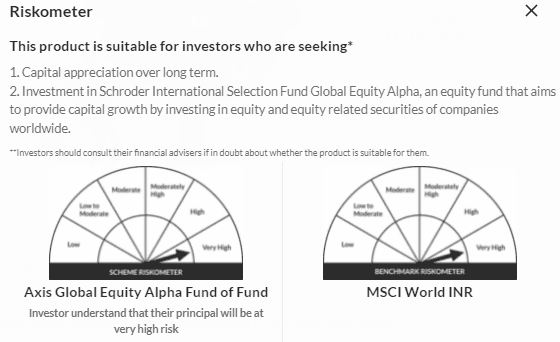
* Investors should consult their financial advisers if in doubt about whether the product is suitable for them.
Mutual Fund Investments are subject to market risks, read all scheme related documents carefully.
Calculator
View All








Mutual fund investments are subject to market risks, read all scheme related documents carefully.
Copyrights  2020. All rights reserved Axis Mutual Fund.
Privacy | Terms | Disclaimer | Sitemap