









How to Find a Suitable ELSS Fund as Per Your Need


(Article dated 04th feb,2020)
Taxpayers with a moderately high risk appetite seeking capital appreciation and tax benefits through equity investments can consider investing in ELSS. Over time, ELSS has gained popularity both among seasoned as well as young investors.
Equity Linked Saving Scheme or ELSS is a tax saving scheme that has the potential to provide investors capital appreciation. Under Section 80C of the Indian Income Tax Act 1961, investments made in ELSS are eligible for tax deductions. An investor can invest up to Rs. 1, 50,000* annually and bring down their overall taxable income through investing in instruments that come under Section 80C. ELSS, however, has the potential to offer investors with tax benefits, as well as it can give capital appreciation if stayed invested for the long run.
Here’s an example to help you understand ELSS better:
Swati Bhanushe is a data scientist with a taxable income worth Rs. 15 lakhs a year. That lands Swati in the 30% tax bracket. Swati learns about ELSS through some of her colleagues and decides to invest a total amount of Rs. 1.5 lakh. As per 80C of the Indian income tax act, Swati’s gross taxable income has now been reduced to Rs. 13.5 lakh as she can claim deductions worth 1.5 lakh rupees through her ELSS investments.
Like all equity linked schemes, investments made in ELSS, too, carry some amount of risk. Having said that, investing enthusiasts should bear in mind that all investments carry certain risks with them. Returns from equity investments are never guaranteed, but that doesn’t necessarily mean that an investor will bear losses.
ELSS comes with a mandatory lock-in of three years, which means that ELSS investors cannot redeem their mutual fund units for at least three years. Equity investments like ELSS should be considered as long term relationships. You will be investing your hard earned money in an equity linked scheme and hence, should be aware of what you are getting yourself into. Investors seeking long term capital appreciation through ELSS have plenty of schemes available in the market.
If you wish to save some money this tax season and are considering investing in ELSS, here are a few tips to help you find a suitable ELSS fund as per your need:
1. Consider investing in ELSS funds based on various research parameters & past performance
New investors seeking tax benefits might get excited and rush towards investing in ELSS by investing in a scheme that is top performing at the time. This isn’t actually a smart way of investing because the ELSS scheme that is currently performing needn’t necessarily deliver similar results in future. Hence, what investors need to do here is do a little bit more research and find out how the fund is performing in the past five to seven years. If the fund has managed to give consistent returns over a long period, which means the fund is in the hands of good management, and there are chances of capital appreciation. Hence, don’t get tempted by looking at a scheme’s current performance and make your investment decision. Remember that consistent returns can be than one time high returns.
2. Find out whether you want to go with the growth option or IDCW option
ELSS schemes are available to investors in two options – growth and IDCW. Which option should you go for? Well, that totally depends on who you are what your financial needs are. Investors depending on ELSS, for income, might feel opting for IDCW option. However, investors opting for IDCW may lose out on benefiting from the power of compounding. On the other hand, investors seeking long term capital appreciation might find growth option a bit more favorable for them. Investors going with growth option usually stand a chance of benefiting from the power of compounding.
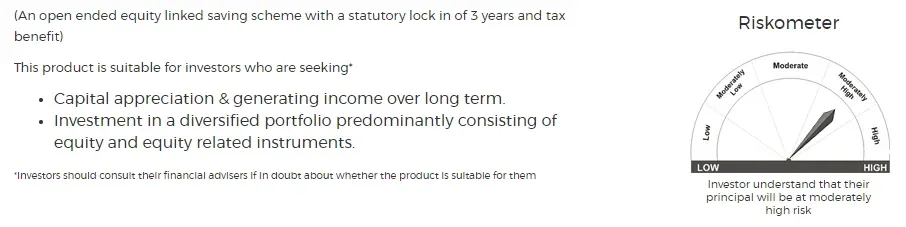
If you have a moderately high risk appetite and seek capital appreciation through equity oriented schemes, you may consider investing in Axis Long Term Equity Fund. Axis Long Term Equity Growth Fund is an open ended equity linked scheme, whose investment objective is to generate income and long-term capital appreciation from a diversified portfolio of predominantly equity and equity-related securities.
We hope that the above pointers help you with finding a suitable ELSS fund.
Axis Long Term Equity Fund
An open ended equity linked saving scheme with a statutory lock in of 3 years and tax benefit
Mutual Fund Investments are subject to market risks, read all scheme related documents carefully.
Calculator
View All








Mutual fund investments are subject to market risks, read all scheme related documents carefully.
Copyrights  2020. All rights reserved Axis Mutual Fund.
Privacy | Terms | Disclaimer | Sitemap