






How to choose the best Axis Mutual Fund's Index Fund for your goals


Many believe that choosing the right Index fund can be quite challenging. However, in the long run, it can be a fruitful investment. With so many choices available, it's essential to take a step back and consider the first things you need to do when investing: determine your reasons for investing, assess the risks you can bear, and decide on the duration you can keep your money invested. Such preparation is crucial for making a well-thought-out decision, ensuring you get the desired outcomes from the fund you choose.
What Are Index Funds?
Index funds are a type of mutual fund designed to replicate the performance of a specific market index, such as the Nifty 50 or Sensex. These funds follow a passive investment strategy, meaning their primary goal is not to outperform the market but to mirror its performance. This approach generally results in lower management fees and, consequently, lower risk compared to actively managed funds.
Why Invest in Index Funds?
1. Low Costs: Since they are passively managed, index funds typically have lower fees compared to actively managed funds.
2. Diversification: When you invest in an index fund, you're automatically investing in a broad mix of companies, which helps reduce the risk of over depending on any one particular stock.
3. Transparency: This is a benefit because you know exactly what stocks you're investing in.
4. Regular Returns: While they might not outperform the market, they generally give consistent returns reflecting those of that market, on average.
How to Select an Axis Mutual Fund Index Fund suitable for You
1. Specify Your Investment Goals
That's a great question to start with! Understanding the purpose of your investments is crucial. Are you saving for retirement, planning for a major purchase like a home or car, funding your child's education, or perhaps building an emergency fund? Each goal can influence your investment strategy, risk tolerance, and the types of funds you might consider.
2. Evaluate Your Risk Appetite
You will need to learn about your own risk appetite. Although index funds tend to be less risky than holding individual stocks, they are subject to market risk. If you are risk-averse, you may want a fund that tracks a more stable index. If you can afford to assume more risk for potentially higher rewards, you might want a fund tracking a more volatile index.
3. Review Axis Mutual Fund Products
There are index funds under Axis Mutual Fund. Among those, popular funds are:
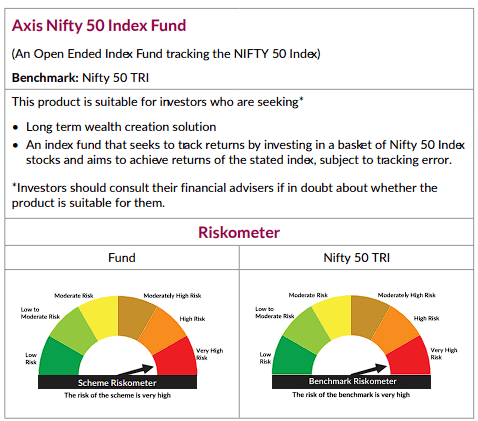
? Axis Nifty 50 Index Fund: This fund attempts to closely mimic the performance of the Nifty 50 Index, which consists of 50 Indian equities with the largest and most liquid capitalization.
? Axis Nifty Next 50 Index Fund: This fund invests in companies ranked after the top 50 based on their value, replicating the investments of the Nifty Next 50 Index.
? Axis BSE Sensex Index Fund: This fund replicates the performance of the BSE Sensex, a benchmark index of 30 well-established companies.
4. Compare Expense Ratios
Expense ratios are a significant cost factor for index funds. However, they can vary across different funds. Compare the expense ratios of various index funds to ensure you are getting the best value for your investment.
5. Measure Fund Performance
While past performance does not predict future results, it can give some insight into how well the fund has tracked its index. Consider funds that have a history of closely matching the performance of their benchmark.
6. Consider Fund Size and Liquidity
Funds having larger AUM (assets under management) have good liquidity; hence, shares can be bought and sold with minimal impact on the price of the fund. In addition, larger funds have more economies of scale, and this may offer cost advantages.
7. Tracking Error Monitoring
Monitoring tracking error checks how much the performance of a fund is in line with the index. The lower the track error, the better its performance in line with that index. So, try to select funds with minimal tracking error for better portfolio alignment with the market.
Final Decision
After researching and taking into account the above factors, you should have a clearer idea of which Axis Mutual Fund index fund aligns with your goals. Remember, the best fund for you will depend on your unique financial situation and objectives.
Additional Tips for Investing in Index Funds
- Review the portfolio regularly, irrespective of whether the investment strategy is passive. The current goals have to be synchronized with your portfolio from time to time.
- Keep abreast of market trends and economic news that may impact your investments.
- Diversify-though index funds diversify in a specific market, diversify across several types of assets and across geographies to diminish risk further.
- Be patient: Index funds are for the long term. Stick to your investment plan and do not make decisions out of fear due to short-term market movements.
Conclusion
This process of choosing the best Axis Mutual Fund index fund depends on your goals, risk tolerance, and characteristics of each. Following the steps outlined in this guide and keeping up to date with information will ensure you make a decision that is best for your financial goals.
Calculator
View All








Mutual fund investments are subject to market risks, read all scheme related documents carefully.
Copyrights  2020. All rights reserved Axis Mutual Fund.
Privacy | Terms | Disclaimer | Sitemap