









Axis Balanced Advantage Fund: A Guide to Beginners


Understanding Axis Balanced Advantage Funds: A Comprehensive Guide
How do you invest when you want equity exposure but cannot withstand volatility? While assessing an investor’s risk appetite, psychological tolerance is more important than financial capacity. As such, there must be an alignment between investment choices and investor mindset to ensure consistency and wealth creation. One such product is the Axis Balanced Advantage Funds (BAFs) which may strike a balance for your portfolio.
A Dynamic asset allocation approach to Investing
Dynamic asset allocation is a unique category of mutual funds, where the asset allocation is managed dynamically between equity and debt instruments according to changing market conditions. The strategy is to increase equity exposure when equity valuations are cheap and increase debt allocation when equity valuations are high; thus, capitalising on market opportunities and managing downside risks simultaneously.
This category was created by SEBI in 2017 when they introduced the formal categorisation of schemes, offering Equity, Debt, and Hybrid categories. The most significant benefit is risk management as it aims to limit the downside risk by interchanging between equity and debt as per market valuations. This also enables Balanced Advantage Fund to take advantage of market upswings and potentially grow better.
Axis Balanced Advantage Fund is one of the prominent players in the Dynamic Asset Allocation segment, known for its disciplined approach and unique investment strategy. The main differentiating factor among the various funds in this category is their respective in-house model that guides how schemes switch between equity and debt.
Axis Balanced Advantage Fund follows a 5-factor approach to determine equity exposure while rebalancing viz. valuation, earning momentum, global and domestic macros, market trends and global geo-political scenarios. All 5 variables are given importance while computing the net long exposure. While few factors are quantifiable like valuation and earnings momentum; other factors allow us to understand their impact on the trend in the stock market. This ensures the 360o coverage of factors to ensure the equity allocation is not just the basis of valuation, macros and trends but also includes broad parameters like FII flows, geo-political scenarios and unexpected market events. In the black swam events like Covid and, the Russia-Ukraine war, the internal asset allocation committee can immediately take an active call on asset allocation.
The distinguishing factors of Axis Balanced Advantage Fund are:
1. Portfolio Strategy
• Equity: Here the focus lies on maintaining a flexi-cap approach, allowing for adaptability and agility in capitalizing on market opportunities. Employing a bottom-up stock selection approach ensures meticulous scrutiny and selection of individual stocks based on their intrinsic value and growth prospects. The investment philosophy emphasizes growth at a reasonable price, combining quality attributes with the principles of Growth at a Reasonable Price (GARP).
• Fixed Income: In this domain, the portfolio adopts an actively managed duration strategy, driven by a dynamic assessment of interest rate outlooks and market conditions. This proactive approach enables the portfolio to adjust its fixed income exposure in response to changing interest rate environments, thereby optimizing returns while managing interest rate risks. The strategy is to have an optimal mix of high quality corporate bonds and g-secs.
2. 3 pillar investment approach to stocks selection.
• At its core is a model-based valuation framework that relies on comprehensive valuation and risk parameters to assess market conditions. It involves continuous monitoring of key metrics, such as valuation multiples and risk indicators.
• Complementing the model-based approach there is an internal Asset Allocation Committee, which convenes monthly to review the portfolio allocations. This committee comprises seasoned professionals who bring diverse perspectives and expertise to the table.
• Additionally, the investment strategy emphasizes agility and responsiveness in seizing opportunities as they arise. Active calls and decision-making based on market events, enable the portfolio to capitalize on emerging trends, exploit mispricing, and navigate through market uncertainties effectively.
Axis Balanced Advantage Fund can be ideal for:
• Investors looking for a solution that dynamically adjusts equity exposure
• Investors looking to cushion the downside while participating in market
• Relatively conservative investors who are not looking for pure equity returns
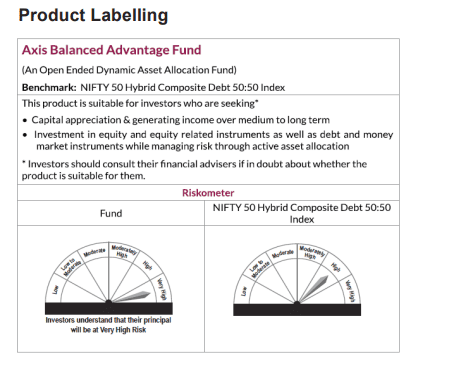
• Investors who have an investment horizon of 5 years+
Before investing in Axis Balanced Advantage Fund, investors should consider their own risk appetite and investment horizon in addition to the scheme expense ratio, past performance, and fund manager's track record.
In the quest for a dynamic investment portfolio, Balanced Advantage Funds may emerge as a prudent choice, offering a blend of risk management and growth potential. Among these, the Axis Balanced Advantage Fund may offer you an opportunity to participate with a balanced investment approach, backed by a robust investment strategy and track record. By learning about Dynamic asset allocation and doing thorough research, investors may confidently pursue wealth creation.
One should consult their financial partner to identify the right product for them or visit the Axis MF app for more information on mutual fund investments to make informed decisions.
Details of the scheme are as follows:
| Inception date | 01.08.2017 |
| Benchmark | NIFTY50 Hybrid Composite Debt 50:50 Index |
| Minimum application | Lumpsum: Rs. 100 & in multiples of Re.1 thereafter SIP: Rs.100 & in multiples of Re. 1 thereafter |
| Exit Load | If redeemed/switched out within 12 months from the date of allotment, For 10% of investments: Nil For remaining investments: 1%. If redeemed/ switched - out after 12 months from the date of allotment: NIL. |
Disclaimer: Past performance may or may not be sustained in the future.
Effective Oct 1, 2021, fundamental attribute of Axis Balanced Advantage Fund (erstwhile Axis Dynamic Equity Fund) has been revised.
Devang Shah is managing Axis Liquid Fund, Axis Dynamic Bond Fund, Axis Gilt Fund, Axis Strategic Bond Fund and Axis Short Duration Fund since 5th November,2012, Axis Credit Risk Fund, Axis Money Market Fund and Axis Arbitrage Fund since 14th August , 2014 and Axis Treasury Advantage Fund and Axis Conservative Hybrid Fund and Axis Corporate Bond Fund since July 13th, 2017 and Axis CRISIL IBX 70:30 CPSE Plus SDL April 2025 Index Fund since inception and Axis Long Duration Fund since July 27th December, 2022, Axis All Seasons Debt Fund of Funds since 1st February, 2023, Axis Multi Asset Allocation Fund since 5th April, 2024, Axis Balanced Advantage Fund since 5th April, 2024, Axis Retirement Fund since 5th April, 2024, Axis Aggressive Hybrid Fund since 5th April, 2024, Axis Equity Savings Fund since 5th April, 2024, Axis Childrens Gift Fund since 5th April, 2024.
Hardik Shah is managing Axis Balanced Advantage Fund, Axis Corporate Bond Fund and Axis Floater Fund since 29th February 2022 and Axis CRISIL IBX SDL May 2027 Index Fund since Inception and Axis Long Duration Fund since July 27th December, 2022, Axis CRISIL IBX 50:50 Gilt Plus SDL June 2028 Index Fund since 24th January, 2023, Axis Equity Savings Fund, Axis Children's Fund since 1st February, 2023, Axis Fixed Term Plan - Series 112 (1143 Days) , Axis Banking and PSU Debt Fund since 3rd July, 2023, Axis Dynamic Bond Fund since 5th April, 2024, Axis All Seasons Debt Fund of Funds since 5th April, 2024, Axis Multi Asset Allocation Fund since 5th April, 2024, Axis Retirement Fund since 5th April.
Ashish Naik is managing the equity portion of Axis Conservative Hybrid Fund and Axis Multi Asset Allocation Fund since 22nd June,2016 and Axis Children's Fund since July 6th, 2016 and Axis Nifty 50 ETF since July 3rd, 2017 and Axis Special Situations Fund, Axis Nifty 100 Index Fund, Axis NIFTY India Consumption ETF, Axis Quant Fund and Axis NIFTY Bank ETF Since 04th May 2022 and Axis Aggressive Hybrid Fund since inception, Axis Arbitrage Fund since 4th May, 2022, Axis Business Cycles Fund since inception, Axis Balanced Advantage Fund since 1st March 2023, Axis S&P BSE SENSEX ETF since Inception, Axis Bluechip Fund and Axis ELSS Tax Saver Fund since 3rd August 2023, Axis S&P BSE Sensex Index Fund Since 27th Feb, 2024.
Jayesh Sundar is Managing Axis Balance Advantage Fund, Axis Aggressive Hybrid Fund, Axis Multi Asset Allocation Fund, Axis Children’s Fund, Axis Equity Savings, Axis Conservative Hybrid Fund since 28th September, 2023, Axis Retirement Fund which include Aggressive Plan, Dynamic Plan, Conservative Plan since 15th January, 2024.
This document represents the views of Axis Asset Management Co. Ltd. and must not be taken as the basis for an investment decision. Neither Axis Mutual Fund, Axis Mutual Fund Trustee Limited nor Axis Asset Management Company Limited, its Directors or associates shall be liable for any damages including lost revenue or lost profits that may arise from the use of the information contained herein. No representation or warranty is made as to the accuracy, completeness or fairness of the information and opinions contained herein. The AMC reserves the right to make modifications and alterations to this statement as may be required from time to time. The information is provided for general information only.
Statutory Details: Axis Mutual Fund has been established as a Trust under the Indian Trusts Act, 1882, sponsored by Axis Bank Ltd. (liability restricted to Rs.1 Lakh). Trustee: Axis Mutual Fund Trustee Ltd. Investment Manager: Axis Asset Management Co. Ltd. (the AMC). Risk Factors: Axis Bank Limited is not liable or responsible for any loss or shortfall resulting from the operation of the scheme.
Mutual Fund Investments are subject to market risks, read all scheme-related documents carefully.
Calculator
View All








Mutual fund investments are subject to market risks, read all scheme related documents carefully.
Copyrights  2020. All rights reserved Axis Mutual Fund.
Privacy | Terms | Disclaimer | Sitemap