






Exchange Traded Funds: Take Part In Passive Investing with ETFs


An exchange traded fund is a mutual fund scheme whose underlying portfolio of stocks replicates a particular index that it is tracking as its benchmark. Exchange traded funds are passively managed funds where the fund manager only ensures that the portfolio of the scheme remains aligned with the securities that comprise the underlying benchmark in the same proportion without changing the portfolio composition. ETFs are designed to track the performance of their benchmark and to generate close to similar returns with minimal tracking error.
An exchange traded fund tracks indices like the NIFTY 50, SENSEX 30, etc. as its benchmark. While actively managed funds try to generate yields by outperforming their benchmark, passive funds like ETFs try to generate returns close to their benchmark instead of outperforming it.
Things to keep in mind before investing in ETFs
One way to maximize your long term alpha from exchange traded funds is by investing in a scheme with a low expense ratio. Passive funds like ETFs have a low expense ratio than active funds, investing in an ETF with a feasible expense ratio may allow your portfolio to generate better yields. When considering ETFs for investment, if two ETF funds are tracking the same index, they are more likely to generate similar returns. In such a scenario, an individual may consider the ETF with a low expense ratio.
Returns from ETFs are not based on any buying or selling decisions taken by the fund manager. These funds generate returns by closely mimicking the performance of the underlying securities that comprise the benchmark. An ETF with a high tracking error should be avoided as one does not want to invest in a scheme whose returns deviate from the returns generated by the index. This mostly happens, if the portfolio of the underlying securities does not match with the securities that comprise the benchmark. The index witnesses rejigging from time to time and if the fund manager fails to match the portfolio composition, this leads to tracking error.
Unlike mutual funds, exchange traded funds are bought and sold at the stock exchange. This determines their liquidity. It is important for an individual to consider an ETF that is frequently bought and sold as this determines its liquidity. It is always recommended to invest in an ETF that has high liquidity as opposed to an ETF that is illiquid. An ETF with low liquidity can give investors a tough time as they may not find enough buyers when they want to sell their ETF units.
Axis Equity ETFs FoF Regular Growth
An open ended fund of fund scheme predominantly investing in units of domestic equity ETFs
Investment objective
To provide long-term capital appreciation from a portfolio investing predominantly in units of domestic equity ETFs. There is no assurance that the investment objective of the Scheme will be realized. However, there can be no assurance that the investment objective of the Scheme will be realized.
Liquidity
The Scheme offers Units for Subscription and Redemption at NAV based prices on all Business Days on an ongoing basis, commencing not later than 5 business days from the date of allotment. Under normal circumstances the AMC shall dispatch the redemption proceeds within 10 business days from the date of receipt of request from the Unit holder.
Benchmark
NIFTY 500 TRI
Plans and Options
Plans and Options under the Scheme:
Plans Axis Equity ETFs FoF - Regular Plan
Axis Equity ETFs FoF - Direct Plan
Direct Plan
Direct Plan is only for investors who purchase /subscribe Units in a Scheme directly with the Fund and is not available for investors who route their investments through a Distributor.
Regular Plan
Regular Plan is available for investors who purchase/ subscribe Units in a scheme through a Distributor. All the plans will have a common portfolio.
Options under each Plans
Each plan offers the following options:
• Growth option
• Income Distribution cum Capital Withdrawal (IDCW) Option – IDCW Payout and IDCW Reinvestment facility
Load Structure
Entry Load: Not Applicable
Exit Load: If redeemed / switched-out within 15 days from the date of allotment – 1% If redeemed/switched out after 15 days from the date of allotment – Nil
Eligible investors / modes for applying
All categories of investors (whether existing or new Unitholders) as permitted under the Scheme Information Document of the Scheme are eligible to subscribe under Direct Plan. Investments under Direct Plan can be made through various modes offered by the Fund for investing directly with the Fund {except Platform(s) where investors’ applications for subscription of units are routed through Distributors}.
Axis Equity ETFs FoF Regular Growth
(An open ended fund of fund scheme predominantly investing in units of domestic equity ETFs)
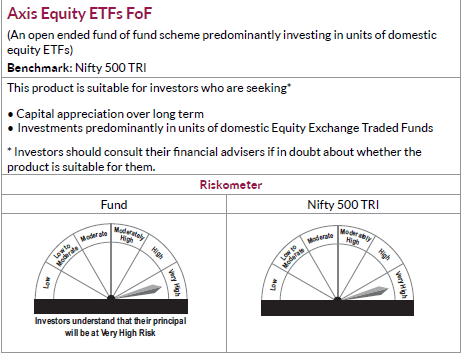
Investors should consult their financial advisers if in doubt about whether the product is suitable for them.
Mutual Fund Investments are subject to market risks, read all scheme related documents carefully.
Calculator
View All







Mutual fund investments are subject to market risks, read all scheme related documents carefully.
Copyrights  2020. All rights reserved Axis Mutual Fund.
Privacy | Terms | Disclaimer | Sitemap