









Everything You Need to Know Before Investing in Axis Nifty Bank Index Fund


Investing in equity is well-known for its wealth-building potential despite uncertainties across the world. While direct equity investment isn't everyone’s cup of tea, mutual funds offer an accessible way to participate in equity markets. However, investors can consider investing in mutual funds through passive investing which offers diversification, consistency, and cost-efficiency.
What is an Index Fund and how does it work?
An index fund is a type of mutual fund that tracks the performance of a market index, such as the Nifty, S&P 500, Sensex etc. and aims to mimic the index performance. Passive investing is already popular in developed economies, however, in the past few years, a lot of investment has started coming into passive mutual funds in India too.
Passive Investing entails investing in Index funds or ETFs that replicate a broad market index (e.g., Nifty 50 the stock market index of the National Stock Exchange (NSE) of India). ETFs trade similar to stocks on exchanges, necessitating a demat account for trading and incurring associated fees. On the other hand, Index Funds are traded based on NAV just like mutual funds or through mutual fund distributor. The major advantages are:
1. Cost-effectiveness: relatively Lower expenses maximize returns.
2. Simplicity: Accessible to all investors.
3. Standardised exposure: Consistent market access.
4. Diversification: Minimal decision-making, broad market coverage.
5. India's growth potential: Ideal for long-term investors.
The following table clearly shows the rise of the passives in India especially the Index Funds.
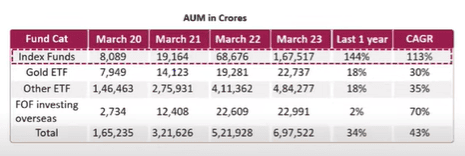
Source: amfiindia.com
Data as on March 31, 2024
Investors now have the option to focus not only on the entire broad index but also on specific sectors, such as the Banking and Financial services sector. This sector holds significant importance not only because it has the largest weightage of 34% in the Nifty (as of 31st March 2024) but is also widely regarded as the most stable and resilient within the financial industry.
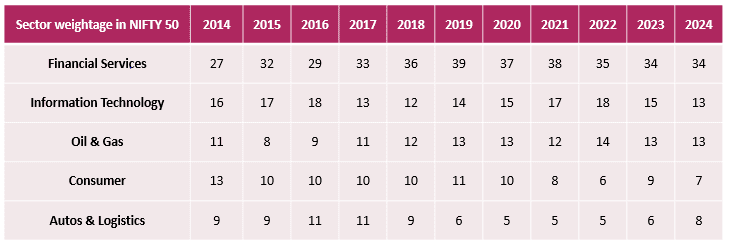
Source: Axis MF Research, Data for top 5 sectors in Nifty 50 as on 31st March 2024. Constituents as on March End of every Year. Past performance may or may not be sustained in the future. Sector(s) mentioned above are for the purpose of illustration and should not be construed as recommendation. Investors are requested to consult their financial, tax and other advisors before taking any investment decision(s).
India's banking sector distinguishes itself among global peers due to several key factors:
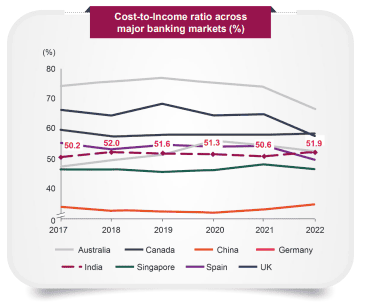
Sources: Capitaline IQ pro, BCG Analysis Past performance may or may not be sustained in future.
Advantages of investing in Nifty Bank Index Fund:
• Cost-to-income ratio - Firstly, with a cost-to-income ratio ranging from 40-50%, lower than many other countries, Indian banks benefit from reduced operating costs and a robust economy, despite regulatory complexities.
• Net interest Margins - Secondly, While historically higher, Net Interest Margins (NIMs) are now aligning with global norms as the sector evolves. In the last few years, banks witnessed strong improvement in NIMs led by higher rates and a mix shift towards higher margin loans. With increasing digitization initiatives, banks have been able to increase efficiency and maintain costs. Furthermore, banks are more focused on better quality lending which brings down the NPA’s and a shift towards high quality retail segment. Robust balance sheets - Thirdly, banks maintain robust balance sheets, with high capital ratios even amidst challenges like the COVID-19 pandemic and IL&FS default, supported by proactive regulatory controls.
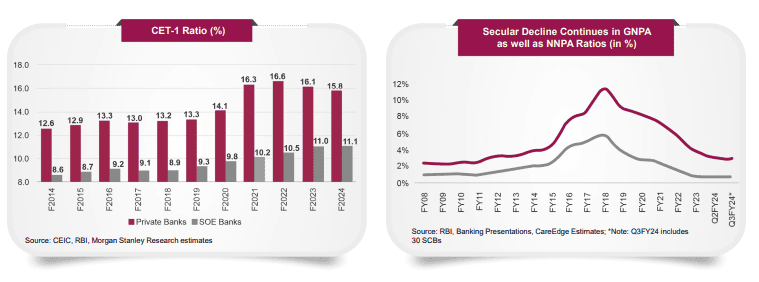
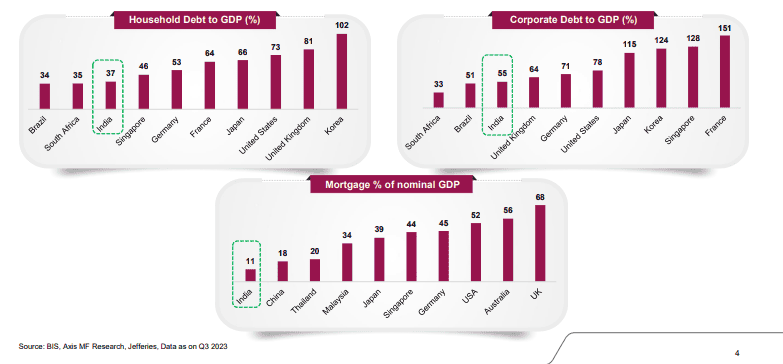
• Healthy credit growth - Additionally, Indian banks have the benefit of healthy credit demand. While the CD ratio might raise some concerns in the short term, credit growth remains robust and diversified. The expansion in retail credit is supported by factors such as growing disposable income, rising consumerism, and improved credit accessibility. On the other hand, the corporate sector exhibits healthy balance sheets and increased capacity utilization, which could sustain the momentum in private capital expenditure approvals.
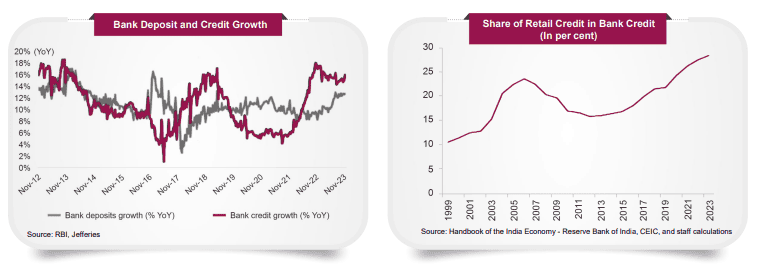
• Moreover, the under-penetration of credit, as evidenced by indicators such as household debt to GDP (%), corporate debt to GDP (%), and mortgage % to nominal GDP, presents a significant long-term growth opportunity, according to data from BIS, Jefferies, and Axis MF Research.
• Digital transformation - Finally, the digital transformation in Indian banking has revolutionized digital transactions and UPI payments. Digital banking maturity i.e. level of advancement achieved by Indian banks in their digital offerings and capabilities is way higher than the global average.
This sector is represented by the Nifty Bank Index which was launched in 2000 and comprises 12 large and most liquid Indian banking shares listed on NSE. It is an important benchmark index providing insights into the performance and dynamics of the banking sector in India. Axis Bank is one of the 12 constituents of the Nifty Bank Index with a weightage of more than 9% (2024). Constituents of index - https://www.niftyindices.com/indices/equity/sectoral-indices/nifty-bank
Benefits of Investing in Nifty Bank Index Fund
Investing in the Nifty Bank Index offers several benefits.
• Primarily, it provides exposure to a crucial sector of the economy, one intricately tied to India's growth story.
• With the under-penetration of credit and increasing demand for financial services, the banking sector presents long-term growth opportunities.
• Additionally, historical data suggests that the Nifty Bank Index has the potential to be a long-term wealth creator, delivering higher CAGR compared to other sectors.

• Reviewing the calendar year returns and valuations of the Nifty Bank Index provides further insights. Despite market fluctuations, the index has demonstrated resilience, delivering consistent returns over time.

Source: MFI explorer, Axis MF Research. Data as on 31st March 2024 Past performance may or may not be sustained in the future. Rolling returns calculated on daily basis. All returns in CAGR. The performance figures pertain to the index and do not in any manner indicate the returns/performance of the scheme.
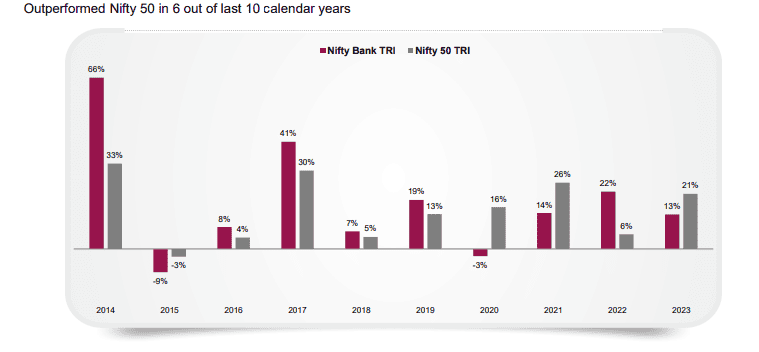
Source: ACE MF, Axis MF Research. Past performance may or may not be sustained in the future. The performance figures pertain to the index and do not in any manner indicate the returns/performance of the scheme.
• Reasonable valuations ensure an attractive entry point for investors, mitigating downside risks and maximizing potential gains. Bank ROAs have improved from 0.20% in FY19 to 1.10% in FY23. Nifty Bank Index is trading at a P/B of 2.77, in line with a 10-year average of 2.72
Axis Nifty Bank Index Fund
Recognizing the promising growth trajectory within the banking sector, Axis MF is poised to introduce the Axis Nifty Bank Index Fund NFO based on the Nifty Bank Index. Backed by meticulous research indicating substantial sectoral growth in the forthcoming decades, Axis MF aims to capitalize on this opportunity, bringing forth unparalleled advantages to its investors.
Details of the NFO are as under:
| Scheme Name | Axis Nifty Bank Index Fund |
| Benchmark | Nifty Bank TRI |
| Fund Manager | Karthik Kumar, Ashish Naik |
| Face Value | Rs.10 |
| Minimum Investment (NFO) | Rs.500 & in multiples of Re. 1/- thereafter |
| Exit Load | 0.25% if redeemed / switched out within 7 days from date of allotment / Investment if redeemed/ switched out after 7 days from the date of allotment/ Investment - Nil |
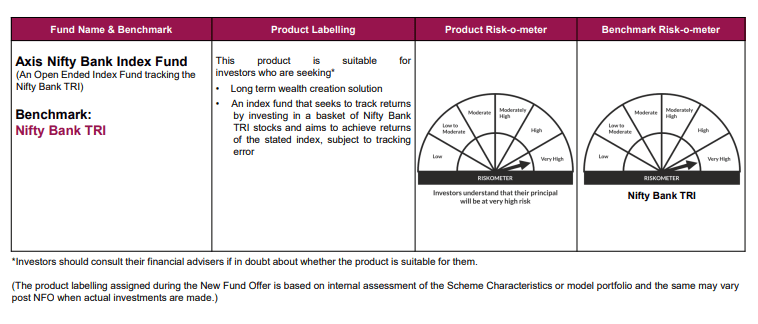
| Category on the riskometer | Very High both for the scheme and benchmark |
This product is suitable for investors who are seeking:
• Long-term wealth creation solution
• An index fund that seeks to track returns by investing in a basket of Nifty Bank TRI stocks and aims to achieve returns of the stated index, subject to tracking error
Benefits of Investing in Axis Nifty Bank Index Fund
Investing in the Axis Nifty Bank Index Fund NFO presents a compelling opportunity for investors seeking exposure to India's thriving banking sector. With the economy poised for growth, the demand for banking services is set to surge, offering significant potential for the sector's expansion. The fund's portfolio of 12 banking stocks of the Index ensures exposure to industry leaders while mitigating individual stock risk.
Moreover, trading at reasonable valuations, the fund offers an attractive entry point for investors, promising long-term capital appreciation. Additionally, the flexibility of Systematic Investment Plans (SIPs) smooths market volatility, allowing investors to benefit from rupee cost averaging and enhancing returns potential. While headline returns can be flashy, focusing on risk-adjusted returns provides a clearer picture of a mutual fund's true performance. By factoring in volatility, you can make informed investment decisions that prioritize long-term growth with a realistic understanding of potential risks.
With a focus on delivering consistent value through disciplined investment practices, the Axis Nifty Bank Index Fund stands as a promising avenue for investors seeking to capitalize on India's burgeoning banking sector. One should consult their financial partner to identify the right product for them or visit Axis MF app for more information on mutual fund investments and take informed decisions.
Disclaimer: Past performance may or may not be sustained in the future. Past performance may or may not be sustained in the future.
Sector(s) / Stock(s) / Issuer(s) mentioned above are for the purpose of disclosure of the portfolio of the Scheme(s) and should not be construed as recommendation. The fund manager(s) may or may not choose to hold the stock mentioned, from time to time.
NSE Disclaimer: It is to be distinctly understood that the permission given by NSE should not in any way be deemed or construed that the Scheme Information Document has been cleared or approved by NSE nor does it certify the correctness or completeness of any of the contents of the Draft Scheme Information Document. The investors are advised to refer to the Scheme Information Document for the full text of the 'Disclaimer Clause of NSE. Constituents of index - https://www.niftyindices.com/indices/equity/sectoral-indices/nifty-bank
The Axis Nifty Bank Index Fund offered by “the issuer” is not sponsored, endorsed, sold or promoted by NSE Indices Limited (formerly known as India Index Services & Products Limited (IISL)). NSE Indices Limited does not make any representation or warranty, express or implied (including warranties of merchantability or fitness for particular purpose or use) and disclaims all liability to the owners of Axis Nifty Bank Index Fund or any member of the public regarding the advisability of investing in securities generally or in the Axis Nifty Bank Index Fund linked to Nifty Bank TRI or particularly in the ability of the Nifty Bank TRI to track general stock market performance in India. Please read the full Disclaimers in relation to the Nifty Bank TRI in the in the Offer Document / Prospectus / Scheme Information Document.
The fund manager(s) may or may not choose to hold the stock mentioned, from time to time. Investors are requested to consult their financial, tax and other advisors before taking any investment decision(s).
Statutory Details: Axis Mutual Fund has been established as a Trust under the Indian Trusts Act, 1882, sponsored by Axis Bank Ltd. (liability restricted to Rs.1 Lakh). Trustee: Axis Mutual Fund Trustee Ltd. Investment Manager: Axis Asset Management Co. Ltd. (the AMC). Risk Factors: Axis Bank Limited is not liable or responsible for any loss or shortfall resulting from the operation of the scheme.
This document represents the views of Axis Asset Management Co. Ltd. and must not be taken as the basis for an investment decision. Neither Axis Mutual Fund, Axis Mutual Fund Trustee Limited nor Axis Asset Management Company Limited, its Directors or associates shall be liable for any damages including lost revenue or lost profits that may arise from the use of the information contained herein. No representation or warranty is made as to the accuracy, completeness or fairness of the information and opinions contained herein. The AMC reserves the right to make modifications and alterations to this statement as may be required from time to time.
Mutual Fund Investments are subject to market risks, read all scheme related documents carefully.
Calculator
View All








Mutual fund investments are subject to market risks, read all scheme related documents carefully.
Copyrights  2020. All rights reserved Axis Mutual Fund.
Privacy | Terms | Disclaimer | Sitemap