









Everything You Need to Know About Axis Growth Opportunities Fund


As written on: 2nd Feb , 2021
Mutual funds have gained momentum among investors in the recent past. Several individuals are now shifting from conservative investment avenues to mutual funds for a variety of reasons. To begin with, mutual funds offer active risk management since these are handled by an elite team of experienced fund managers. What Asset Management Companies (AMCs) owning mutual funds do is that they collect money from investors sharing a common investment objective and invest this pool of funds across various types of instruments/asset classes. Depending on the nature of the scheme and its investment objective, a mutual fund may invest across various asset classes like equity, gold, real estate, debt, company fixed deposits, debentures, certificate of deposits, government securities, commercial papers, etc. For example, an equity fund with aim at generating capital appreciation over the long term by investing in a diversified portfolio of company stocks and other equity related instruments. Similarly, a gold ETF must invest in gold ETFs or gold commodities to help the scheme track its underlying index.
The performance of a mutual fund scheme may depend on the performance of these underlying assets and how they perform in their own sectors and industries. Generally, mutual fund investors are allotted units in quantum with the investment amount and depending on the fund’s existing NAV (net asset value). The primary reason why mutual funds are gaining recognition is because they offer diversification like no other investment vehicle. One single unit of a mutual fund is combination of multiple stocks and other marketable securities. This also means that a mutual fund scheme also holds the potential to balance the portfolio’s overall risk. It is very less likely for all the asset classes to behave in a similar manner in terms of performance all in tandem. If one asset class underperforms, the other performing asset might even out the losses.
Before investing in market linked schemes like mutual funds, retail investors are first expected to understand their investment objective. If they are investing for the short term, mutual funds like equity schemes might not work in their favor. That’s because equity mutual funds are known to get affected by the constant market vagaries. However, over the long term they are known to not only beat inflation but also help investors churn decent capital appreciation. This is why investors need to first understand their investment objective and only invest if the mutual fund scheme holds the potential to help them with their income needs. At times, new investors seem to get influenced by others and make an investment decision. This may not be an ideal way to invest because every individual’s liabilities and goals vary depending on where they currently stand in their respective lives. Hence, it is essential for investors to first determine their appetite for risk before investing their hard earned money in any type of scheme. Financial goals are bound to fluctuate from time to time and hence financial planning is essential for achieving capital appreciation over the long term. Just like understanding your investment objective, risk appetite and financial goals is essential one also needs to remember the amount of time they have in their hands to achieve their goals. For example, if you have recently started your professional career then and looking to build a wedding corpus for yourself, you may have anywhere between five to seven years in hand to achieve this corpus. Depending on the number of years you have in hand and depending on your appetite for risk, investors need to come up with an investment strategy that may help them spread their finances across various asset classes and help them get closer to their financial goals.
Mutual Fund schemes are divided depending on the their several unique attributes like asset allocation strategy, risk profile, investment objective, asset under management etc. Mutual funds can be majorly categorized as equity, debt, hybrid, Fund of Funds, ETFs, retirement schemes, children’s fund etc. The motive behind this categorization is to bring all the schemes under one umbrella and to help investors take an informed investment decision without getting confused.
Equity mutual funds are generally added by investors to their portfolio for long term investment. These are market linked schemes that are highly volatile in nature but also known of their risk reward ratio. Here are few reasons why investors should consider investing in equity funds –
Diversification – To minimize the risk of making losses it is always prudent to distribute your investments across sectors. This helps in minimizing the risks in your overall portfolio.
Tax benefits – Investing in Equity Linked Saving Schemes i.e., ELSS give you tax exemption of up to Rs 1.5 lakhs on your taxable income as per section 80C of Income Tax Act and you can save up to Rs. 46,800* in taxes.
Convenience – You can invest in equity mutual funds via SIPs or lumpsum investments. You can also liquidate investments as easily as you sell stocks.
IDCW Income – You can earn extra income in the form of IDCW when equity funds give the same.
Start small – Anyone can start investing in equity funds through SIP mode with as low as Rs. 1,000 per month.
Potential to generate superior returns – Equity funds have the potential to beat inflation over a long term. Equities grow wealth by harnessing the power of compounding which amplifies return potential with the tenure of investment.
Types of equity mutual funds
ELSS – Comes with dual advantages: Building wealth over long term + tax benefit
LARGE CAP FUNDS – These funds invest only into large cap companies i.e. the largest 100 companies by market capitalization listed in India. These companies usually are market leaders and have been in the market for a long period of time and therefore are considered to be a relatively safe/stable.
MID CAP FUNDS – These companies have a potential to become large size companies in the future and the fund’s endeavor is to spot such opportunities which will yield good returns in future.
SMALL CAP FUNDS– These funds typically invest in small size companies and have not been discovered by the market but might have a great potential to be a leader in future.
MULTI CAP FUNDS – These funds invest across all three segments large, mid and small cap companies.
What is Axis Growth Opportunities Fund?
Axis Growth Opportunities Fund is an open-ended equity scheme investing in both large cap and mid cap stocks.
Investment objective of Axis Growth Opportunities Fund
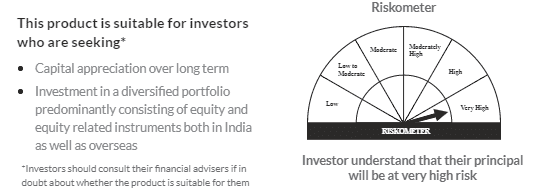
The investment objective of Axis Growth Opportunities Fund is to generate long term capital appreciation by investing in a diversified portfolio of Equity & Equity Related Instruments both in India as well as overseas. However, there can be no assurance that the investment objective of the Scheme will be achieved.
Benefits of Axis Growth Opportunities Fund
- Exposure to large and mid cap domestic market space while adding select global stocks
- Domestic quality portfolio with global diversification can reduce volatility and drawdowns
- Opportunity to invest in world class companies and themes, which are not available in India
- The fund aims to provide Axis’s domestic research & investing capabilities Schroders’ global expertise
- Ideal wealth creation strategy over 5 years or longer
Axis Growth Opportunities Fund can be bought in regular or direct plan
If you as an investor do not want any third party involved in your transaction of purchase of Axis Growth Opportunities Fund, then you can go with the direct plan. A direct plan can be bought directly from the AMC owning that particular fund. And since there is no third party involved, the expense ratio of owning a direct mutual fund scheme is generally on the lower end. On the other hand, a regular plan can be purchased from a broker, a mutual fund agent or any third party aggregator. The fund house has to pay a commission fee to the third party involved in selling of the scheme. This is why the expense ratio for owning a regular scheme is a bit higher than a direct mutual fund scheme.
Axis Growth Opportunities Fund is offers multiple investment options
If you are keen on investing in Axis Growth Opportunities Fund, you must be aware that there are multiple ways to invest in this scheme. Investors can either make a lump sum investment or they can opt for a systematic investment plan. Lump sum is a one way to invest in mutual funds. Investors who make a lump sum investment, they generally enter market when the NAV of the scheme is low. This way more units are allotted to the investor’s portfolio in quantum with the investment amount and over the long term when the markets begin to perform and gain momentum, there is a good chance of earning decent capital appreciation. However, the only drawback of lumpsum investments is that investors end up exposing their entire investment amount right from the beginning. On the other hand, more and more investors are turning to SIP investments are they are known to hone several interesting benefits. A Systematic Investment Plan or SIP is a way to invest in mutual funds. Investors can start a SIP in Axis Growth Opportunities Fund if they wish to invest small fixed amounts at regular intervals instead of making a lump sum investment. To start a SIP, investors need to decide on a frequency like weekly , monthly etc investment amount first. For monthly SIP - Every month on a fixed date, this amount is debited from their savings account and electronically transferred to the fund. The monthly investment option through SIP allows almost everyone to invest in mutual funds. One does not need to have a large capital in the form of principal amount for investing in Axis Growth Opportunities Fund. Investors can also refer to an online SIP calculator to determine the amount they need to invest at regular intervals in order to achieve the desired corpus. SIP investments, over the long term can even multiply and create wealth for investors, thanks to the power of compounding. If you wish to inculcate the discipline of regular investing or do not want to expose your entire investment amount to market volatility right from the beginning, SIP might be the way to go.
Axis Growth Opportunities Fund offers growth and IDCW plans
Depending on your investment objective and income needs, investors can choose between the growth plan or IDCW plan. In the growth plan, the capital appreciation earned by the scheme is reinvested back into it. Over the long term, this may or may not lead in the increase in the net asset value of the scheme. A growth option is generally opted by investors who do not intend to use their investment amount anytime in the near future and wish to achieve long term financial goals like buying a dream home or building a retirement corpus. A growth plan generally ideally considered by investors who seek long term capital appreciation. A IDCW plan On the other hand is more suitable for investors who aim at earning regular income. In the IDCW option, whenever the fund manages to earn surplus, the fund manager rolls out IDCW in the form of bonuses for its investors. However, these IDCW are rolled out at the sole discretion of the fund manager. Also, there is no assurance that investors will receive IDCW at fixed intervals.
Although above stated things are almost everything that you need to know about Axis Growth Opportunities Fund, investors are expected to carefully read the offer document to get further details about the scheme. Also, they should consult a financial advisor or a mutual fund expert before investing.
Axis Growth Opportunities Fund
An open-ended equity scheme investing in both large cap and mid cap stocks
Mutual Fund Investments are subject to market risks, read all scheme related documents carefully
Calculator
View All








Mutual fund investments are subject to market risks, read all scheme related documents carefully.
Copyrights  2020. All rights reserved Axis Mutual Fund.
Privacy | Terms | Disclaimer | Sitemap