






ETFs: Why Exchange Traded Funds are A Must In Your Portfolio


If you are investing for long term wealth creation, it is important to remember that wealth creation will only happen if your investment portfolio is well-diversified. To create a rewarding portfolio, one may have to invest in different assets like equity, debt, gold, etc. based on their risk appetite and investment objective. Asset allocation must always remain in sync with the investor’s investment objective. But investing in these asset classes may require the individual to first carefully understand the different market caps and then invest so that they know how much of their portfolio should take exposure to what type of asset class.
It is not easy for office goers and working professionals to understand the intricacies of how the equity market works. How an investor views the market every single day is different, and this market sentiment determines whether the linked securities will perform or underperform. Since it is not possible for everyone to stay afloat with the constant fluctuations that happen in the market, these individuals can adopt a passive investing style through exchange traded funds. Also referred to as ETFs, these are a pool of funds that invest the majority of their investible corpus in a specific index. They track and mimic their underlying benchmark for generating returns. An ETF may invest in stocks, bonds, gold, international markets, etc.
An ETF is a basket of securities. Its portfolio consists of all the stocks that comprise its underlying benchmark in the same proportion. The ETF does not change its portfolio composition and ensures that it holds all the securities in the same percentage as they stand in the index to avoid tracking errors. Investing in ETFs is as easy and simple as investing in company stocks. Just like company stocks listed at the exchange, ETFs are listed at almost every stock exchange. Since they are listed at the exchange, ETF units can be bought or sold anytime throughout the day during live trading hours. Unlike other mutual funds that can be bought or sold for their NAV that is determined at the end of the day, ETF units can be bought at their live market price that fluctuates during the trading hours. There isn’t much difference between the market price and NAV of the ETF. However, one can carry out intraday trading and enter or exit ETFs several times during the day.
By investing in exchange traded funds, investors get the diversification that is offered by a mutual fund scheme. Also, they can trade in equity securities just like company stocks.
Benefits of Investing In ETFs
Invest in a diversified pool of funds
One good advantage that ETFs hold is that they invest in a portfolio of stocks that comprise an index. This is better than having direct exposure to stocks as it can be extremely volatile and may expose the investor’s entire finances to market volatility. Also, investing in direct equities limits the performance of your portfolio to that of the company whose stocks you buy. This not only increases the volatility factor but also mitigates diversification. Investing in ETFs ensures that your investments are spread across securities of different companies. This way, even if one of the securities under the portfolio underperforms, others might be able to compensate for the overall performance of the portfolio.
Cost effective than active mutual funds
What sets ETFs apart from other mutual funds is that these have a low expense ratio. An expense ratio is a cost that the fund house has to bear for the smooth functioning of the scheme. It is the total assets of the fund that are utilized for bearing recurring expenses such as operational costs, advertising, management fees, etc. Since ETFs are designed to track the index to replicate yields similar to that of their underlying benchmark, they have a significantly low expense ratio as opposed to other mutual funds. However, ETF investors may have to bear transactional costs as well as other costs like annual fees for owning a DEMAT account.
Offers high liquidity
An investor can monitor the ETF’s fluctuating market price and make an investment decision or choose to sell their units based on that. This makes ETF fund highly tradeable security that is more liquid than other mutual funds. In case an ETF is not performing as per your expectations, you can quickly exit from there and park your funds in another tradable security. With mutual funds, investors have to place a request to the AMC, and transactions are carried out based on the NAV that is concluded at the end of the day.
What is an ETF FOF?
An exchange traded fund that invests in multiple other ETF funds to achieve its investment objective is referred to as ETF FOF.
Axis Equity ETFs FoF Regular Growth
An open ended fund of fund scheme predominantly investing in units of domestic equity ETFs
Investment objective
To provide long-term capital appreciation from a portfolio investing predominantly in units of domestic equity ETFs. There is no assurance that the investment objective of the Scheme will be realized. However, there can be no assurance that the investment objective of the Scheme will be realized.
Liquidity
The Scheme offers Units for Subscription and Redemption at NAV based prices on all Business Days on an ongoing basis, commencing not later than 5 business days from the date of allotment. Under normal circumstances the AMC shall dispatch the redemption proceeds within 10 business days from the date of receipt of request from the Unit holder.
Benchmark
NIFTY 500 TRI
Plans and Options
Plans and Options under the Scheme:
Plans Axis Equity ETFs FoF - Regular Plan
Axis Equity ETFs FoF - Direct Plan
Direct Plan
Direct Plan is only for investors who purchase /subscribe Units in a Scheme directly with the Fund and is not available for investors who route their investments through a Distributor.
Regular Plan
Regular Plan is available for investors who purchase/ subscribe Units in a scheme through a Distributor. All the plans will have a common portfolio.
Options under each Plans
Each plan offers the following options:
• Growth option
• Income Distribution cum Capital Withdrawal (IDCW) Option – IDCW Payout and IDCW Reinvestment facility
Load Structure
Entry Load: Not Applicable
Exit Load: If redeemed / switched-out within 15 days from the date of allotment – 1% If redeemed/switched out after 15 days from the date of allotment – Nil
Eligible investors / modes for applying
All categories of investors (whether existing or new Unitholders) as permitted under the Scheme Information Document of the Scheme are eligible to subscribe under Direct Plan. Investments under Direct Plan can be made through various modes offered by the Fund for investing directly with the Fund {except Platform(s) where investors’ applications for subscription of units are routed through Distributors}.
Standard Risk Factors
• Investment in mutual fund units involves investment risks such as trading volumes, settlement risk, liquidity risk, default risk including the possible loss of principal.
• As the price / value / interest rates of the securities in which the Scheme invests fluctuates, the value of your investment in the Scheme may go up or down.
• Past performance of the Sponsor/AMC/Mutual Fund does not guarantee future performance of the Scheme.
• Axis Equity ETFs FoF is the name of the Scheme and does not in any manner indicate either the quality of the Scheme or its future prospects and returns.
• The sponsor is not responsible or liable for any loss resulting from the operation of the Scheme beyond the initial contribution of Rs. 1 lakh made by it towards setting up the Fund.
• Axis Equity ETFs FoF is not a guaranteed or assured return scheme.
To understand all the risks associated with this investment scheme, please refer to the Scheme Information Document (SID). You can also access the SID conveniently through the MF investment app.
Axis Equity ETFs FoF Regular Growth
(An open ended fund of fund scheme predominantly investing in units of domestic equity ETFs)
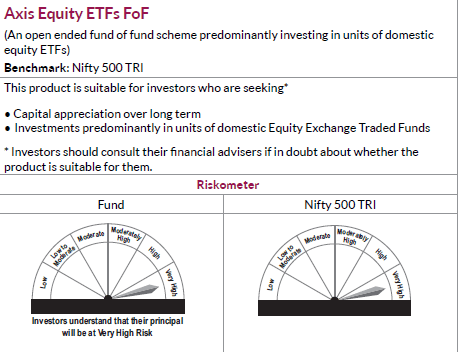
Investors should consult their financial advisers if in doubt about whether the product is suitable for them.
Mutual Fund Investments are subject to market risks, read all scheme related documents carefully.
Calculator
View All







Mutual fund investments are subject to market risks, read all scheme related documents carefully.
Copyrights  2020. All rights reserved Axis Mutual Fund.
Privacy | Terms | Disclaimer | Sitemap