









Do ELSS funds make for a good investment option beyond tax savings?


Most people invest either for capital appreciation or to keep their corpus safe. However, often, some investment options come with other perks as well. One example of this is Equity-Linked Savings Schemes (ELSS). These are mutual funds that invest in equities, and they are the only mutual fund investment that offers a tax benefit.
But are tax benefits the only perk of investing in an ELSS? Are ELSSs beneficial even without tax benefits? Read on to examine ELSSs in detail and to find answers to these questions.
What is ELSS?
ELSS funds enable you to reduce the amount of money you pay in taxes while possibly allowing you to earn returns on your investments. An ELSS primarily invests its corpus in the stocks of publicly traded companies. The provision of tax benefits in accordance with section 80C of the Indian Income Tax Act, 1961, is a significant advantage of ELSSs. You can claim tax deduction on your ELSS investments of up to Rs. 1.5 lakh in a financial year, which helps to reduce your overall taxable income.
The lock-in period for investments in ELSS funds is three years. This means that you are required to hold your investments for at least three years before you can sell them. This requirement has been imposed to discourage short-term speculation while simultaneously encouraging long-term investment.
If you wish to reduce the amount of money you pay in taxes while possibly appreciating your capital, ELSS funds might be a good investment option for you. However, the value of ELSS investments may change significantly depending on the performance of the underlying stocks, and there is the possibility of incurring a capital loss. Before deciding whether ELSS is appropriate for you, it is critical to examine your financial objectives, level of comfort with risk, and time horizon for investing in ELSS.
Advantages of investing in ELSS
• ELSS mutual funds act as a gateway to the equity market because they can place up to 80% of their investible corpus in equities. Because ELSS funds buy shares in diverse companies, they can theoretically generate notable capital appreciation.
• ELSS mutual funds have a lock-in period of three years, which is shorter than those of all other tax-saving investment options such as Public Provident Fund (PPF) and National Savings Certificate (NSC).
• You may choose to invest your entire corpus at once through the lump sum route or in instalments through the Systematic Investment Plan (SIP) route. Investors who receive monthly income in the form of a salary may find the SIP route to be more suitable because it allows them to invest in manageable chunks over time rather than making a single large investment.
• The SIP option allows investors to invest as little as Rs. 500 per month, and therefore, it is easier on their wallets.
• Because the majority of an ELSS mutual fund's assets are invested in equities, the return capability of the fund is significantly higher than that of other tax-saving investment options.
• ELSS mutual funds are managed by experts who have a vast amount of experience managing mutual funds. These experts monitor their funds regularly and perform in-depth analyses of the markets for adjusting the stock holdings (if necessary) to take advantage of emerging market trends.
Source: https://www.amfiindia.com/investor-corner/knowledge-center/equity-funds.html
Is ELSS good only for tax benefits?
ELSS funds not only provide you with the opportunity to reduce your taxable income but may also be a lucrative investment opportunity if your focus is on the long term. These funds have the potential to yield higher returns than conventional tax-saving products, which are debt-oriented, such as bank fixed deposits and PPF.
In addition, ELSS funds have a lock-in period of three years, which encourages you to keep your money invested over the long term and, thus, increases your potential for appreciation. In fact, if an ELSS fund is performing well, you can hold your investment in that fund for longer than the lock-in period of three years. Therefore, even after the tax benefit is exhausted, so long as the fund is performing well and the returns are helping you get closer to your financial goals, ELSS funds can remain a strategic part of your investment portfolio.
Conclusion
Investing in an ELSS fund exposes you to a certain amount of risk because the value of your holdings may change depending on market conditions and other factors. To make educated decisions about your investments and select products that are compatible with your financial profile, it helps to have a solid grasp of your risk appetite. Hence, before investing in ELSS, ensure that you clearly understand your risk appetite.
Axis Long Term Equity Fund
(An Open Ended Equity Linked Savings Scheme With A Statutory Lock In Of 3 Years And Tax Benefit)
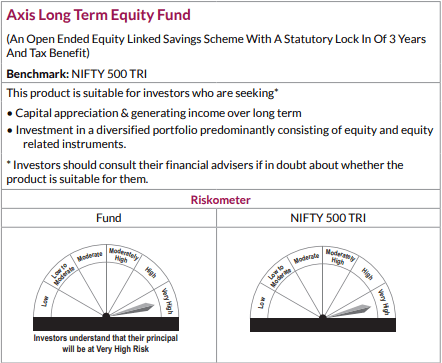
* Investors should consult their financial advisers if in doubt about whether the product is suitable for them.
*ELSS Investments are subject to a 3-year lock-in period and are eligible for tax benefit under section 80C of the Income Tax Act, 1961.
#As per the present tax laws, eligible investors (individual/HUF) are entitled to deduction from their gross income of the amount invested in Equity Linked Saving Scheme (ELSS) up to Rs.1.5 lakhs (along with other prescribed investments) under section 80C of the Income Tax Act, 1961. Tax savings of Rs. 46,800 mentioned above is calculated for the highest income tax slab.
Finance Act, 2020 has announced a new tax regime giving taxpayers an option to pay taxes at a concessional rate (new slab rates) from FY 2020-21 onwards. Any individual/ HUF opting to be taxed under the new tax regime from FY 2020-21 onwards will have to give up certain exemptions and deductions. Since, individuals/ HUF opting for the new tax regime are not eligible for Chapter VI-A deductions, the investment in ELSS Funds cannot be claimed as deduction from the total income.
Investors are advised to consult his/her own Tax Consultant with respect to the specific amount of tax and other implications arising out of his/her participation in ELSS
Note: Views and opinions contained herein are for information purposes only and should not be construed as investment advice/ recommendation to any party or solicitation to buy, sale or hold any security or to adopt any investment strategy. It does not warrant the completeness or accuracy of the information and disclaims all liabilities, losses and damages arising out of the use of this information. The recipient should exercise due caution and/ or seek professional advice before making any decision or entering into any financial obligation based on information, statement or opinion which is expressed herein.
Statutory Details: Axis Mutual Fund has been established as a Trust under the Indian Trusts Act, 1882, sponsored by Axis Bank Ltd. (liability restricted to Rs. 1 Lakh). Trustee: Axis Mutual Fund Trustee Ltd. Investment Manager: Axis Asset Management Co. Ltd. (the AMC). Risk Factors: Axis Bank Limited is not liable or responsible for any loss or shortfall resulting from the operation of the scheme. No representation or warranty is made as to the accuracy, completeness or fairness of the information and opinions contained herein. The AMC reserves the right to make modifications and alterations to this statement as may be required from time to time.
Past performance may or may not be sustained in future.
Mutual Fund Investments are subject to market risks, read all scheme related documents carefully.
Calculator
View All








Mutual fund investments are subject to market risks, read all scheme related documents carefully.
Copyrights  2020. All rights reserved Axis Mutual Fund.
Privacy | Terms | Disclaimer | Sitemap