









Do Tax Planning & ELSS Investments Go Hand in Hand?


Do tax planning and ELSS go hand in hand?
(As on date 30th July 2020)
A lot of individuals are keen on making a financial plan so that they can set long term and short term goals. But what some people do not realize is that tax planning is a part of financial planning. Whether you are a salaried individual or a self-employed individual running an enterprise, sooner or later you will fall under one of the tax brackets, making your income eligible for tax deductions. There are several investment schemes available in the market which you can consider investing in if you want to bring down your gross taxable income. But before investing in any of those schemes, you may have to understand your risk appetite.
If you are someone with zero risk tolerance and do not wish to take any chances with their investment money, you may consider investing in conservative investment schemes that offer low fixed interest rates. However, if you seek long term capital gains whilst saving taxes and have a moderately high risk appetite, you may want to find more about the equity linked saving scheme, also known as ELSS.
What is an equity linked saving scheme?
Equity Linked Saving Scheme is a tax saver fund which comes with a mandatory lock-in of three years. This means that those who invest in an ELSS scheme cannot withdraw or redeem their mutual fund units for three years at least. Yes, ELSS is an open ended mutual fund scheme that has the short lock-in period. Also, as per Section 80C of the Indian Income Tax Act, 1961, any tax paying individual can invest up to Rs. 1.5 lakhs* per financial year and claim tax deduction for the same.
Here is an example to help you understand how ELSS investments help save tax:
If you are taxable income of Rs.15 lakhs per annum, that brings you under the 30 per cent tax slab. If you want to bring down your gross annual income, you can invest up to 1.5 lakhs in an ELSS fund and bring down your taxable income to Rs. 13.5 lakhs.
How does ELSS and tax planning go hand in hand?
Investing in ELSS may prove to be beneficial for tax planners which is why several people feel that ELSS and tax planning go hand in hand. Here are some of the reasons why people consider investing in ELSS for taking care of their tax woes:
ELSS offers SIP and lumpsum investment choices
If you have surplus cash parked with you and are making a last minute investment in an ELSS fund to save taxes, then you may have to go with the lumpsum investment. Lumpsum investment is generally opted by those investors who are making last minute investment during the tax season to bring down their tax liabilities. When you make a lumpsum payment towards an ELSS scheme, you invest the entire investment amount at the beginning of the investment cycle. This is actually good because ELSS investors are allotted more number of units in quantum with the investment amount and depending on the fund’s existing NAV.
Systematic Investment Plan or SIP, on the other hand, is a systematic way to invest in this tax saver fund. Taxpayers seeking long term capital gains through regular, systematic investments may consider investing in ELSS via SIP. With SIP, all one needs to do is instruct their bank and every month on a predetermined date, a fixed amount is debited from your savings account and electronically transferred to their ELSS fund. An individual may continue investing in ELSS through SIP until your investment objective is met.
ELSS may be clubbed for long term financial goals
As the name suggests, ELSS is an equity oriented scheme. Generally, investments made in equity related instruments tend to give the desired results only when one invests in them keeping a long term investment horizon. Hence, if you wish you may continue investing in an ELSS fund for the long run and even club it with your long term financial goals like retirement planning or a short term goal like a vacation.
ELSS scheme is available in growth and IDCW option
Generally there are two investment options for anyone seeking investment in a tax saving scheme like ELSS - you can either go with the growth option or you can choose the IDCW option. Whether you should opt for the growth scheme or IDCW scheme may entirely depend on your investment objective. For example, those you are investing in ELSS for regular income may go with the IDCW option. In IDCW options, investors have the option of opting for payouts. Whenever the ELSS scheme makes a profit, the fund manager rolls out bonuses to investors in the form of IDCW. On the contrary, if you are investing in ELSS for the long run, you may choose the growth option. In the growth option, the profits earned by the ELSS fund are invested back in the fund and this is supposed to impact the fund’s NAV in a positive way, thus in turn benefiting the investors.
Now that you know how ELSS and tax planning go hand in hand, are you planning on investing in this tax saver fund to bring down your tax liabilities this fiscal year? If so you can also consider investing in Axis Long Term Equity Fund
*As per the present tax laws, eligible investors (individual/HUF) are entitled to deduction from their gross income of the amount invested in Equity Linked Saving Scheme (ELSS) up to Rs.1.5 lakhs (along with other prescribed investments) under section 80C of the Income Tax Act, 1961. Tax savings of Rs. 46,800 mentioned above is calculated for the highest income tax slab.
Finance Act, 2020 has announced a new tax regime giving taxpayers an option to pay taxes at a concessional rate (new slab rates) from FY 2020-21 onwards. Any individual/ HUF opting to be taxed under the new tax regime from FY 2020-21 onwards will have to give up certain exemptions and deductions. Since, individuals/ HUF opting for the new tax regime are not eligible for Chapter VI-A deductions, the investment in ELSS Funds cannot be claimed as deduction from the total income.
Investors are advised to consult his/her own Tax Consultant with respect to the specific amount of tax and other implications arising out of his/her participation in ELSS
Axis Long Term Equity Fund
(An open ended equity linked saving scheme with a statutory lock in of 3 years and tax benefit)
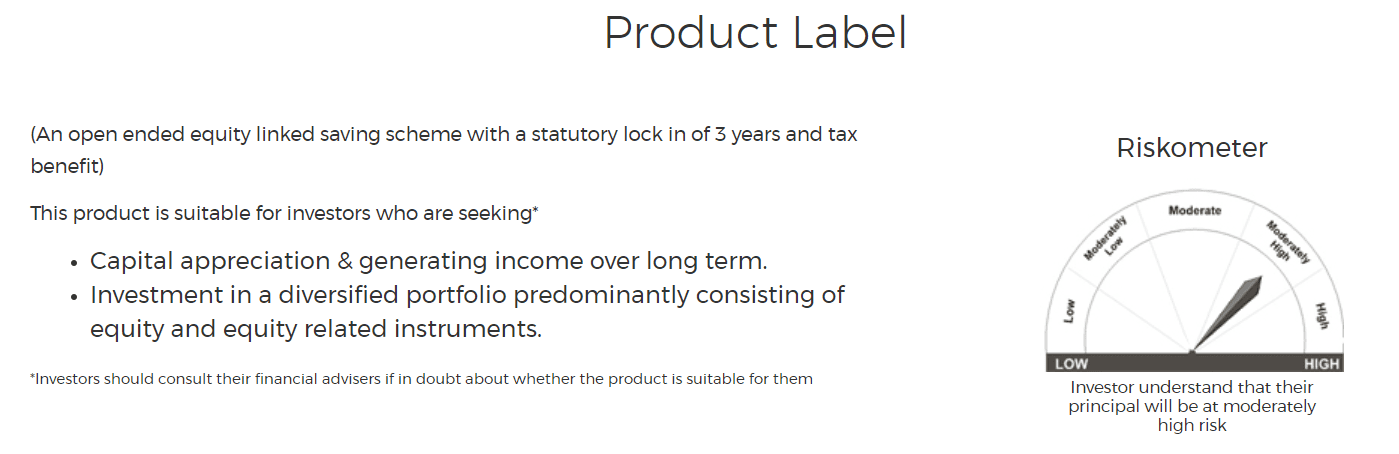
Mutual Fund Investments are subject to market risks, read all scheme related documents carefully.
Calculator
View All








Mutual fund investments are subject to market risks, read all scheme related documents carefully.
Copyrights  2020. All rights reserved Axis Mutual Fund.
Privacy | Terms | Disclaimer | Sitemap