








Diversify Your Portfolio With Global Funds


Recently, the IMF projected India as the fastest growing major economy for FY21. While India’s spectacular growth story is on track, it should be noted that India accounts for only 3%# of the global market capitalization. This means that sticking to domestic investments will not get you exposure to a majority of businesses and growth themes in the world markets.
Further, limiting yourself to only domestic markets substantially raises your portfolio’s concentration risk. On the other hand, if you invest in global markets, you can truly make the most of diversification. After all, making a strong portfolio is all about diversifying your investments to manage risk.
Let us understand how investing in global markets truly helps achieve diversification.
Different markets have different risk levels:
Globally, markets have varying risk levels. In particular, developed markets have a lower risk compared to emerging markets. If we compare volatality across world markets from Jan 1, 2003 to Mar 31, 2020, we see that the overall world market volatilty has been ~15.1%, while that of emerging markets such as India and China has been well above 20%. On the other hand, volatility of markets such as the US and UK was below 20% for the same period.i
Lower correlation helps reduce risk:
While achieving diversification, what we are essentially aiming for is a low correlation among our investments. Correlation is a statistic that shows whether and how strongly pairs of variables are related. In simple words, a high correlation between two markets indicates that they tend to move in the same direction, and vice versa.
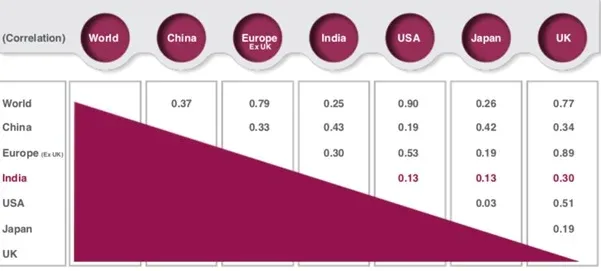
Source: Bloomberg, Axis AMC Research. Data Period 1st Jan 2003 to 31st March 2020. Correlations of daily returns series considered over the period.
The correlation of Indian markets with world markets is 0.25. Between Indian and US markets, correlation is much lower at 0.13ii. Investing in markets which have a low correlation with the domestic market reduces risk substantially.
Better risk-adjusted returns:
An optimal portfolio is one that gives maximum returns for minimum risk. What we are essentially trying to achieve is optimal returns for the risk we take, i.e. balancing the risk and the reward for taking that risk. Although there is always some risk-reward tradeoff, our aim should be to enhance our risk-adjusted returns. Risk-adjusted tells how much return your investment makes relative to the amount of risk the investment has. It has been seen that the more globally diversified your portfolio is, the better the risk-adjusted returns. Apart from the much-need diversification your portfolio needs, global investments also give access to global growth themes and sunrise sectors that may not present in Indian markets. You have not truly diversified your portfolio unless you have invested in global markets as well. What’s more, investing globally is not as complicated as it seems. A convenient way to do so is through the mutual fund route. You can explore various global mutual funds and invest seamlessly using mutual fund investment app.
Give your investments a global edge by investing in global funds today!
Disclaimer: This article represents the views of Axis Asset Management Co. Ltd. and must not be taken as the basis for an investment decision. Neither Axis Mutual Fund, Axis Mutual Fund Trustee Limited nor Axis Asset Management Company Limited, its Directors or associates shall be liable for any damages including lost revenue or lost profits that may arise from the use of the information contained herein. Investors are requested to consult their financial, tax and other advisors before taking any investment decision(s). Statutory Details: Axis Mutual Fund has been established as a Trust under the Indian Trusts Act, 1882, sponsored by Axis Bank Ltd. (liability restricted to Rs. 1 Lakh). Trustee: Axis Mutual Fund Trustee Ltd. Investment Manager: Axis Asset Management Co. Ltd. (the AMC). Risk Factors: Axis Bank Limited is not liable or responsible for any loss or shortfall resulting from the operation of the scheme. No representation or warranty is made as to the accuracy, completeness or fairness of the information and opinions contained herein. The AMC reserves the right to make modifications and alterations to this statement as may be required from time to time.
Past performance may or may not be sustained in the future.
Mutual Fund Investments are subject to market risks, read all scheme related documents carefully.
iBloomberg, Axis AMC Research. Data Period 1st Jan 2003 to 31st March 2020. . Risk is depicted by Standard Deviation for daily returns over the period. Minimum return in the last 17 years (daily basis) is used to show the downside risk of each of the portfolios. Past performance may or may not be sustained in future
iiSource: Bloomberg, Axis AMC Research. Data Period 1st Jan 2003 to 31st March 2020. Correlations of daily returns series considered over the period.
#World Bank. Data as on 31st Mar, 2020
https://www.livemint.com/news/india/imf-projects-india-to-be-fastest-growing-major-economy-11586870380725.html
Calculator
View All








Mutual fund investments are subject to market risks, read all scheme related documents carefully.
Copyrights  2020. All rights reserved Axis Mutual Fund.
Privacy | Terms | Disclaimer | Sitemap