






Diversify your investment portfolio with Nifty ETF fund


Diversification in mutual funds refers to adding multiple schemes to your portfolio depending on your risk appetite. A lot of people feel that too much diversification may leave an investor confused, and it is true to some extent. But depending on just one mutual fund to help you achieve your goals isn’t sufficient. It is believed that diversification may even help an individual with financial success.
We will tell you why investing in just one type of mutual fund may not be a good idea. Supposed you placed all your bets on a small cap funds. Tomorrow, due to economic unrest, the market crashes. This will directly affect your investment portfolio and you will have to bear losses. This will only happen if you fail to have a diversified investment portfolio. Diversification helps with risk management, as you learn to not keep all your eggs with one basket. It may be a better idea to have a mix of equity and debt assets in your portfolio. For example, if the equity markets underperform, it is less likely for the debt markets to crash at the same time or in tandem.
Diversifying your mutual fund portfolio is essential, but so in determining your risk appetite. That’s because every investment scheme carries a different risk profile and you do not want to invest in a scheme that doesn’t match with your risk appetite. There are some retail investors who only want to invest to save taxes. Such investors do not wish to seek capital appreciation and are happy putting their money in conservative schemes. These conservative schemes offer fixed interest rates that are generally on the lower side.
However, if you are someone who is keen on investing in market linked schemes with the hope of seeking some capital appreciation in future, you may consider investing in exchange traded funds. Exchange traded funds are a mutual fund category that are unique compared to other mutual funds. To understand how an ETF is different from a mutual fund, you will have to understand what a mutual fund is.
What are mutual funds?
A mutual fund is a professionally managed fund that is usually run by a fund house or an asset management company. The AMC charges a certain fee for running the mutual fund from the investors in the form of an expense ratio. AMCs hire fund managers whose job is to manage these mutual funds by buying/selling securities in accordance with the scheme’s investment objective. What AMCs do is that they collect money from investors sharing a common investment objective and invest this pool of funds across the Indian economy in various money market instruments. It is believed that the performance of a mutual fund depends on the performance of its underlying assets.
What are exchange traded funds?
According to SEBI, the regulator of mutual funds in India, an ETF is an “is an open ended scheme which replicates/tracks the particular index. Of the total assets, this fund must invest a minimum of 95 per cent in securities of a particular index (which is being replicated or tracked)”.
How Axis NIFTY ETF may help you diversify your investment portfolio?
Axis NIFTY ETF is an open ended scheme replicating its benchmark i.e. NIFTY 50 Index. The investment objective of Axis NIFTY ETF is to provide returns before expenses that closely correspond to the total returns of the Nifty 50 Index subject to tracking errors. However, there is no assurance or guarantee that the investment objective of the Scheme will be achieved.
Here’s how investing in Axis NIFTY ETF may help you with diversification:
-
Axis NIFTY ETF carries a diversified portfolio by holding a basket of securities corresponding to the NIFTY 50 index
-
Axis NIFTY ETF is a passively managed fund. You don't have to keep track of every single investment your ETF owns. The fund manager ensures that the portfolio resembles the benchmark index with minimal tracking error
-
Axis NIFTY ETF carries a low cost of acquisition which means that it can be purchased in multiples of 1 unit on listed stock exchanges
-
Since ETFs are considered as equity funds, tax on capital appreciation received through Axis NIFTY ETF will be treated just like that for an equity fund
-
Axis NIFTY ETF offers you the same intraday pricing you get when trading stocks through a broker
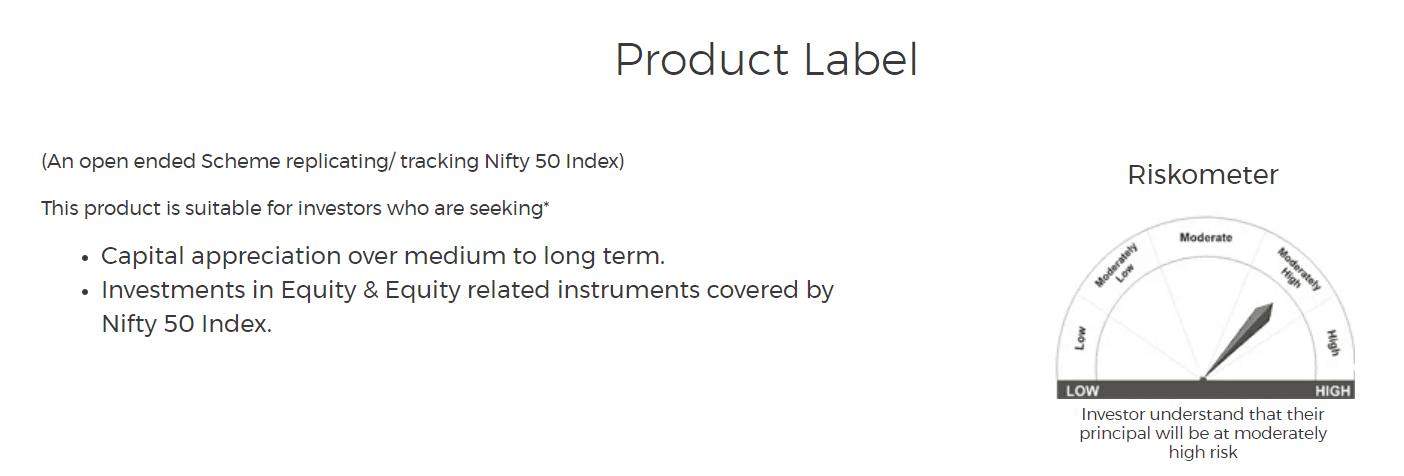
Investors may consider Axis NIFTY ETF if they are looking to diversify their mutual fund portfolio with ETF funds. However, they should bear in mind that the fund carries a moderately high risk profile and they should only consider investing if their risk appetite allows them to do so. Also, since it is a market linked scheme, returns from investments in Axis NIFTY ETF are not guaranteed.
Axis NIFTY ETF
An open ended Scheme replicating/ tracking Nifty 50 Index
Mutual Fund Investments are subject to market risks, read all scheme related documents carefully.
Calculator
View All








Mutual fund investments are subject to market risks, read all scheme related documents carefully.
Copyrights  2020. All rights reserved Axis Mutual Fund.
Privacy | Terms | Disclaimer | Sitemap