






Difference Between Gold Fund of Fund & Gold ETF


As written on 3rd Feb 2021
Mutual funds are a pool of professionally managed funds. What fund houses do is that they pool funds from investors sharing a common investment and invest the capital raised with the intention of generating capital appreciation over the long term. Mutual funds are managed by a team of professional fund managers who buy and sell securities in quantum with an investment strategy that allows the fund to achieve its underlying index. Depending on the nature of the scheme and the investment objective of the fund, a mutual fund may invest across multiple asset classes like equity and debt. Apart from this it also invests in money market instruments like, government securities, etc. Mutual funds generally depend on the performance of their underlying assets to generate capital appreciation over time.
A mutual fund portfolio can also face losses during volatile market conditions. In order to stop this from happening, a mutual fund generally diversifies its investment portfolio among various money market instruments. So even if one asset class underperforms, investments in other sectors/industries may even out the losses. It is less likely for all the asset classes to underperform in tandem at the same time.
What are gold funds?
There are different mutual fund categories created by market regulator SEBI (Securities and Exchange Board of India) to help investors make an informed investment decision. It is also important for investors to determine their risk appetite before making an investment decision, especially when it comes to mutual fund investments.
So, depending on the investor’s financial goals, income needs and their risk appetite, they should make an investment decision. Some mutual funds even give investors an opportunity to seek capital appreciation from one single industry or asset like real-estate, banking, gold etc.
Gold needs no special introduction for Indian investors. This precious yellow metal is a status symbol and a favorite among women and men both when it comes to jewelry. Just like music is considered to be a universal language, gold’s worth and value has global acceptance. Apart from flaunting gold as a jewelry, this commodity also has a customary value for several Indian households. Gold is also considered as an asset. Physical gold has been bought at stores for investment purposes by Indians for many years now. It is almost a tradition to invest in gold as a commodity for the long term.
However, buying gold in physical form has become kind of an aggravating process. That’s because one is always worried about the authenticity of the gold offered by vendors. Also, the price of physical gold fluctuates depending on the region and shop you buy it from. Buying gold in physical form in bulk attracts several risks. There is always the fear of theft. This is why physical gold cannot be stored in bulk at home. Thanks to technical advancement in the investment industry, one can now invest in gold without having to invest in purchasing it in physical form. Thanks to gold mutual funds, Indian investors can now invest in digital gold in case they are keen on investing in gold as an asset. Axis Gold Fund is an open ended fund of fund scheme investing in Axis Gold ETF. The investment objective of Axis Gold Fund is to generate capital appreciation that closely corresponds to capital appreciation generated by Axis Gold ETF.
Are there any benefits of investing in Axis Gold Fund?
Axis Gold Fund is a passively managed fund. This is the reason it carries a relatively low expense ratio. One does not need to open a demat account to invest in Axis Gold Fund. Individuals seeking investment in Axis Gold Fund do not need to have a surplus capital as principal investment amount. They can invest with a small amount at regular intervals as long as the amount fits the minimum investment requirements mentioned in the offer document. Axis Gold Fund gives investors an opportunity to invest in Gold ETF without the hassles of storage or concerns on quality.
Axis Gold Fund is available in direct and regular plan
There are two plans available for investors which they can choose depending on their income needs. There is no third party involved when investing in Axis Gold Fund – Direct Plan. This is why the expense ratio for owning a gold fund with a direct plan is relatively lower. A regular plan on the other hand can be bought from a distributor or a broker. These third party individuals are paid commission fees for selling the funds. This commission fee is recovered by the fund house by charging a higher expense ratio on the regular plan. Axis Gold Fund is available in both direct plan and growth plan. Investors should consult their financial advisor before deciding which plan, they should invest.
Axis Gold Fund offers multiple investment plans
Now if you are someone who is investing in Axis Gold Fund for the long term then you can opt for a Systematic Investment Plan. Another way to invest in Axis Gold Fund is via one time lump sum investment. The lumpsum amount needs to be paid right at the beginning of the investment cycle. This type of investment is generally considered by those who have a surplus cash parked which they want to put to better use. A Systematic Investment Plan on the other hand is an easy and hassle free way to invest in the Axis Gold Fund. An individual need to be KYC compliant to invest in this fund via SIP. All one has to do is complete a onetime mandate with their bank following which every month on a predetermined date, a fixed amount is debited from your savings account and electronically transferred to the fund. Over a period of time, the small investment amounts that you are investing at regular intervals may turn into a decent corpus thanks to the power of compounding. In mutual funds, compounding refers to the interest earned on the interest earned from the initial investment amount. If you remain invested in Axis Gold Fund for the long run through SIP, there is a good chance that your investments will multiply and provide capital appreciation over the long term.
What are gold ETFs? How are they different from Gold Funds?
Gold ETFs invest money in gold bullion and gold manufacturing companies by trading their units on the stock exchange, just like any other stock or share. Securities and Exchange Board of India or SEBI, the regulatory body of ETFs and mutual funds, in general, describe gold ETFs as, “an open ended scheme which replicates/tracks the particular index. Of the total assets, this fund must invest a minimum of 95 per cent in securities of a particular index (which is being replicated or tracked)”.
Benefits of investing in Gold ETF
If gold ETF investments attract you, then you can take a look at Axis Gold ETF. Axis Gold ETF is an open ended scheme replicating/tracking Domestic Price of Gold. The investment objective of this fund is to generate returns that are in line with the performance of gold.
Gold ETFs offer great amount of liquidity
Just like most mutual funds, gold ETFs are open ended funds and do not come with a lock in period. This means that you can redeem your ETF units any time as per your requirement. There is no obligation of holding on to your funds, and ETF holders can liquidate their funds on any business working day.
Gold ETF investors do not have to worry about authenticity
The international hallmark category of gold is considered to be 99.5 percent pure. This is why gold ETF holders do not have to worry about the purity or authenticity of gold and can invest in them without having any trust issues.
Gold ETFs are better than the physical goal
The best part about owning gold ETFs is that you do not have to worry about its security. Gold ETFs are owned in electronic format, making them theft averse and completely secure. In the case of physical gold, one always worries about keeping it inside the house and usually has to rent a safety vault for its security. Also, since gold ETFs are nonphysical, there are no making charges involved either. All these things make them a better investment than physical gold.
What are some of the major differences between Gold ETF and Gold Funds?
Gold ETFs do not function without a demat account
The one major difference between a gold exchange traded fund and a gold fund is that investors do not have to open a demat account to invest in gold fund. However, without a demat account one cannot invest in gold exchange traded funds. That’s because gold ETF units need to be digitally stored somewhere and that is why they need a demat account. When you trade gold ETF units at the stock exchange, the bought/sold ETF units are credited/debited from the investor’s demat account. Opening a demat account may or may not cost but there is an annual maintenance fee which one has to pay for owning a demat account. On the other hand, one does not need a demat account to store their gold fund units, thus gold fund investors do not worry about opening a demat account.
Gold funds cannot be traded at the stock exchange
A mutual fund investor invests via SIP or lumpsum in a gold fund. On the other hand, gold ETF owners have a complete control of their ETF units. They can buy or sell the gold ETF units at their own will to generate capital appreciation. Investors can trade daily or choose to remain invested in their gold exchange traded funds depending on their investment objective.
One cannot start a SIP in gold ETFs
Gold ETF units can be bought by the investor through a lump sum investment depending on their need. However, with gold funds, one has the option of SIP as well as lumpsum investment. SIP investments hold several advantages, investors benefit from rupee cost averaging, their long term investments have the potential of multiplying thanks to the power of compounding. SIP can also inculcate the discipline of investing regularly. But without a SIP option, a gold ETF owner may not be able to take advantage of any of the aforementioned SIP benefits.
Now that you know the difference between gold ETFs and gold funds, where are you planning on investing? No matter where you invest, remember that both gold funds and gold ETFs are exposed to market volatility. Also, none of these investments offer guaranteed returns. It is always better to do some research about these funds before investing in them.
Axis Gold Fund
An open ended fund of fund scheme investing in Axis Gold ETF
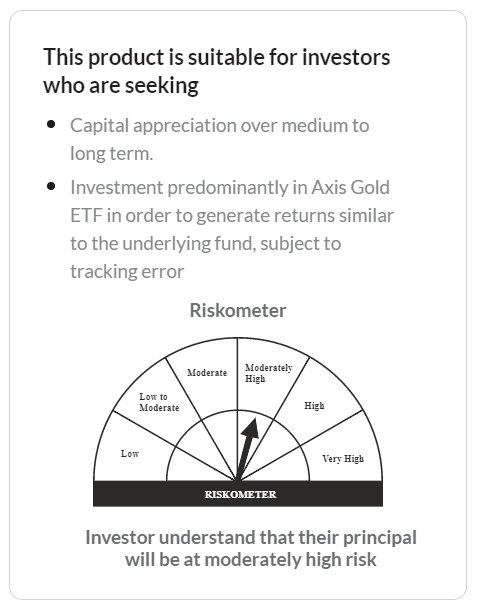
Axis Gold ETF
An open ended scheme replicating/tracking Domestic Price of Gold
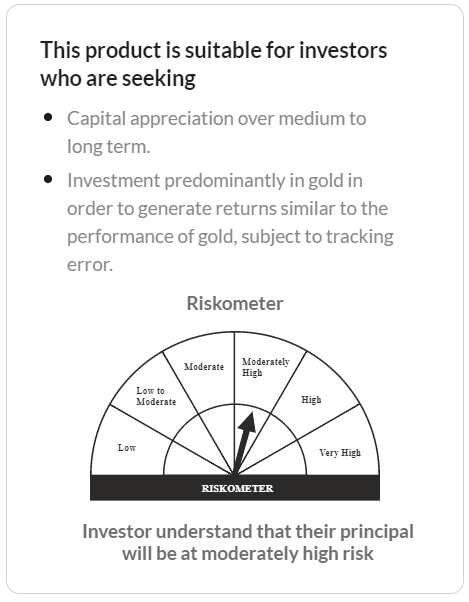
Mutual Fund Investments are subject to market risks, read all scheme related documents carefully.
Note: Investors will be bearing the recurring expenses of the scheme, in addition to the expenses of the schemes, in which Fund of Funds schemes make investments.
Calculator
View All








Mutual fund investments are subject to market risks, read all scheme related documents carefully.
Copyrights  2020. All rights reserved Axis Mutual Fund.
Privacy | Terms | Disclaimer | Sitemap