









Check out the latest emerging consumption trends that make for a promising investment theme


The consumption sector of India has grown to be quite promising. As the outlook of the overall economy seems positive, the consumption sector may be a particularly bright spot.
The consumption sector comprises brands and companies that are consumer-facing. For example, think of FMCG products, home appliances, gadgets, etc.
Let’s take a look at these emerging trends –
Companies involved in the consumption sector have always been dependent on the disposable income in the ordinary consumer’s hands. Usually, when an economy is growing, market demand shifts to premium products. In contrast, when an economy is struggling, consumers prefer value products. Currently, we are seeing a shift towards premium consumer products in India
Growing Demand for Premium Products 
Source: Fortune
*Brands mentioned here are for illustration only
Indian consumers due to increasing disposable income have started spending more on premium products giving a rise to the category and also opening up spaces for premium retail.
Better Market Penetration
The size of the addressable market in India has been steadily increasing. Just a couple of decades ago, companies would not consider the rural population of India as part of their target markets. Now, rural demand is catching up quickly in the FMCG category.
As the household income of the average Indian rises, they have more disposable income to spend on discretionary products. This increase means that companies that offer consumer products are likely to see an uptick. For example, according to a CRISIL report, organized jewellery retailers are expected _________________________________________________________
https://www.investopedia.com/terms/c/consumer-goods-sector.asp
to see an annual growth of 17% to 19% in fiscal 2025 , the share of 65+ inch televisions went from 5% of total television sales in 2020 to 12% in 2023. That’s just in a gap of three years. Similarly, the market share of smart inverter ACs grew to 77% in 2023 compared to 27% in 2017.
Increasing Formalisation and Organisation
The market share of organised players is increasing in a variety of niches in India. Just a couple of decades ago, unorganized service providers were the dominant players in markets such as real estate, jewellery, consumer electronics, and many more.
However, we are witnessing a trend where organized companies are capturing greater market share, as the Indian consumer is showing a preference for buying from organized companies that can provide a better customer experience. This increase can lead to a more conducive environment for listed companies within the consumption space.
Spreading Digitisation
Source: Bain
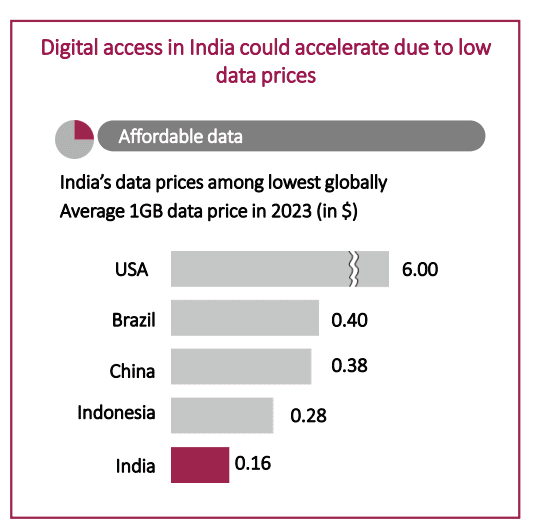
Data prices in India are lowest among majority of the nations, making room for faster digitisation, which can be a boon for consumer-facing companies in India. It will allow brands to reach consumers in a way that wasn’t possible before. Growing e-commerce spending means that large organized companies can create and grow brands and compete in a highly fragmented market.
The potential for growth in India’s digital funnel is enormous. The number of digital buyers in India is expected to grow to 400 million. This number is only expected to grow in the coming decade which presents new market opportunities for sophisticated companies.
__________________________________________________
https://economictimes.indiatimes.com/industry/cons-products/fashion-/-cosmetics-/-jewellery/organised-gold-jewellery- retailers-to-achieve-strong-revenue-growth-in-fy25-crisil/articleshow/110326051.cms?from=mdr
https://www.matrixpartners.in/matrixmoments/unlocking-growth-in-indias-premium-market
https://www.statista.com/statistics/251631/number-of-digital-buyers-in-india/
Wrapping Up
Overall, these emerging trends support the narrative that companies operating in the consumption space are poised for potential growth in the medium to long term. So investments in this sector can help you potentially benefit from the changing consumer preferences in the long run.
Sector(s)/ stock(s) mentioned above are for the purpose of illustration only and should not be construed as a recommendation.
This document represents the views of Axis Asset Management Co. Ltd. and must not be taken as the basis for an investment decision. Neither Axis Mutual Fund, Axis Mutual Fund Trustee Limited nor Axis Asset Management Company Limited, its Directors or associates shall be liable for any damages including lost revenue or lost profits that may arise from the use of the information contained herein. No representation or warranty is made as to the accuracy, completeness or fairness of the information and opinions contained herein. The AMC reserves the right to make modifications and alterations to this statement as may be required from time to time. Mutual Fund Investments are subject to market risks, read all scheme related documents carefully.
Statutory Details: Axis Mutual Fund has been established as a Trust under the Indian Trusts Act, 1882, sponsored by Axis Bank Ltd. (liability restricted to Rs. 1 Lakh). Trustee: Axis Mutual Fund Trustee Ltd. Investment Manager: Axis Asset Management Co. Ltd. (the AMC). Risk Factors: Axis Bank Limited is not liable or responsible for any loss or shortfall resulting from the operation of the scheme.
Mutual Fund Investments are subject to market risks, read all scheme related documents carefully.
Calculator
View All








Mutual fund investments are subject to market risks, read all scheme related documents carefully.
Copyrights  2020. All rights reserved Axis Mutual Fund.
Privacy | Terms | Disclaimer | Sitemap