






Are Gold ETFs Better Than Gold Funds Which One To Choose


Indians don’t need a special introduction to gold. Since ancient times, gold has been looked upon as a symbol of wealth among Indians. During wedding and festive seasons, Indians buy physical gold in the form of either jewelry or coins, bars, etc. Gold is still an important part of an investor’s investment portfolio and has been conveniently used as a hedge against rupee depreciation over the years.
Gold as an asset class is closely related to other asset classes such as bonds and shares which is why economic distress such as inflation barely seems to affect its performance. Gold is a relatively liquid asset that is often considered by investors in their investment portfolios to preserve wealth.
However, in contemporary times some people have adopted a modern approach towards gold investing. Talking about modern ways of investing in gold, investors these days are turning to gold funds and gold exchange traded funds. Today we are going to understand both the investment avenues and determine the differences between gold funds and gold ETFs.
What is a gold fund?
A gold fund is an open-ended mutual fund scheme that invests in gold ETFs. The investment objective of a gold fund is to create wealth by investing in gold as a commodity. A gold fund is one of the ways to invest in gold as an asset class without holding it in physical form. Anyone who wishes to get exposure to this precious yellow metal without having to hold it in physical form may consider investing in gold funds.
How do gold funds work?
As mentioned earlier, gold funds are open-ended schemes that invest in units of a Gold Exchange Traded Fund (ETF). The main goal of gold funds is to create long term wealth by making use of the potential of gold as a commodity. It may be suitable for investors who have a desire to take exposure to gold as an asset class. Investing in gold has become convenient with gold funds. Investing in gold with gold funds may be simpler and easier than owning the commodity in physical form. Investing in gold funds may be similar to owning gold in physical form, but with the added advantage of professional fund management.
Just like all mutual funds, gold funds too have a designated fund manager who implements investment strategy and carries out trading activities depending on the investment objective of the fund. The capital appreciation generated by gold fund may closely correspond to the performance of its underlying securities, i.e., the gold ETF. The NAV (Net Asset Value) of a gold fund may be driven by the overall price movement of the precious yellow metal.
What is a gold ETF?
Gold ETFs (exchange traded funds) are open-ended schemes that invest in gold bullion. Gold ETF units are traded at the stock exchange and can be bought and sold just like company stocks at the exchange. These funds aim to generate capital appreciation by investing in gold as an asset class.
SEBI (Securities and Exchange Board of India) the governing body of commodities and securities in India defines gold ETF as, “an open-ended scheme which replicates/tracks the particular index. Of the total assets, this fund must invest a minimum of 95 percent in securities of a particular index (which is being replicated or tracked)”.
How do gold ETFs work?
Gold exchange traded funds mimic the price of physical gold as its benchmark with minimal tracking error. They are listed at the stock exchange and track the price of international gold. With gold ETFs, investors can own gold in digital form and buy or sell its units at its current market price at the stock exchange during live trading hours.
Investors who are planning to invest in gold funds may consider taking a look at Axis Gold Fund.
Axis Gold Fund is an open-ended fund of fund scheme investing in Axis Gold ETF. The investment objective of the Axis Gold Fund is to generate capital appreciation that closely corresponds to capital appreciation generated by Axis Gold ETF.
Benefits of investing in Axis Gold Fund
Here are some of the benefits of investing in Axis Gold Fund:
• Investors can invest in Axis Gold Fund without opening a demat account
• Investors may not require a large surplus of capital to invest in Axis Gold Fund. One can invest with a small amount as long as this amount fits the minimum investment requirements.
• Axis Gold Fund allows investors to invest in Gold ETF without the hassles of storage or concerns on quality
• Axis Gold Fund has a low expense ratio
• Axis Gold Fund offers transparent pricing based on international gold price movements
• No transaction charges on buying and selling as compared to physical gold
Risk profile of Axis Gold Fund
Axis Gold Fund carries risks associated with investing in Axis Gold ETF and money market instruments. Investment in units of Gold ETFs involves investment risks such as market risks, listing related risks, and risks related to redemption. Investments in money market instruments are subject to interest rate risk, reinvestment risk, liquidity risk, credit risk, settlement risk, etc. Also, the value of the scheme’s investments may be affected by currency exchange rates, changes in law/policies of the government, taxation laws, and political, economic, or other developments.
Exit load
An exit load of 1 percent will be levied if the investor redeems / switches out within 1 year from the date of allotment. No exit load will be charged for switching between Existing Plan and Direct Plan where the transaction is not routed through Distributor in Existing Plan. If the transaction in Existing Plan is routed through Distributor, then the applicable exit load will be charged for switching from Existing Plan to Direct Plan. Further, for switches between the Growth and Dividend Option and on the Units allotted on reinvestment of dividends no load will be charged by the scheme.
Investors who plan on investing in gold ETFs may take a look at Axis Gold ETF
Axis Gold ETF is an open-ended scheme replicating / tracking the Domestic Price of Gold. The investment objective of Axis Gold ETF is to generate returns that are in line with the performance of gold.
Benefits of investing in Axis Gold ETF
Diversification: A tried and tested asset class across time periods that provides investors the requisite portfolio diversification
Safety: Investors need not worry about the quality of gold, as the same is held in demat form
Security: Unlike physical gold, the risk of theft is eliminated as gold units are stored in an electronic form
Safe Haven: Historically, gold has been relied upon as a safe haven in times of financial or economic crisis
Ease of transaction: Gold ETFs can be easily bought and sold like any other stock on the exchange compared to physical purchases through a jeweler
Investment strategy
The Scheme endeavours to generate returns that are in line with the performance of gold, subject to tracking errors. The Scheme is not actively managed, and no attempt will be made to buy or sell gold to protect against or to take advantage of fluctuations in the price of gold. The Asset Management Company (AMC) does not make any judgments about the investment merit of gold or particular security nor will it attempt to apply any economic, financial, or market analysis. The Scheme shall invest all of its funds in gold, except to meet its liquidity requirements. Explore Equity mutual funds to potentially benefit from the growth potential of the stock market.
Liquidity offered by the scheme
All investors including Authorized Participants (AP), Large Investors, and other investors may buy / sell their units on all the trading days of the stock exchange(s) on which the units are listed. There is no minimum investment, although units are normally traded in round lots of 1 unit. Alternatively, Authorized Participants and Large Investors can directly subscribe / redeem from the AMC in 'Creation Unit' size. The AMC shall appoint Authorized Participants who will provide a two-way quote in the secondary market to provide liquidity in the market.
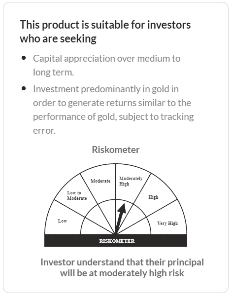
The risk profile of the scheme
Mutual Fund Units involve investment risks including the possible loss of the principal amount. Please read the SID carefully for details on risk factors before investing in the scheme. Scheme specific Risk Factors are summarized below:
• The scheme carries risks associated with investing in gold and money market instruments
• Investment in Scheme’s units involves investment risks such as market risks, trading volume risk, settlement risk, liquidity risk, and default risk. The AMC may choose to invest in unlisted securities which may increase the risk on the portfolio
• The value of the Scheme’s investments may be affected by currency exchange rates, changes in law/policies of the government, taxation laws, and political, economic, or other developments
• Investments in money market instruments are subject to interest rate risk, reinvestment risk, liquidity risk, credit risk, settlement risk, etc.
Investors can invest in Axis Gold Fund without a demat account using Mutual fund app. On the other hand, investors can trade units of Axis Gold ETF at its current NAV. Investors who are unsure about which investment scheme to invest in may have to seek professional consultation and take an informed investment decision.
Axis Gold Fund
An open ended fund of fund scheme investing in Axis Gold ETF

Axis Gold ETF
An open ended scheme replicating/tracking Domestic Price of Gold
Calculator
View All








Mutual fund investments are subject to market risks, read all scheme related documents carefully.
Copyrights  2020. All rights reserved Axis Mutual Fund.
Privacy | Terms | Disclaimer | Sitemap