








5 Mutual Funds for Your 2025 Portfolio


Investing is an essential component for having healthy finances. One of the popular ways to invest is through mutual funds. However, it can be hard to choose the right mutual fund for your needs.
There are several factors to consider when choosing a suitable mutual fund to invest in 2025. This includes your financial goals, investment horizon, risk appetite, and so on. Different categories of mutual funds will be suitable for different needs. An investor can also invest in a combination of various mutual funds for different purposes.
Here are 5 mutual funds for 2025 you can look for:
Multicap Fund
A multicap fund invests in stocks from each type of market cap. It invests at least 25% of its corpus in large-cap stocks, 25% in mid-cap stocks, and 25% in small-cap stocks. The rest of the 25% will be invested at the discretion of the fund manager.
The primary benefit of a multicap fund is that it provides exposure to all market caps. In today's uncertain market, a multicap fund can offer a well-rounded investment solution. While small-cap and mid-cap stocks can provide relatively higher growth opportunities, large-cap stocks are relatively less volatile.
Balanced Advantage Fund
A balanced advantage fund invests in both fixed income assets as well as equity. The proportional allocation of the corpus to each type of asset will depend on the discretion of the fund manager.
A balanced advantage fund can be a good choice for a mutual fund portfolio in 2025 allowing investors to potentially benefit from the relative stability of fixed income assets while also gaining exposure to potential growth through equities.
Arbitrage Fund
An arbitrage fund aims to generate returns for investors by capitalizing on price differences between securities in different markets. The fund purchases securities at lower prices in a certain market and sells them at a slightly higher price in a different market.
With Arbitrage Funds you can save up to 33% more on taxes with minimal risk.
Let’s look at how we can do that with an example:
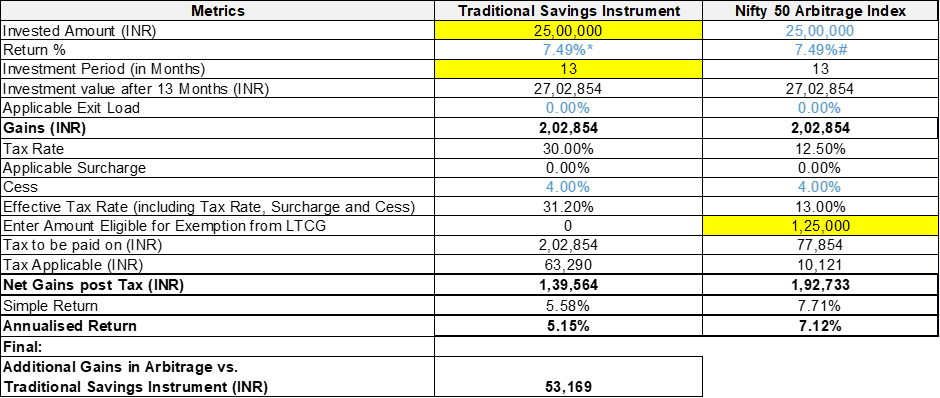
Suppose you fall in the income bracket between ?30 - 50 Lakhs per annum and invest ? 25 Lakhs for 13 months in a Traditional Savings Instrument versus investing the same amount for the same duration in an Arbitrage Fund.
Source: Axis MF internal Research.
*Past performance may not be sustained in the future. For performance in SEBI prescribed format, refer to page no. 3.
# Please note that the tax rate for Traditional Savings Instrument is applicable for the highest tax bracket. The Traditional savings instruments’ actual rates may differ. Further, while there is no exit load in such cases there may be penal Interest rates/TDS/other factors in some cases.
Considering similar returns across both, you gain ? 2.02 Lakhs. With Traditional Savings Instrument applicable tax slab of 30% along with Cess, your total return is ?1.39 Lakh (5.15% annual return on your invested amount).
But with Arbitrage Fund, you get the benefit of ? 1.25 Lakhs being exempted from the applicable tax slab of 12.5% and Cess, hence you are taxed for just the remaining ? 77,854, increasing your total returns to ?1.92 Lakhs, a 7.12% annual return, and saving ?53,169 in taxes.
Similarly, you can# save an additional ?58,486 in taxes if you fall in the income bracket of ?50 Lakhs - ? 1 Cr per annum and ?61,145 in taxes if you fall in the bracket of ?1 Cr - ?2 Cr per annum.
Index Funds
An index fund is a passively managed fund. It invests in securities mimicking the constituents of an underlying index. For example, a Nifty 50 index fund will aim to mimic the performance of the Nifty 50 index.
The primary advantage of an index fund is that it can provide market-level returns at a relatively lower cost. By investing in Index funds, you can participate in overall market growth with minimal need to constantly monitoring and active management. It is also simple to understand and transparent in a way that an investor can know the composition of the fund through its underlying index at any given point.
Thematic Funds
A thematic fund invests in stocks according to a predefined theme. For example, an infrastructure fund will aim to invest in high-performing stocks within the infrastructure sector. Similarly, a manufacturing fund will invest in companies that are involved in manufacturing.
A thematic fund can be useful for investors looking to gain diversified exposure to a particular sector or theme. However, it's important to note that thematic funds are also subject to higher risk. The performance of these funds is closely tied to the success of the underlying theme. So, if a specific theme is what you might believe to be growing in the coming years, you may considering investing in thematic funds for long term.
Wrapping Up
As we say goodbye to 2024, investors can plan their investments for the next year. There are several mutual fund categories available for investors. Investors can plan their mutual fund investment strategies for 2025 based on their financial goals and risk appetite. They can also choose a basket of mutual fund SIPs in 2025 that complement each other for a well-rounded portfolio.
Disclaimers:
This document represents the views of Axis Asset Management Co. Ltd. and must not be taken as the basis for an investment decision. Neither Axis Mutual Fund, Axis Mutual Fund Trustee Limited nor Axis Asset Management Company Limited, its Directors or associates, shall be liable for any damages including lost revenue or lost profits that may arise from the use of the information contained herein. No representation or warranty is made as to the accuracy, completeness or fairness of the information and opinions contained herein. The material is prepared for general communication and should not be treated as a research report. The data used in this material is obtained by Axis AMC from the sources which it considers reliable. While utmost care has been exercised while preparing this document, Axis AMC does not warrant the completeness or accuracy of the information and disclaims all liabilities, losses and damages arising out of the use of this information. The AMC reserves the right to make modifications and alterations to this statement as may be required from time to time.
The sector mentioned herein are for general assessment purpose only and not a complete disclosure of every material fact. It should not be construed as investment advice to any party.
The recipient is advised to consult its financial advisor/ tax consultant prior to arriving at any investment decision.
Axis Bank Ltd. is not liable or responsible for any loss or shortfall resulting from the operation of the scheme.
Mutual Fund Investments are subject to market risks, read all scheme-related documents carefully.
Calculator
View All








Mutual fund investments are subject to market risks, read all scheme related documents carefully.
Copyrights  2020. All rights reserved Axis Mutual Fund.
Privacy | Terms | Disclaimer | Sitemap