









5 Benefits of Balanced Advantage Fund


We as individuals have many dreams and aspirations. Some of these dreams need monetary strength if they are to be achieved. If you too are unhappy with your existing financial state and looking forward to creating wealth through investing, you need to first understand financial planning. The key to successful financial planning is understanding your short term and long term goals.
Setting realistic goals is necessary because that way, you as an investor are able to go in the right direction and draw an investment strategy that may potentially help you get near your financial goals. You need to have an investment horizon to be able to remain invested for reaching your financial goals. For example, if you want to build a retirement corpus, you need to have an investment horizon of at least 15 to 20 years. On the other hand, if you are looking forward to buying a luxurious car, you need to give your investments at least 3 to 5 years to grow. One cannot expect their investments to give them desired results on an immediate basis.
So when you set realistic goals and invest within your risk appetite, your investment journey becomes a lot simpler. A risk appetite is an investor’s ability to invest in a scheme that carries a certain risk profile with the hope of seeking some capital appreciation out of the investment. If you are someone who is willing to take risk to give their investment portfolio an aggressive approach, you may consider investing in mutual funds.
What is a mutual fund?
Fund houses collect money from investors sharing a common investment objective and invest this money across multiple assets like equity, debt, G-sec, T-bills, etc. depending on the risk profile of the scheme. This pool of funds raised by the fund house which is collectively invested on behalf of the investors is referred to as a mutual fund
SEBI, the regulatory body of mutual funds in India describes mutual funds as, “a mechanism for pooling the resources by issuing units to the investors and investing funds in securities in accordance with objectives as disclosed in the offer document. Investments in securities are spread across a wide cross-section of industries and sectors and thus the risk is reduced. Diversification reduces the risk because all stocks may not move in the same direction in the same proportion at the same time. Mutual fund issues units to the investors in accordance with the quantum of money invested by them. Investors of mutual funds are known as unitholders.”
The second half of the article focuses on dynamic funds and tries to shed light on some of the benefits of investing in a dynamic fund.
What are balanced advantage fund?
Mutual fund’s schemes are further categorized by SEBI so that investors are able to understand the uniqueness of each fund which might help them in making the right investment decision. These schemes are categorized based on certain unique attributes like equity, debt, solution oriented, ETF, FoF, index, hybrid, etc. Dynamic Asset allocation or Balanced advantage funds come under hybrid funds. Hybrid schemes are those mutual fund’s schemes that invest in both equity and debt related instruments. Balanced Advantage Funds too, have a mix of both equity and debt related instruments in their portfolio. Axis Balanced Advantage Fund usually follow an investment strategy where they invest less when the markets are down and more when the markets are low.
Benefits of investing in dynamic funds
Investing in dynamic funds has its own perks. Here are some of the benefits of investing in dynamic funds:
- Dynamic portfolio diversification: Dynamic funds invest in both equity and debt related instruments. The fund manager invests in either of the asset classes depending on the market situation. The equity part of the portfolio offers an opportunity to earn some capital appreciation, whereas the debt part tries to manage risk through active asset allocation.
- No need for commitment: Unlike some equity funds that come with a three year lock in, dynamic funds do not have any lock in period. This means you are not obligated to remain invested for any particular period. You may continue investing in dynamic funds till your investment objective is achieved or you may withdraw the units on as per your convenience
- SIP investment option: You can invest in equity funds via SIP to give your dynamic fund investments a systematic approach. With SIP, you can continue investing regularly till your investment objective is achieved. SIP may inculcate the discipline of investing regularly.
- You can choose from the growth and IDCW option: If you are investing in dynamic funds for regular income then you may go with the IDCW option. However, if you are investing for the long term, you may opt for the growth option.
If you are planning on investing in dynamic funds, make sure you do adequate research about the fund before investing.
Axis Dynamic Equity Fund
An open ended dynamic asset allocation fund
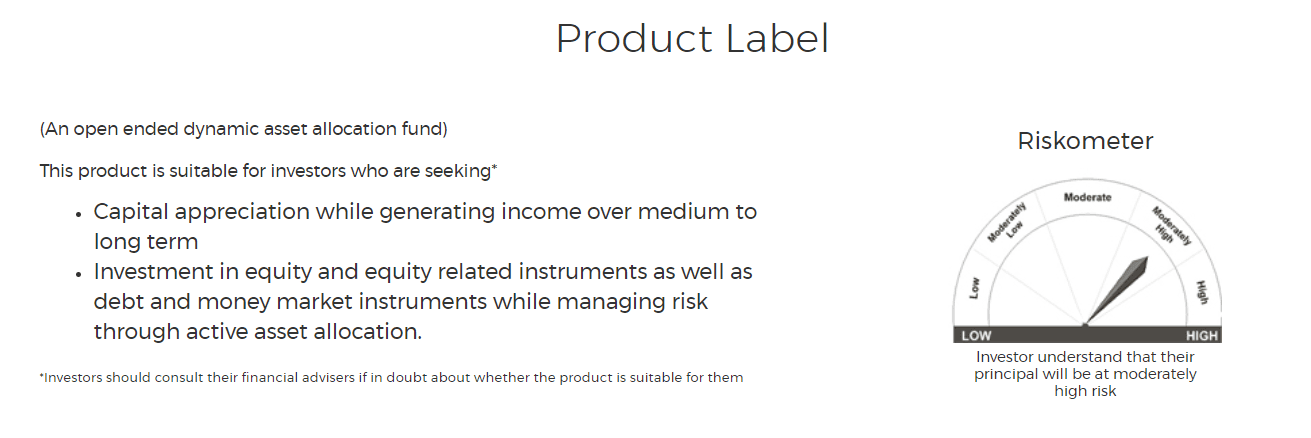
Mutual Fund Investments are subject to market risks, read all scheme related documents carefully.
Calculator
View All








Mutual fund investments are subject to market risks, read all scheme related documents carefully.
Copyrights  2020. All rights reserved Axis Mutual Fund.
Privacy | Terms | Disclaimer | Sitemap